[Spanish 3710-Spanish Baroque Theater]
[Spanish 3710-Spanish Baroque Theater]
Campus and Author(s): California State University, Bakersfield. Teresa Fernández-Ulloa
Date: Spring, 2022
Course Description:
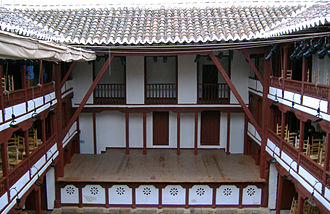
Course Spanish 3710. Topics in Literature (Spanish Baroque Theater). A description of the main characteristics of the Spanish Baroque theater, with a focus on the plays by Lope de Vega, Tirso de Molina, Calderón de la Barca, Ana Caro Mallén de Soto, María de Zayas, Sor Juana Inés de la Cruz and Ángela de Acevedo.
Project Abstract:
- This 3 credit-course can be taken as one of the 2 required courses for the literature section in the Spanish major. I usually teach it every 2-3 semesters, always online, in Canvas. The maximum number of students allowed in these courses is 20. To redesign this course, I had four things in mind mainly: 1) to simplify the materials and make them more accessible to students by selecting open access materials; 2) to bring more "to life" the plays, by exposing them to the recorded plays (sometimes in the old version, and sometimes with different modern approaches); 3) to continue incorporating women to the literature canon (years ago they did not usually appear in the programs); through my research, I have continued bringing them to the public and to my students, and this time I added Ángela de Acevedo to the other three I had before; and 3) to offer students an active and engaging learning opportunity through the discussions, the Flip grid and the creative visual projects (mind maps and posters); and 4) to keep working in the linguistic and discourse skills that they acquired in Spanish 3000 (Advanced Language Skills), through the writings.
- Pedagogical approaches:
- The course is organized in modules, sometimes with submodules. Having the course organized in micro sequences facilitates the assimilation and the scaffolding of knowledge. By organizing courses in modules, you are creating those learning micro sequences. Each of them is a set of short interrelated and linked activities oriented to elaborating a final product in the form of a text (oral, written, visual or audiovisual). I start with short video lectures and readings, and/or other videos related to the topic. There are also short review quizzes and quizzes with instant feedback (multiple-choice, true-false, and multiple-answer questions).
- Since critical thinking involves conceptualizing, applying, analyzing, synthesizing, and/or evaluating information gathered from, or generated by, observation, experience, reflection, reasoning, or communication, it is incorporated in the class through the aforementioned assessment, and also the multiple questions they had to answer and return to the instructor.
- Discussion boards are the heart of a distance education course. Discussions promote learner interaction with the course content, other learners, and you (the instructor).
- Attention to diversity. Diversity (of sex, culture, mother tongue, level of Spanish, and learning style) is common in the classroom, so including different activities favoring various students every time is a must. Incorporating female writers into the canon is also a must, and has to do with diversity.
- Importance of including open educational resources (OERs). Incorporating them in our courses allows us to use materials in a creative way, choosing and adapting lesson plans according to our course’s needs and students’ interests. Printing, reproducing, and modifying materials gives freedom to the instructor and affordability to the students.
- Social and emotional learning. Positive reinforcement is needed. Students will do some things better than others, but, in general, they are always learning, also or even more from their mistakes. Insisting on that learning and the goal achieved gives them confidence in themselves and you. Reviews and modules built on previous modules help them realize that and get them more involved.
- "Slow teaching". This is a philosophy that challenges the culture of distraction. We need to calm the “monkey mind” and include more activities that have to do with visualizing and connecting concepts and ideas (mind maps and posters).
Background on the Redesign
Why Redesign Your Course?
- Course Characteristics: We have changed from having textbooks to having links to open-access materials and other materials available online, plus I have incorporated more motivating assignments, such as visual projects. I have also augmented the number of discussions to foster the creation of a community. I have created more engaging activities and assessments with innovative tools (mind maps, posters, Fligrid).
- The Learning Problem: The class is being taught online. It is difficult for students to engage in 17th-century Spanish materials by only reading about them. Videos about the time studied, videos of the plays, plus discussions on the topics (apart from written assignments and short quizzes) are needed.
Course History/Background
- This is an elective course that satisfies the requirements in the "literature block" of the Spanish major (two courses are needed here). It is advisable to take it after 3100, which provides an overview of Spanish literature from medieval times to the 18th century.
- Spanish 3000 is a prerequisite. Advanced Spanish skills are taught there, and can be applied now to this content (I teach both courses). After this course, students can take 4100 (Golden Age Literature).
- Student success in these literature courses is usually high, compared to others in Linguistics, for example. Content seems a little bit easier to understand than abstract Linguistics concepts.
- As it has been mentioned, this course is associated with the Spanish major.
- This course has only been offered since 2017.
High Demand / Low Success Issues
- The course is in high demand (class is always full), but the course closes with 20 students. These numbers allow the instructor to correct assignments and discussions in a timely manner (every week), which is good for students since they get quick feedback (apart from the instant feedback they get from the quizzes).
Better Learning Now - I have reduced the length of the readings (they are also less difficult) and I have included more recorded explanations. Also, activities and assessments are more creative: posters, mind maps, Flipgrids. Thanks to Canvas, I can provide very detailed feedback on each assignment for every student (in written and recorded); I can mark things on the assignments and, that way, they can improve their command of the language and other aspects of writing or creating projects (best ways to answer a question, issues related to visual projects...).
Student Characteristics
- Most students are Spanish heritage speakers. Their major is Spanish. They need to take Spanish 3000 before, which provides skills necessary to succeed in this class (linguistic competence, and also discursive competence, which is a student's ability to understand and create logical and coherent speech statements presented orally or in writing).
Advice I Gave My Students to be Successful
- What are the instructions you give your students so they can plan for a redesigned course learning experience?
- Apart from general tips about online learning provided by the university, I create an introductory video with explanations about the course and the reason to choose the materials and activities/assessment.
- I also explain that I will grade students using different types of assignments to give them more opportunities to succeed. May times, they are also allowed to choose the materials (readings or videos for the plays; or choose between a documentary or a reading to get information to do an assignment).
Impact of Student Learning Outcomes/Objectives (SLOs) on Course Redesign
- Old and new Learning outomes(before I only had course outcomes, now I have course and modules outcomes aligned with the previous ones). Materials, tools, and assessment are aligned too.
Alignment of SLOs With Course Redesign
- Briefly describe how the course redesign will align with the SLOs:
- It was easy to just change the chapters from the books for readings on Open Access sites (links were in Canvas) to address the content expressed in the outcomes. I also created some short videos explaining the theory.
- I had to create a new learning outcome related to the creation of visual projects (CO5).
Assessments Used to Assess Students' Achievement of SLOs
- In the link provided above (outcomes) you can see how I am going to assess the SLOs.
- All course activities/assessments are measured by using rubrics, except the quizzes (they are multiple-choice and true/false).
- My rubrics are integrated into Canvas. Here you can see some of them (the only one missing is the one for outlines since I use a holistic one, very simple: 15 points -5 per content, 5 per writing, 5 per organization). For the rest of the assignments, I use some analytic and holistic rubrics. (Rubric for summaries. Rubric for questions-Critical thinking. Discussion Board Rubric. Rubric for posters. Mind map rubric.)
Accessibility, Affordability, and Diversity Considerations
Accessibility
- I have considered the course to serve students with varied abilities and all the recorded plays can also be accessed in writing. My videos are captioned or have enough information on the slides.
Affordability
- All the course materials are Open Access or Creative Commons. Some others are freely available online. Students are saving money this way, if we consider the books used before (La cultura del Barroco, by A. Maravall, $35 at Used Abebooks; Diccionario filológico de la literatura española. Siglo XVII, by P. Jauralde Pou, $96 hardcover/$17 kindle). It is also easier in terms of having the materials available from the first day of classes.
- Technologies used are all readily available for free for my students (Lino, Glogster, Xmind...), or at least they can use a free reduced version.
Diversity
- Our classes reflect the cultural, racial, and socio-economic diversity of the CSUB Campus. I want to believe that the different perspectives make class discussions a valuable and necessary tool. I also consider cognitive differences by including different types of assignments. As a first-generation student myself, I know these students may experience some anxiety. Guiding all students from the beginning, by giving individualized feedback, and following the "slow teaching" approach (by including more activities that have to do with visualizing and connecting concepts and ideas) help them a lot.
- In my classes I also consider “Equity Minded Practices and Culturally Affirming Teaching and Learning Practices.” (See Wood and Harris, 2020). These practices have strategies that can be used during the course, but they can also be incorporated in the introductory video and the syllabus, or maybe in an initial survey (I usually include one). They have to do with being a) intrusive (engage students proactively, for example, asking them if it is the first online course, or what concerns they have about the course); b) relational (by humanizing yourself and also learning something personal about your students –a first discussion board where everybody talks about themselves is an excellent place to start); c) culturally relevant and affirming (by connecting the students’ experiences to the course content and materials –the fact that I always point out the female contribution to the topics studied -Baroque literature in this course-we are making an effort to bring them, finally, to the canon, and also connect with our many female students, reducing stereotypes). As I have mentioned, I have various assignments, so indicating in the syllabus that you will grade students using different types of assignments to give them more opportunities to succeed and empower them to produce knowledge is a good practice; d) community-focused (provide opportunities for students to engage --usually, I propose group works outside of class, with COVID this has been more difficult, but they can still meet online. I do not have group work in this class, but students give feedback on visual assignments, to help the others to improve their work; and e) race-conscious (topics might try to include the talk, and you can always include equity issues, Tichnor-Wagner et al., 2019, pp. 37-53). As an example, although not specifically from another race, I include Sor Juana Ines de la Cruz, a Mexican writer, in the Baroque theater (even if we are talking about "Spanish Baroque Theater," she was a prominent figure in this movement in colonial Hispanic America). I also consider differences in sexual orientation, since we took into account, through materials, the relationship of Sor Juana with the countess of Paredes, Viceroy of Mexico (this was important, not only for the pressure they suffered in those times but also in terms of Sor Juana's production since the countess was her patron.) Feminism is also mentioned in the materials related to women writers.
About the Instructor
- Teresa Fernandez-Ulloa.
- Ph. D. in Spanish Language and Linguistics. Areas of research: discourse analysis, teaching methodologies, women writers and creators.
- CV
Course Redesign Teaching and Learning Resources
Course Redesign ePortfolio Exemplar
An example of an ePorfolio created by faculty at CSU East Bay to exhibit their course redesign project and their findings.
CSU Course Redesign Website
Review the description of the CSU system-wide initiative supporting faculty redesigning their courses to improve student success.
MERLOT's Pedagogy Portal
The MERLOT Pedagogy Portal is designed to help you learn about the variety of instructional strategies and issues that could help you become a better teacher. The resources you'll find in the Pedagogy Portal should apply to teaching a variety of disciplines.
MERLOT
MERLOT is a collection of free and open online teaching, learning and faculty development services contributed and used by an international education community. The MERLOT collection of open resources spans across a wide variety of disciplines and education levels. What sets MERLOT apart is a combination of peer reviews, member comments, learning exercises and other valuable information and metadata associated with the materials.
Implementing the Redesigned Course
Which Aspects of Your Course Have You Redesigned?
- Since it has always been an online class, before I used to tell students to read chapters of a book or read/watch a play, and then answer some questions (I started to add quizzes only the last time I taught it before being redesigned). Although there were some discussions, they were not so many. Now, I record short explanations (examples 1 and 2) and include Open-access materials. They can choose between reading the play or watch it recorded (most of them are available at the Spanish public television or Youtube), sometimes we focus on some excerpts and then they have short assignments and quizzes, and more discussions. They also have to create visual projects in one of the modules (mind maps, posters), which helps to retain the information easier (I am planning on including more for all modules in the future). They also give feedback on these on the discussion board.
Adopted Technologies?
- Now they create mind maps using Xmind, Canva, Lucichart or Coggle. They also create an infographic/poster with Canva, Line, Piktochart or Glogster. I also use Flipgrid (and they have to create a short video summarizing something); once it is an alternative to a writing assignment, and another time is mandatory for all students. Flipgrid is very useful because students can watch what others do and provide feedback. Alternatives are good to favor different learning/cognitive styles, as it has been mentioned.
Which Professional Development Activities Have You Participated in During Your Course Redesign?
- I have participated in a 6 hours workshop on teaching Spanish to heritage speakers by the Cervantes Institute of New York, October 16, 2021. I also participated in an hour webinar on artful thinking in the classroom. I have also taken the course "Social and emotional learning" (October-November 2021, University of Fresno). And in November 2021 I participated in the First Annual California Global Education Forum.
- The reason to participate in those is to try and incorporate more visual activities in the classroom to stimulate retention. Also, most of my students are heritage speakers, so learning more about them helps me redesign my course, too. Social and emotional learning is always important, but it has been crucial during this COVID times. Global education should be incorporated in all classes, with aspects such as diversity, equity...
Additional Resources for the Redesign?
- I am a Quality Matters rubric "peer reviewer", "master reviewer" and a certified online facilitator of the "Improve Your Own Course" workshop. All these certifications and other workshops that I have taken in QM have helped with the alignment of the course (outcomes, materials, activities, tools, and assessment). I have also participated in several workshops at the Teaching Learning Center at CSUB, among them one during the COVID times, dedicated to improving online courses. I consult on a regular basis with the person in charge of technology at the TLC, Alex Mitts. He has been a great help.
Course Redesign Impact on Teaching and Learning
- How has the course redesign strategies affected your instruction and your students’ learning? Did your redesign strategy solve the issues that motivated you to redesign the course?
The redesign strategies affected my instruction and student’s learning in various ways, and they helped to solve some issues that I had before:
-Using open access resources is very important in our institution, where students are mainly working class. I have always noticed that many of them do not have the books at the beginning of the semester, and they way until they get paid. Having everything online helps them to start working from day 1 (even before, because I usually open my course earlier).
-Visual projects helped with the engagement of the students. With these projects, you can achieve what is called the “flow experience”, or that immersive experience that means reaching an optimal psychological state when engaged in an appropriately challenging activity to one’s skill level. This can result in deep learning and high personal and work satisfaction levels.
- Describe how your students mastered the student learning outcomes. Were the students more successful in the redesigned course than in previous courses? Explain.
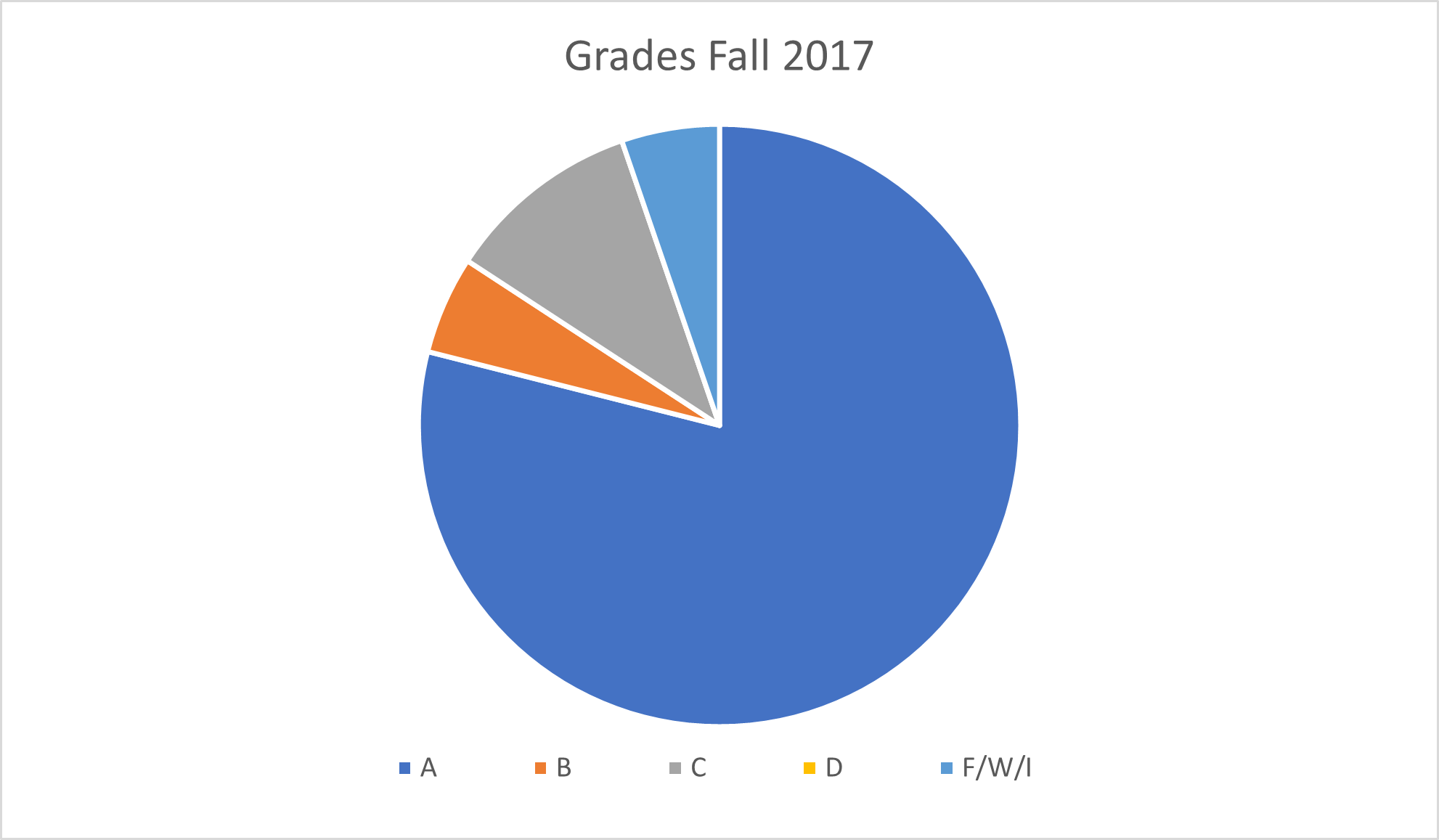
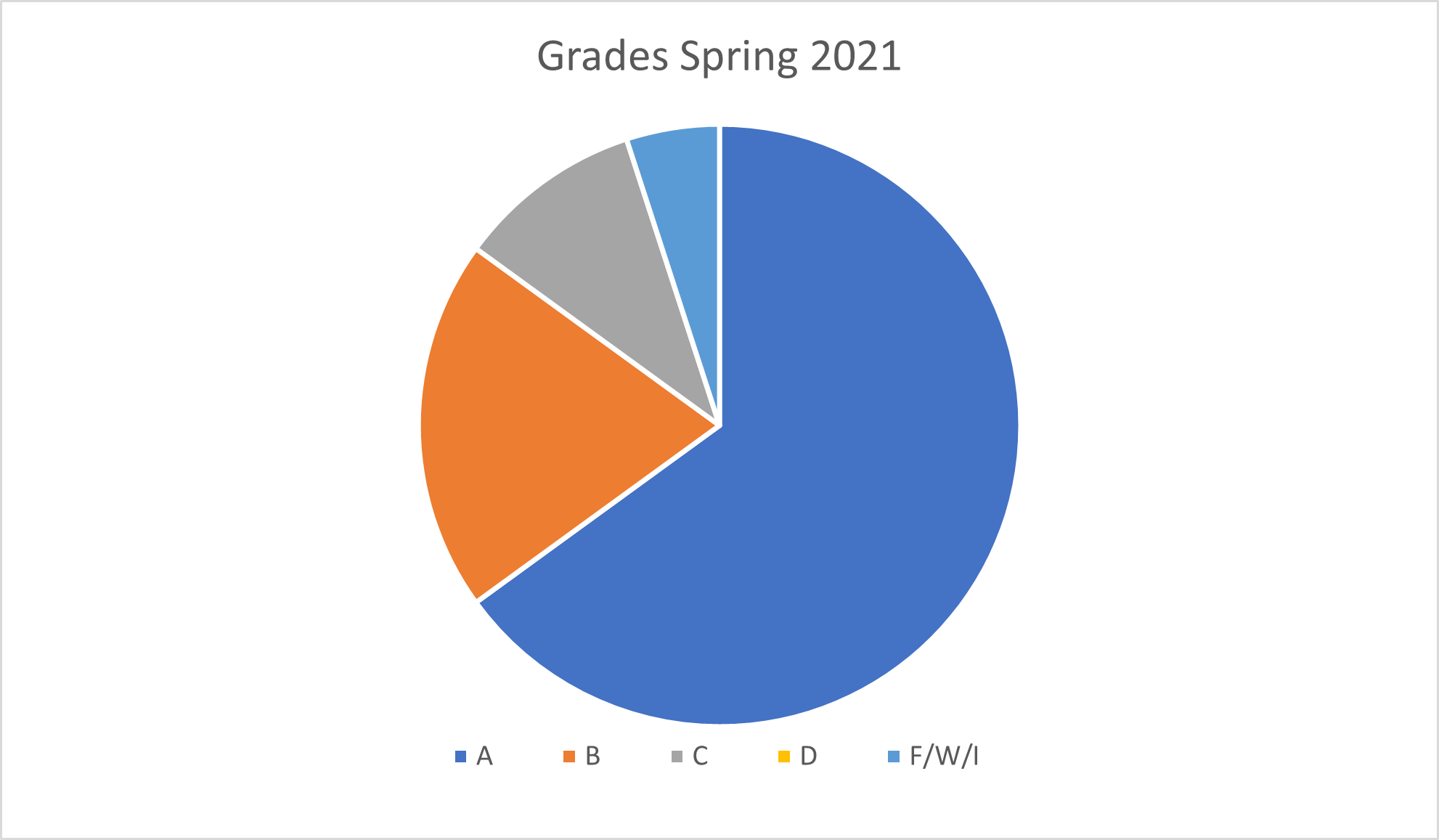
I do not see that scores were so much better in general, but the design significantly improved retention, probably because students were more engaged with the materials and activities. In Fall 2017, two students did not finish the course, and in Spring 2021 one student did not finish it. In Spring 2022, students had a good average during the course, and the lowest grade was a C+.
Although their grades in Fall 2017 were a little better, it was probably because I did not include review quizzes or quizzes then. Later on, I decided it was essential to include some to retain some important concepts. I have included more in the course I am currently teaching. There are six review quizzes (with two attempts) and two quizzes (with only one try), one for the first two modules and one at the end.
See the grades for Fall 2017, 20 students (A refers to A and A-, and same with the rest; F/W/I refers to F, mainly because students stopped doing the assignments, withdraw or asked for an incomplete):
Grades, Spring 2021 (20 students). Letter refer to grades as explained before:
Grades, Spring 2022 (18 students). In this case, there were only 4 different grades in the group: A, B-, B+ and C+:
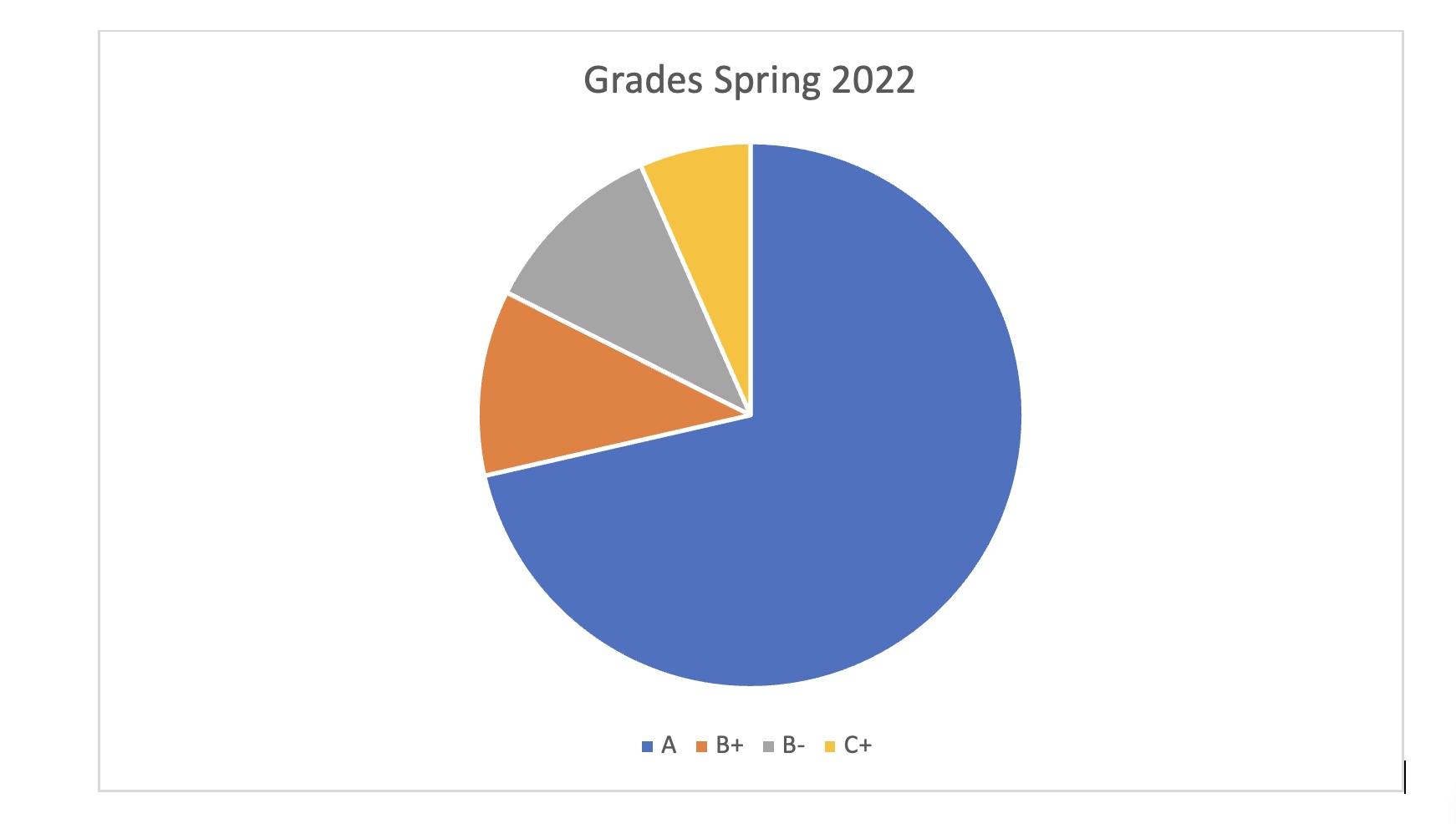
As you can see, there are no incomplete, withdraw, or F.
As I have mentioned, the activities now are more engaging (discussions, visual projects), and also the materials (instructor’s videos and other experts’ videos) made the content easier to digest and remember. Both the discussions and the videos, where students could chat with their classmates and see their instructor, respectively, probably gave them a greater sense of community, which helps with retention.
Examples of these videos can be found here:--Videos by the instructor: intro video / explanation video.
-Videos by experts: Antoni Brosa (University of Lodz, Polonia) and María José Rodríguez Campillo (University Rovira i Virgili, Tarragona, Spain), and Inmaculada Caro Rodríguez (University of Sevilla, Spain).
Here you can see a filewith the list of all the discussions and the details of some of them.
- Did you experience unexpected results after teaching the redesigned course? If so, what were they?
No (until now). I will wait to see the final results and the answers to the survey I have created.
- Consider attaching a more in-depth report describing the impact of your activities and experiences during the course redesign as a document/link/image. If possible consider including samples of students' work that reflect the impact of the redesign.
Examples of students' work (more coming soon...). I think watching the play recorded and working with small chunks of materials, apart from the explanations that I recorded helped them retain the concepts and understand better the plays.
- Discussion-Lope de Vega's plays.
- Summary.
- Review quiz.
- Questions.
- Example of a mind map about female play writers.
- Another example of a mind map.
- Example poster-1.
- Example poster-2.
Assessment Findings
- You can see the graphs with the grades in the previous section.
- Students achieved the learning outcomes easier since the readings were shorter and a little easier. I also included some videos where I explained the topics (also, these videos created more of a sense of closeness to the instructor, I want to believe, something absent in previous courses). I explained the readings in my videos. I think it was easier for them to master the outcomes by discussing the topics on the discussion boards. They had to prepare an answer, and then reply to their mates, so they needed to work more with the content, in a more interactive way than just summarizing or completing a quiz. Before, I had fewer discussions. The creative projects also helped them to retain the information better since selecting the pictures and the excerpts from the authors' plays and the information about their lives, caused them remember and distinguish them better. (Check the results from the survey below).
Student Feedback
- See the survey. (Students will complete this at the end of each semester; results can be seen here).
Challenges My Students Encountered
- Challenges were more related to the linguistic and the discursive competencies (how to create a summary, or how to answer questions giving details, some problems with punctuation...). Although I created a module with reviews from the previous Spanish 3000, which addressed these aspects, in the future I will create a video or connect in Zoom to review those aspects at the beginning of the course. They did not have any issue with the redesigned activities, since they had already prepared posters in the 3000 course. They seemed to enjoy doing those projects instead of having to answer more questions or creating summaries about the materials. They are usually accustomed to some discussions, so they did not have problems with those.
- Regarding the materials, the idea of including short readings from open-access websites and video recordings where I explained the topics seemed to help them a lot.
Lessons Learned & Redesign Tips
Teaching Tips
- Regarding technology training and support, specifically for courses related to Spanish as a second language and CLIL (content and language integrated learning) courses, I participate every month in webinars, seminars and short courses by the publishers Edinumen and Difusion (with the digital platform Campus Difusion). The Cervantes Institute (especially the one in New Delhi, with their annual seminar) offers many interesting workshops. The Spanish Embassy (Education, United States and Canada) with their program to prepare teachers also organizes many short workshops by experts (they are having one this April on teaching without books). All these are online, so it is easy to participate.
- The American Association of Teachers of Spanish and Portuguese (AATSP) also offers Teaching and Learning Resources.
- To create learning outcomes, and work in the alignment of them with tools, activities, and assessment, Quality Matters is very helpful.
- Many research articles and websites dedicated to education talk about how visual work helps with retention. I would recommend: "Studies recommend the power of visuals...", Motivation and retention in large online classes", "The benefits of deeper learning...", "Retention in online courses".
- There are some interesting ones on discussions, too: "Online discussions", "Provide Feedback Strategically in Online Discussions", "Tips for Effective Online Discussions", "Create Question-and-Answer and Social Forums".
- About microlectures: "Plan and record engaging microlectures", "7 Things You Should Know about Microlectures".
- Regarding the first introductory video and the syllabus, two very important tools to engage students and humanize the course: "How to create a course introduction video", "Creating a positive impression through your syllabus".
- Regarding some of the tools that can be used, and how to work in groups and offer feedback, I have published an article in the Cervantes Institute: "Creatividad y colaboración en la clase de español a través del pensamiento de diseño". I also talk about the introductory video, the syllabus, discussions and visual projects in "Dreaming of an ideal online class or how to create a community through a learner-centered and collaborative course", Paper presented at the XI International Conference liLETRAd. “Sueños, Ideas y Moldes”. December 15-17, 2021. [In press, Granada, Comares].
Course Redesign Obstacles
- What challenges did you confront and how did you overcome them?
I honestly cannot think about any challenge.
Strategies I Used to Increase Engagement
- As pedagogical strategies to engage students with the contents, and make the course their own, I provide them with several questions or prompts in the discussions to choose from. Another way to make the course a community where everybody contributes is by asking them to create content used later in the course (posters and mind maps to review content for the final quiz were a way to do it). To engage students with each other, I use the discussion boards, where students have social interaction since they are required to give feedback to at least another classmate. Flipgrid also allows comments.
- A great way to engage students is through creativity, so activities such as the poster and mind map were very useful in that sense. A mind map can assist students with understanding because it conveys hierarchy and relationships, allowing them to see the big picture (for example, organizing the main features of authors and their plays). Mind maps activate many levels of brain activity and are a great tool to help with memorization — from vocabulary words to a foreign language. See more at Quality Matters.
- They also had to create a poster/infographic. Infographics, when created by the instructor, help them understand something, but it is even better when they have to create them. This helps students connect information and make lessons more engaging. See more at Quality Matters.
Instructor Reflection
- Reflections:
- Reflecting on the work done with the course has been important mainly because it gives the instructor the opportunity to think once again about the course and how it can still be improved. In the future, I will include visual projects not only in the second part of the course, but since the beginning.
Also, I did not want to impose a burden in these online classes by doing group work, but I think I could start with something easy; maybe they can contribute with a PowerPoint or a poster with some ideas from a lesson (dividing several chapters or articles among them, for example, and have them present them). They can also create a collaborative presentation, for example, we can divide them in groups of 4-6, and each student create some slides, and then the materials are used by the whole class to review the content (that way they also feel part of the learning community and they become prosumers). I have done this in the face-to-face classes, but not online. They also can search for relevant websites to share with the entire class.
Regarding the Open Access materials, sometimes seems easier, for us and for them, to follow a book, but the book is never enough, and we end up using other materials, so we might as well take a time before the course and select Open access materials and other types of free materials, organize them well in the LMS and create activities and assessment that align them with those materials and the outcomes. We are saving money to our students and, also, we are providing a variety of materials, usually needed to address different topics (such as female writers, in this case). The idea or inviting experts to discuss about the topics, synchronically or asynchronically, is a good idea that I want to continue and expand.
Regarding the technology used, I think it is better to suggest different tools to our students (for example, when they need to prepare a poster), and to facilitate tutorials, but them let them choose the one they prefer.
We need to have a learner-centered class, which includes some of the critical elements that define the learner-centered approach, namely an attempt to create community, a sharing of power and control over what is learned and how it is learned as well as a focus on assessment and evaluation tied directly to learning outcomes (Cullen & Harris, 2009, p. 117). This can be achieved by saying that students will be able to choose some of their assignments (in this course I let them choose once between two assignments, and I also let them choose some materials in one module; I am planning to augment this type of options).
- Reflecting on the work done with the course has been important mainly because it gives the instructor the opportunity to think once again about the course and how it can still be improved. In the future, I will include visual projects not only in the second part of the course, but since the beginning.
Plans to disseminate/publish the findings of your course redesign activity:
I will present the paper "Creating an online community: Using visuals and discussions in a learner-centered redesigned course," VII International Symposium on Ideology, Politics and Demands in Language, Literature and Film, University of Salamanca, Spain, June 1-3, 2022.
I will present the paper
"Using and adapting open access educational resources in the Spanish for
Heritage Speakers classroom," at the I California Spanish Conference, University of California, Riverside (UCR). The Conference was scheduled for April 28-30, 2022, but has been postponed until 2023.