
ET 250 – Electrical Circuits
ET 250 – Electrical Circuits
Purpose: to help other instructors teaching the same course
Common Course ID: ET 250
CSU Instructor Open Textbook Adoption Portrait
Abstract: This open textbook and open educational resource (OER) collection is being utilized in an engineering technology course for undergraduate students by Dr. Zachary Nosker at California Polytechnic University, Maritime Academy. The course uses a combination of openly available textbooks and instructor-created materials, including custom lecture notes, problem sets, worked examples, and laboratory-aligned exercises. The primary motivation to adopt open textbooks and zero-cost materials was to eliminate financial barriers for students while improving alignment between course content, laboratory work, and program outcomes. Most students access the open textbooks and course materials online via external publisher websites and the Canvas learning management system, with all required materials available at no cost.
Course Title and Number - ET 250 – Electrical Circuits
Brief Description of course highlights: ET 250 introduces students to the analysis and application of DC and AC electrical circuits, including resistive networks, energy storage elements, circuit theorems, sinusoidal steady-state analysis, and power calculations. The course emphasizes practical engineering applications and directly supports subsequent coursework in electronics, controls, and automation.
Student population: ET 250 is primarily taken by Engineering Technology students, including majors in Marine Engineering Technology, Facilities Engineering Technology, and future Automation-related programs. Students typically enter the course having completed college-level mathematics and physics, including integral calculus, and E&M physics. The course serves a diverse population, including first-generation college students and students for whom textbook cost can be a significant barrier.
Learning or student outcomes: Upon successful completion of the course, students will be able to:
- Analyze simple DC and AC circuits using network reduction and nodal analysis
- Apply voltage and current divider principles
- Describe RC, RL, and RLC circuit behavior and time constants
- Use Thevenin and Norton equivalent circuits to model real sources
- Apply phasor analysis to sinusoidal circuits
- Calculate real, reactive, and apparent power and power factor
- Connect theoretical circuit analysis to practical engineering applications
Key challenges faced and how resolved: A primary challenge was replacing a comprehensive commercial textbook with materials that maintained rigor while improving accessibility. This was resolved by combining high-quality open textbooks with instructor-created materials that explicitly bridge theory and laboratory practice. Another challenge was ensuring consistency across lecture and lab sections, which was addressed through custom problem sets and aligned examples.
Syllabus and Sample assignments [optional]: The syllabus outlines the integration of open textbooks with original lecture notes and laboratory exercises. Sample assignments include problem-solving exercises, circuit analysis reports, and laboratory experiments aligned with course outcomes.
Textbook or OER/Low cost Title:
Ulaby, F. et al. – Circuit Analysis and Design, 2nd Edition
Pasquale, A. – Electrical Circuits
Both texts are provided free of charge to students.
Brief Description: Circuit Analysis and Design by Ulaby et al. provides a structured, application-focused approach to circuit analysis with strong conceptual explanations and worked examples. Dr. Pasquale’s Electrical Circuits text complements this by offering clear theoretical development and problem-solving emphasis suitable for engineering technology students. Together, these resources support multiple learning styles and allow instructors to tailor content depth as needed. Instructor-created materials include original lecture notes, problem sets, solutions, and laboratory-aligned examples designed specifically for ET 250.
Please provide a link to the resource
Ulaby et al.: https://cad2e.eecs.umich.edu/
Pasquale, A: https://doctor-pasquale.com/wp- content/uploads/2021/09/CircuitAnalysisBook.pdf
Authors:
Fawwaz Ulaby et al.
AJ. Pasquale
Student access: Students access all materials online, primarily through:
- External open textbook websites
- No printed textbook purchase is required.
Supplemental resources:
- Instructor-created lecture notes
- Original problem sets and worked solutions
- Laboratory exercises aligned with ET 250L
- Reference readings for enrichment
Provide the cost savings from that of a traditional textbook. The previously used commercial textbook (Electrical Engineering: Principles and Applications by Allan R. Hambley) typically cost $180–$220.
Current cost to students: $0, resulting in full textbook cost elimination.
License*: Ullaby et al. is copyrighted but made available for free online.
Pasquale is licensed under CC BY-NC-SA 4.0. The instructor-created materials are in the process of being prepared for publication under an open license.
OER/Low Cost Adoption Process
Please provide an explanation or what motivated you to use this textbook or OER/Low Cost. The primary motivations were to eliminate textbook costs, improve alignment between lecture, lab and textbook content, and allow greater flexibility in adapting materials to course and program needs.
How did you find and select the open textbook for this course? Resources were selected through review of existing OER textbooks, evaluation of content quality and rigor, and direct classroom use. Instructor experience and iterative refinement played a major role. While the Ulaby text contains good information, the Pasquale text introduces material in a more accessible and understandable format, which is why I use both books.
Sharing Best Practices: Faculty new to OER should start by supplementing rather than replacing everything at once, pilot materials in one course, and collaborate with librarians and colleagues. Iterative improvement is key.
Describe any challenges you experienced, and lessons learned. The main challenge was finding a textbook that introduced material in the order I wanted with the same academic rigor. In the end there was no perfect solution with textbooks alone which is why I developed my own lecture notes to bridge the gap between available texts and my lectures.
Instructor Name Zachary Nosker
I am an Assistant Professor of Engineering Technology at California Polytechnic University, Maritime Academy. 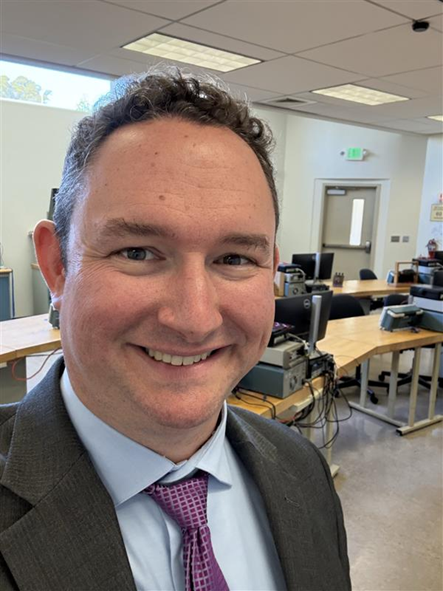 Please provide a link to your university page.
https://catalog.calpoly.edu/engineering/engineering-technology/#faculty
Please describe the courses/course numbers that you teach. I regularly teach Electrical Circuits, Electronics, and Automation-related courses.
I teach ET 250 / ET 250L – Electrical Circuits and Laboratory, which introduce students to the principles and applications of DC and AC circuit analysis. Topics include network reduction techniques, nodal and mesh analysis, equivalent circuits, first-order transients, basic filtering, sinusoidal steady-state analysis, and AC power and power factor concepts. The accompanying laboratory emphasizes hands-on measurement, instrumentation, and analysis, allowing students to apply theoretical concepts directly to physical circuits while developing practical troubleshooting and technical documentation skills.
I also teach ET 370 / ET 370L – Electronics and Laboratory, which focus on the analysis and application of electronic devices and circuits. Course topics include semiconductor devices (diodes, BJTs, MOSFETs, etc.), operational amplifiers, signal conditioning circuits, timers, active filters, data conversion, and basic communication concepts. The laboratory component emphasizes programming and hands-on circuit construction, testing, and troubleshooting, and includes a term project in which students design, build, and evaluate an electronic system. This project integrates theory, experimentation, and technical communication while reinforcing real-world design constraints.
In addition, I teach ET 350 / ET 350L – Electrical Machinery and Laboratory, which cover magnetic circuits, transformers, DC and AC machines, three-phase power systems, power factor correction, and motor control. The laboratory component provides direct experience with real electrical machinery, measurement techniques, and system operation. The course includes a hands-on wind generator project that requires students to apply machine theory to practical applications involving generators, reinforcing the connection between electrical theory and industrial and maritime systems.
Describe your teaching philosophy and any research interests related to your discipline or teaching. My teaching philosophy centers on making engineering concepts concrete, usable, and accessible, particularly for students in engineering technology programs who will apply these skills directly in industrial, maritime, and automation settings. I emphasize strong conceptual understanding supported by practical problem-solving, hands-on laboratory work, and real-world examples drawn from electrical power, control systems, and industrial equipment. Across the courses I teach, including Electrical Circuits (ET 250/250L), Electronics (ET370/370L), and Electrical Machinery (ET350/350L), I work to tightly align lecture content, problem sets, and laboratory exercises so that students clearly see the connection between theory and practice and develop transferable skills in modeling, troubleshooting, and technical communication.
My broader professional interests include curriculum design, laboratory pedagogy, and the use of open educational resources to improve both instructional quality and student access. I have adopted and developed OER to remove financial barriers, enable rapid iteration of course materials, and better tailor content to specific program outcomes and student populations. I view open resources not only as a cost-saving measure, but as a way to promote equity and instructional coherence by ensuring all students have immediate access to required materials. I am particularly interested in integrating electrical, automation, and control concepts into undergraduate curricula in ways that reflect real-world maritime and industrial systems while maintaining academic rigor.