
Finding Primary & Secondary Sources
Finding Primary & Secondary Sources
When we refer to primary sources we mean an original, first hand account, created at the time of the event. For example: letters, photographs, or meeting minutes.
There are 2 types of primary source in law: case law and legislation.
Case law is the law created by the courts, sometimes referred to as judge made law. Case law is established following decisions made by judges in other cases, known as precedents.
Legislation is a law or a set of laws that have been passed by Parliament, also known as Acts of Parliament or statutes.
When searching for a case you might have:
1. A full citation, for example: Pepper v Hart [1993] AC 593, or
2. The names of the parties involved, for example: Pepper and Hart, or
3. No specific case in mind.
If you have a neutral citation: use it. Neutral citations make it easier to find a judgment online from sources such as the British and Irish Legal Information Institute website (BAILII).
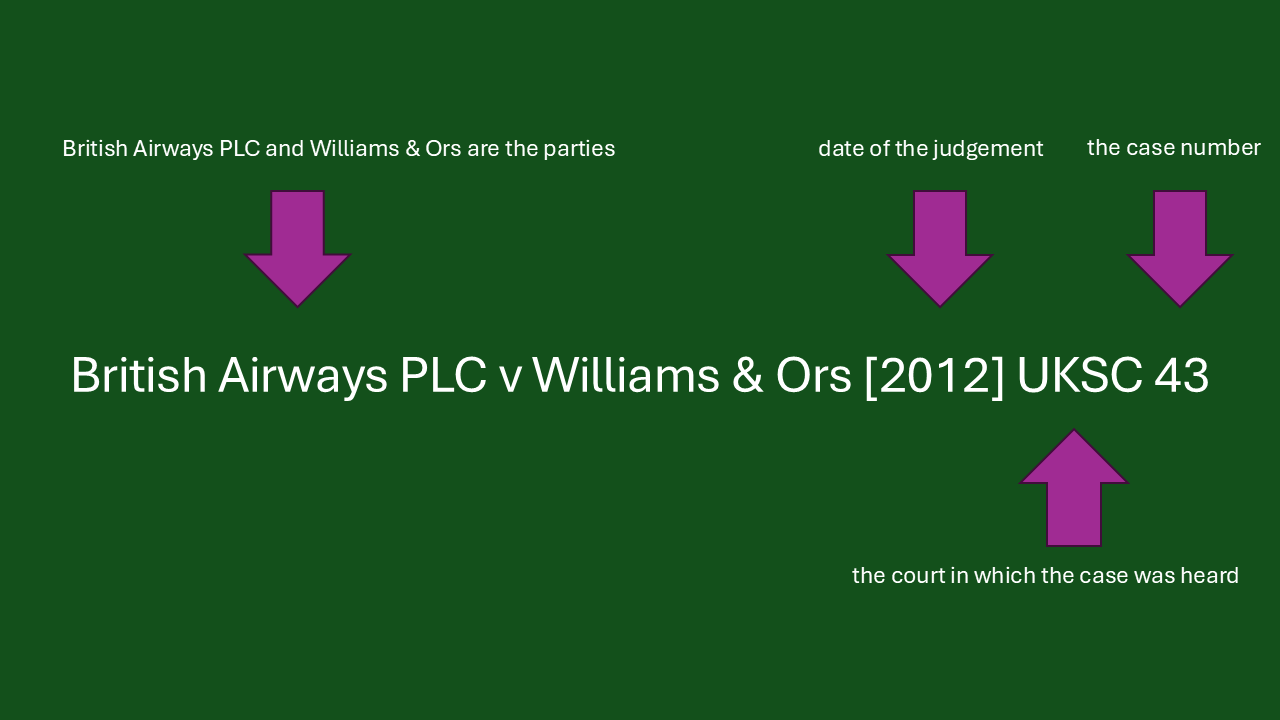
Neutral citations were introduced in the UK in 2001 for judgments from all divisions of the High Court. This provides an official, electronic reference for the case and refers to the year and court in which the case was heard.
For example:
This work is marked CC0 1.0. To view a copy of this mark, visit https://creativecommons.org/publicdomain/zero/1.0/
| Component | Text from Citation | Explanation |
| The Parties | British Airways PLC v Williams & Ors | The Appellant vs. the Respondents ("Ors" is short for "Others"). |
| Year of Judgment | [2012] | The year the court handed down the decision. |
| The Court | UKSC | United Kingdom Supreme Court, the highest court in the UK. |
| Case Number | 43 | A unique number allocated by that court in that year. |
You might find a case with multiple acronyms after the neutral citation. This usually means the case has been reported. You can use the Cardiff Index of Legal Abbreviations to find out which law reports these are.
If you do not have a specific case in mind, you can search by keyword. Alternatively, it may be better to consult a secondary source to point you in the right direction.
| UNREPORTED CASES Some cases are never formally reported. Transcripts may be available, but can come at a cost. Inner Temple Library have further information about unreported cases here: Frequently Asked Questions: Researching UK Law - The Inner Temple Library |
| Name | Description |
| The National Archives: Find Case Law | Find Case Law is a service that provides public access to court judgments and tribunal decisions made in England and Wales from 2001 onwards. |
| BAILII: Case Law | BAILII (the British and Irish Legal Information Institute) provides the most comprehensive set of British and Irish primary legal materials freely available online. There are over 50 case law databases, covering both courts and major tribunals, listed in “BAILII Databases” under the following headings: England and Wales, Scotland, Northern Ireland, Ireland, United Kingdom and Commonwealth, and Europe. Most databases contain predominantly recent material (especially from around 1997 onwards), but older decisions are being added on an ongoing basis along with new cases. |
| Incorporated Council of Law Reporting (ICLR) | Freely available material includes summarised reports of cases 2009 onwards heard by the Supreme Court, House of Lords, Privy Council, Court of Appeal, and all divisions of the High Court, as well as the Court of Justice of the European Communities, that are likely to appear in the Weekly Law Reports, Business Law Reports, Industrial Cases Reports, and Public and Third Sector Law Reports. |
| The Supreme Court of the United Kingdom | The Supreme Court website provides Decided Cases in pdf form after the Judgments are handed down both in a “press summary” and in full. The judgments can be sorted in ascending or descending order of hand-down date, neutral citation, case ID or case name or can be searched for by ID number or by keywords. |
There are 2 types of legislation:
- Primary: Acts of Parliament (also known as Statutes).
- Secondary: Also known as delegated legislation or subordinate legislation. Essentially, it ensures a change in law can be made without the need to bring in a completely new Act of Parliament. The most common type of secondary legislation is Statutory Instruments (SIs).
There is a lot of information and guidance on the official government website. To learn more about how legislation is created and structured, click Understanding Legislation
| Name | Description |
| BAILII: United Kingdom Legislation | BAILII (the British and Irish Legal Information Institute) provides the most comprehensive set of British and Irish primary legal materials freely available online. Its United Kingdom Legislation section includes statutes made by successive parliaments from 1267 onwards: of England 1267-1706, Great Britain 1707-1800, and the United Kingdom 1801 to date. |
| Legislation.gov.uk | All legislation from 1988 – present day is available in its original form, plus a revised version showing amendments which have been made since the original version. Most pre 1988 legislation is also available, however in some cases there will only be an originally published (as enacted) version and no revised version. |
Primary sources - caselaw and legislation - are the law.
Secondary sources talk about the law. This could be encyclopedias, journal articles, books or commentaries.
When you are new to legal research or unfamiliar with an area of law, proceeding from general information (secondary sources) to more specific, authoritative information (primary sources) is a good approach.
Using secondary sources and commentary discussing how the law is applied will lead to relevant primary sources: case law and legislation. However, it is not enough to assume a case or statute is relevant just because you've read it in a secondary source. Always check the case by reading it in full. It is also important to check it is still good law and whether the judgment you are relying on has not subsequently been appealed or overruled.
This is a broad area, but here are a few suggestions:
- Halsbury's Laws of England is an enormous legal encyclopedia that covers all areas of the law. It is trusted (it can be cited in court) and used by practitioners and students alike. It is not likely to be found in public libraries, but you may be able to access it through an academic library. Although it's hard to find, it's worth mentioning as it's a great place to start if you have no knowledge of a topic.
- Casebooks
- Textbooks
- Official publications
Commentary sources are useful because they help explain, interpret and contextualise primary legal materials like statutes and case law. They can help clarify complex areas of law, making them especially valuable for understanding how the law is applied in practice.
An example might be Archbold’s Criminal Pleading, Evidence and Practice.
The availability of these works in public libraries is very limited. You are more likely to find them in academic libraries’ collections, but access will be dependent on each library’s admissions policy. Additionally, these types of sources are moving online making them harder for the public to access.
Understanding where to find authoritative legal resources is important, but it is also important to understand when you might need to consult other types of information too. This could include:
- Newspapers, magazines and trade publications
- Academic journals in other fields of study
- Company or industry information
- Statistics
- Government publications
Much of the above is easier to source, but the same rules should be applied when considering the authority, currency and relevance of the material to your area of research.