EC 500: Environment and Community Field Methods and Community-Based Research
EC 500: Environment and Community Field Methods and Community-Based Research
Purpose: to help other instructors teaching the same course
Common Course ID: EC500
CSU Instructor Open Textbook Adoption Portrait
Abstract: This open textbook is being utilized in an Environment and Community Field Methods and Community-Based Research course for graduate students by Dr. Cinthya Ammerman Muñoz at Cal Poly Humboldt. The open textbook provides the course’s foundational concepts, linking theory, method, and field immersion under a decolonial, relational framework for researching with communities. Its place-based approach affirms the core principles of the class and graduate program. The main motivation for adopting an open textbook was to ease the financial burden on students by eliminating the need to purchase additional materials.. Most students access the open textbook in ebook format through our university library.
Course - EC 500: Environment and Community Field Methods and Community-Based Research
Brief Description of course highlights: Explore frameworks for community-based research on “environment” and “community” that center on race/power/privilege/positionality and build an understanding of how to approach/engage in research through place-based case studies and field immersion experiences. https://catalog.humboldt.edu/preview_course_nopop.php?catoid=14&coid=75103
Student population: This class is for incoming first-year students in the Environment and Community M.A. program. This interdisciplinary program equips students with the tools to create just and sustainable solutions to complex social and environmental challenges, grounded in the knowledge that racial justice, settler colonialism, and environmental problems are deeply intertwined.
Students come from diverse educational backgrounds with undergrad majors in STEM fields, Humanities, and Social Sciences. Many applicants have experience with community-based practice in California and beyond. Over the past three years, the program has seen an increase in out-of-state applicants. This program also offers dual pathway for enrollment for undergraduate students majoring in Native American Studies, Critical Race, Gender & Sexuality Studies, and in Environmental Studies.
Learning or student outcomes:
1) To provide an understanding of race/power/privilege interrelations as they relate to the environment.
2) To ground the understanding of race/power/privilege in particular places in Humboldt County in a manner that foregrounds intersectionality and our own positionality. Case studies provide concrete opportunities to explore these relationships and to ask questions of what we’re seeing/hearing and to ask questions of ourselves and the assigned readings.
3) To provide an opportunity for self-reflection about our own positionality in a manner that fosters “brave spaces” and builds community (through identification/recognition of patterns of power/privilege among us).
4) To build an understanding of how to approach/engage in community-based research through place-based case studies.
Syllabus and Sample assignments:
Syllabus: https://docs.google.com/document/d/171VQGRkhtK7B3YFa7WIjCBIRBmwr1Lvrp6mUW-tVpq8/edit?usp=sharing
Final Paper Prompt: https://docs.google.com/document/d/13nIjOgQAnZlGUdAtDXZJJB4zrJx2aGMu/edit?usp=drive_link&ouid=100102561106673496981&rtpof=true&sd=true
Textbook or OER/Low-cost Title: Place in Research: Theory, Methodology, and Methods
Brief Description: Place in Research: Theory, Methodology, and Methods is a methodological and theoretical text that examines how place functions as an active and constitutive element in research rather than a passive backdrop. The book introduces the framework of critical place inquiry, integrating insights from Indigenous studies, decolonizing methodologies, critical geography, and environmental education to challenge conventional Western research paradigms. Central concepts include relational understandings of land, reflexivity about one’s positionality, and the ethical responsibilities researchers hold to the communities and territories they study. Each chapter integrates theory with reflection, encouraging scholars to interrogate their relationships to power, history, and environment within their own work.
The book is structured across two parts that include chapters on theories of place, methodology and methods of Indigenous and critical place inquiry and ethical implications. The text offers conceptual grounding alongside practical guidance for designing place-engaged, community-based research. It includes numerous guiding questions and case examples. Available through Routledge’s digital platform, it provides full-text search, chapter downloads, and accessibility tools. Overall, the book serves as a foundation for decolonial and participatory approaches to research that center land, relationships, and accountability.
Please provide a link to the resource
Library Link: https://csu-humboldt.primo.exlibrisgroup.com/permalink/01CALS_HUL/omcour/alma9910032273402909
Publisher Link: https://www.routledge.com/Place-in-Research-Theory-Methodology-and-Methods/Tuck-McKenzie/p/book/9781138639683
Authors: Eve Tuck and Marcia McKenzie
Student access: Students are instructed to access the book through our library. Text is available through Taylor & Francis Ebooks.
Supplemental resources: Students used Canvas
Provide the cost savings from that of a traditional textbook. $59.99
License*: Copyrighted. All rights reserved. No part of this book may be reprinted or reproduced without permission in writing from the publishers. (Not published under CC)
OER/Low-Cost Adoption Process
Provide an explanation or what motivated you to use this textbook or OER/Low Cost option. I was motivated to use this book because it articulates a place-based methodology relevant to the core principles of the class and graduate program. Luckily, it was already available online via our library, otherwise, I would have requested the library purchase the ebook for students to access. As a last-resort alternative, I was prepared to digitize the book myself and upload it to Canvas.
How did you find and select the open textbook for this course? I had previously purchased and read the book for my own research. For this particular class, I was looking for a book that brought together Geographic and Native American/ Indigenous theory and this book was the perfect fit.
Sharing Best Practices: During my first couple of years as faculty, I wish I had known how easy and fast it is to request digital copies and book purchases from our library. Our request forms and process is straightforward. I was surprised by the effectiveness and accessibility of materials. I also ensure my students take advantage of the institutional resources, through a research workshop that includes learning how to access and request library materials.
When using OER texts, videos, and articles, I have begun downloading and storing them in a cloud drive. I have learned from experience that relying on external links can lead to problems when teaching the course again as links can expire or break.
When uploading pdfs, or scanning my own, I make sure that they are user accessible PDFs, meaning that the file has selectable text (not image-only scans). Our institution has an accessibility checker to verify proper tagging, alt text, reading order, and document language. I upload pdfs directly into Canvas and save a copy on my own drive as well. In selecting films for my classes, I check to see if they are accessible via one of our media libraries (Panopto or Kanopy), or I request it.
Describe any key challenges you experienced, how they were resolved and lessons learned. The primary challenges I have encountered have been self-generated rather than institutional. My main issue has been waiting until the last minute to request instructional materials. In my experience, delivery can take up to a week—though often they arrive sooner—but this delay has occasionally caused me to miss opportunities to incorporate the materials into my course on time.
In my other classes, I regularly integrate OER texts and links to both peer-reviewed and non-peer-reviewed articles, video lectures, films, and short videos within the syllabus. However, relying solely on external links presents long-term problems as links frequently expire or break between course offerings. For this reason, I now back up all materials by downloading and storing them in a secure cloud drive to ensure continued access and reliability.
Instructor Name - Cinthya Ammerman Muñoz
I am a Native American Studies Assistant Professor at California State Polytechnic, Humboldt.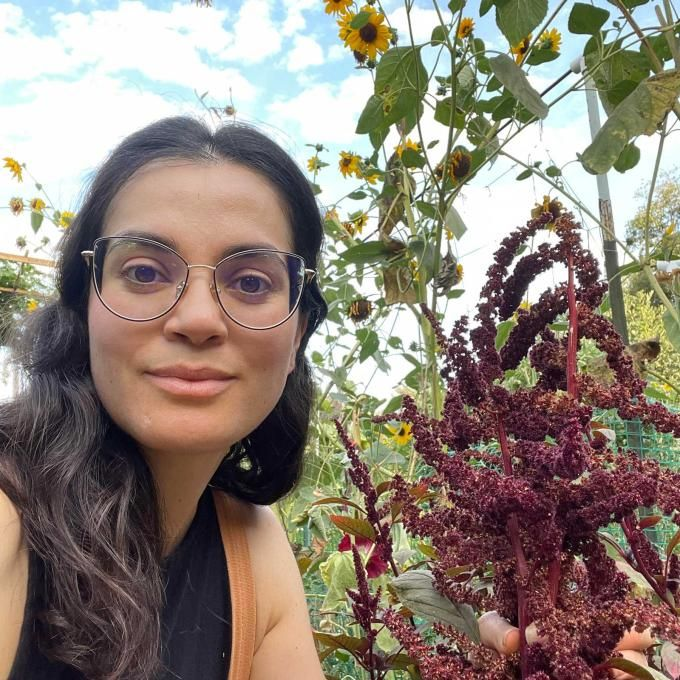 Please provide a link to your university page.
https://www.humboldt.edu/nas/cinthya-ammerman
Please describe the courses/course numbers that you teach. I teach undergraduate classes in Native American Studies and graduate classes in the Environment and Community M.A. program. Below is a list of classes I have taught at this institution:
NAS 101 “TEK and Place-Based Learning” This course introduces traditional ecological knowledge (TEK) and ethical engagement of place-based learning. Students apply critical thinking skills to responsible incorporation of Indigenous knowledges and explore how critical and creative thinking occurs within Indigenous contexts. Students also engage with informed present-day issues and explore how TEK can inform critical and creative thinking and problem-solving skills across disciplines. For this class I created a unique collaborative final project. Students worked in small groups to research and create seasonal round calendars for various California ecoregions. During the last week of class, they gave presentations on the nonhuman relatives featured in their calendars and tribes from their chosen ecoregion.
NAS 306 “Indigenous Peoples of the Americas” This survey course focuses on the complex cultures, historical development and contemporary social and political situations of Indigenous peoples of South, Central, and North America, with an emphasis on Latin America (Abya Yala). This course is designed to introduce students to various iterations of colonialism, imperialism, and Indigenous resistance through a series of thematic units. The course is meant to be interdisciplinary and international, the assignments enable students to engage with the course material from their own disciplinary and geographic grounding. This is the main undergraduate course I teach every semester, both in-person and asynchronously.
Something that sets this class apart from most other NAS classes is that I contextualize the history of colonialism in the Americas with histories of European dispossession, such as the period of enclosures in Britain, the witch hunts, the colonization of Ireland, the Spanish Reconquista, and the Christian Crusades, all of which shaped colonial policies in the Americas. By presenting these histories as part of a continuous structure rather than something that began in 1492, students with European ancestry can recognize colonialism as a system that also acted on their own ancestral lineages. Students have reported that this broader framing enables deeper solidarity with Indigenous struggles, while prompting critical reflection on their own inherited positions within colonial structures.
NAS 307: “Nature and Issues of Genocide” This course examined the processes of genocide, historical genocide acts and genocide in the twenty-first century with an emphasis on the genocide of Indigenous Peoples of the Americas. We explore issues of genocide, and interlinked issues of gendercide, politicide, and ecocide in California and the US, in Guatemala, Chile, the Brazilian Amazon. I also include some baseline information on several other countries such as Honduras, Nicaragua, Ecuador, Mexico, and Colombia. Over the past year, I have expanded the weekly modules to include information on Palestine, drawing careful parallels between the conflict in Gaza and settler-colonial genocide in the Americas.
NAS 333 “Food Sovereignty Lab” The class is oriented to place-based, land-based learning pedagogies and service to the regional Indigenous community. In addition to activities and material that grounds students in regional food sovereignty initiatives, the class also has regular open lab days where students engage in the project group of their choice. This class was a collaboration with Karley Rojas, Blue Lake Rancheria’s Native Plant expert and the Research Associate for the Food Sovereignty Lab. Workshops took place in partnership with the Blue Lake Rancheria Tribe, with funding from their recent Urban Agriculture and Innovative Production Grant (USDA), which funds community workshops around food preservation and processing. This allowed for the compensation of experts, and the purchase of materials. This course was also offered through Extended Education, so that community members may sign up for its entirety, or for specific dates throughout the course. Two class sessions were open community workshops, attended and assisted by the class.
Field Methods and Community-Based Research, Environment and Community 500
EC 630 “Decolonizing Methodologies This graduate seminar was designed as an opportunity to explore, discuss, analyze and envision decolonizing methodologies for community-based research. We explored themes of ethics & intersectionality, critical research & interdisciplinary research methods (autoethnography; Community Based Participatory Research; oral history, narrative & storytelling, arts & creative methodologies) and Indigenous interventions on citation practices & quantitative statistics. We analyzed research as relationships/relational accountability; ethnographic refusal; felt theory; and research as resistance. In this graduate course, students completed a draft of their research proposals.
EC 640 “Klamath River Issues” This graduate seminar is framed by a “theory of water” that foregrounds our relationality, our interdependence and interconnection (Risling Baldy 2017). In this course we address issues concerning the Klamath River Basin, including history and current events, and we make connections with parallel struggles for river protection in Chono, Kawéskar, and Mapuche homelands (Chilean Patagonia). Through class discussion, we analyze the various issues with the Klamath River Basin, whether they are tribal, environmental, political or spiritual.
Notable moments in this class included two guests speakers who came to talk about the parallel struggles for river protection in Southern Chile and Northern California, a scholar from UC Davis, Paulina Rojas, and Danielle Frank, the communications director for Rios to Rivers, a non-profit organization that works with Indigenous youth throughout South America and along the Klamath Basin through empowering educational programs such as Paddle Tribal Waters. Danielle Frank also facilitated our class field trip to go rafting with Paddle Tribal Waters youth on the Klamath River.
Describe your teaching philosophy and any research interests related to your discipline or teaching. My teaching philosophy is grounded in an Indigenous relational pedagogy and is informed by my multicultural upbringing and nearly two decades of experience with learners across all ages, from preschool to university. As a first-generation, immigrant, multicultural, and bilingual educator, I approach the classroom as a cultural bridge-builder, designing curricula that integrate diverse perspectives and foster connections with communities beyond national borders. I strive to make the Zapatista vision of “a world where many worlds fit” tangible in my classroom by cultivating inclusive learning environments and developing curricula that respond to the varied needs and backgrounds of my students. This commitment is consistently affirmed in the strong student feedback I receive for creating a learning space that values and reflects diversity.
Indigenous pedagogies are relational and place-based, fostering community-conscious and self-directed learning. Through valuing students’ diverse life experiences and worldviews, I cultivate a classroom environment where students can learn about themselves, their communities, and their place in the world. In all my classes, I assign reflections for students to consider how their identities and personal histories impact how they understand the issues we are learning about. My courses include a wide range of texts and perspectives for students to connect with the material from their own positionalities. For example, I contextualize discussions about colonialism in the Americas with histories of European dispossession, such as the enclosures in Britain, the witch hunts, the colonization of Ireland, the Spanish Reconquista, and the Christian Crusades, all of which shaped colonial policies in the Americas. By presenting these histories as part of a continuous structure rather than something that began in 1492, students with European ancestry can recognize colonialism as a system that also acted on their own ancestral lineages. Students have reported that this broader framing enables deeper solidarity with Indigenous struggles, while prompting critical reflection on their own inherited positions within colonial structures.
Within the classroom, I foster flexible, cooperative, inclusive, and supportive learning environments. To me, an equitable learning environment emphasizes students’ learning process as opposed to their grades. Most of their weekly assignments are graded as complete/incomplete, with possibilities to re-do the assignment as many times as needed, and I don’t penalize late work. In developing a curriculum, I include a variety of assignments, technologies, and teaching innovations to accommodate all types of learning styles. In some classes, I also include class materials in Spanish as well as English. My classes include audio and visual material such as podcasts, video clips, music, maps, and apps. Despite my affinity for technology I don’t rely heavily on PowerPoint slides in my in-person classes, and encourage my students not to rely on them either but to take handwritten notes, which has been proven to be better for retention of information. During in-person classes I include one-on-one and small group activities, discussions, and educational games to build community. When covering heavy or graphic material, I often incorporate breathwork and other grounding activities. Stress impairs our learning ability; therefore, building community and incorporating activities that ground students in the present moment are essential to creating conditions for learning.
I also include weekly assignments and final projects that are broad and flexible to allow students to engage from their own disciplines and capacities. For example, a student in plant sciences can research issues of biopiracy in the Amazon rainforest; an engineering student can address the impact of a dam on a sacred river; a computer science student can expand on the role of video games or new technology in language and cultural reclamation. I encourage my students to transcend disciplinary and geographic boundaries.
The learning that happens in the classroom is not unidirectional. My job is also to learn about my students’ diverse needs, interests, and learning styles, and to create a respectful and adaptable environment that amplifies their intrinsic motivation to learn. I am committed to working with students who are overcoming systemic barriers to higher education. These students may require additional support with their writing and reading comprehension. I give them extensive feedback on their work throughout the semester, encourage them to make office hours appointments with me, and I refer them to academic resources such as the university writing center. I find that most students welcome the feedback and mentorship, and will continue to reach out to me after our term is over for letters of recommendation, for writing advice, or to share their academic victories. Over the past year I have built mentoring relationships with many students on our campus, connecting them with scholars beyond our university and supporting them as they explore and develop their career interests.
My holistic educational philosophy begins with the premise that learning can be a process of healing as well as emotional, spiritual, and intellectual growth. When carefully facilitated, difficult discussions provide all students the opportunity to strengthen their ability to think critically about sensitive issues such as genocide, colonialism, and institutional racism. Students who are new to Indigenous histories often report feelings of guilt and shame. I encourage them to reflect on their emotions as part of reorienting their responsibilities. Many later report that this process not only reshaped their understanding of colonial structures but also gave them practical ways to act. I emphasize that no contribution is too small: learning about Native communities is itself a restorative act, and students can make an impact by challenging stereotypes, amplifying marginalized histories, and sharing what they learn within their own families and communities. Ultimately, my goal is to cultivate classrooms as spaces of regenerative interaction and solidarity-building. I want students to leave with the understanding that they are part of a larger whole, that they can make a meaningful impact, and that they bring unique contributions to this collective work. I, in turn, continue to learn from them, incorporating their feedback and deepening my own practice through these reciprocal exchanges.