
E-book Textbooks Freely Available to Students from Campus Library
E-book Textbooks Freely Available to Students from Campus Library
Purpose of this showcase:
Encourage faculty to consider choosing a textbook
available as an e-book from their campus library
Common Course ID: GEOL 5220
CSU Instructor Open Textbook Adoption Portrait
Abstract: An e-version of the textbook Tectonic Geomorphology that is freely available to students via our campus library is being utilized in a Geology course for graduate and upper-level undergraduate students by Sally McGill, Ph.D., at California State University, San Bernardino. Students can access the entire e-book for free during the course and for a limited time afterwards. They can also permanently download a limited number of chapters for free (up to about 20% of the book). I was looking for a new textbook for this course and was delighted to find an excellent textbook that our campus library has available for free as an e-book. This book is just as good as the book I was using previously (and is more up-to-date), so there was no downside to reducing the financial burden on our students by adopting a textbook with a free option. About half of the students in the course chose to take advantage of the free, e-book format of the textbook.
Course Title and Number - GEOL 5220: Neotectonics and Seismic Hazards
Brief Description of course highlights:
State-of-the-art methods for studying active faults. Topics include basic seismology, significant historic earthquakes, identifying active faults, estimating fault slip rates by geologic and geodetic methods, types of evidence for prehistoric earthquakes, models for earthquake recurrence, and evaluating the potential for and likely effects of future earthquakes. Three hours lecture and three hours laboratory. https://catalog.csusb.edu/coursesaz/geol/
Student population:
This course is geared toward graduate students in Geology or Environmental Science as well as junior and senior geology majors. The only strict pre-requisite is an introductory course in geology, but prior completion of a course in geologic mapping and a course in structural geology is strongly recommended. In the current offering of this course there are 9 CSUSB graduate students in the M.S. Geology program; two graduate students from Cal Poly Pomona’s M.S. Geology program, and five seniors and juniors from CSUSB’s B.S. Geology program.
Key challenges faced and how resolved:
The only challenges I faced were minor. I needed to spend a hour or so learning how to access the e-book and experimenting with the different options for downloading portions of the book and saving my personal highlights in the e-book. I then created an instruction sheet to explain the options to students. (See a syllabus copy inserted below). I also needed to update my syllabus with the chapters and page numbers for the reading assignments from the new book, but this was made easier by the fact that I could search the e-book for key words to find where certain topics were covered in the book.
Learning or student outcomes: GEOL 5220 Learning Outcomes.docx
Syllabus for GEOL 5220 course: GEOL 5220 Syllabus.docx
OER/Low-Cost Adoption Process
Provide an explanation or what motivated you to use this textbook or OER/Low Cost option.
I was looking for a new textbook for this course and was delighted to find an excellent textbook that our campus library has available for free as an e-book. This book is just as good as the book I was using previously (and is more up-to-date), so there was no downside to reducing the financial burden on our students by adopting a textbook with a free option.
How did you find and select the open textbook for this course?
I was already looking for a new textbook because the one I had last used is pretty old and has never had a new edition released. I did an internet search for textbooks on the topic of my course and found one I had not been previously aware of that looked promising to me. I checked to see if our library had it so that I could look at it in more detail immediately. To my pleasant surprise, our library had an e-version of the textbook that is available for free to our students. I spent a few hours skimming through the topics that are most important for my course and compared them to how those topics were covered in the book I had used previously. For some topics, I found the coverage in the new book to be at a more appropriate level for my course, and for other topics I liked the presentation in my old book better. There were also a few topics in my course that were covered in newer book but not the one I had previously used and vice versa. However, all of the topics had more up-to-date literature references in the new book, so I would have chosen that book even if it had not been available as a e-book. Nonetheless, I was very pleased to be able to offer my students a free textbook option.
Sharing Best Practices:
I wish I had known earlier that our library has free e-versions of some standard textbooks.
Describe any key challenges you experienced, how they were resolved and lessons learned.
The only challenge was that I needed to spend a few hours learning how to access the e-book and experimenting with the different options for downloading portions of the book and saving my personal highlights in the e-book. I then created an instruction sheet to explain the options to students. (See a previous section of this questionnaire). I also needed to update my syllabus with the chapters and page numbers for the reading assignments from the new book, but this was made easier by the fact that I could search the e-book for certain key words to find where certain topics were covered in the book.
Textbook or OER/Low cost Title: Tectonic Geomorphology, 2nd Edition
Brief Description: This textbook has black and white figures, but provides a link to online versions of some figures that are available in color. Students and instructors can also freely download a pdf file containing all of the figures.
Please provide a link to the resource: https://onlinelibrary.wiley.com/doi/book/10.1002/9781444345063
Textbook: Tectonic Geomorphology, 2nd Edition, by Douglas Burbank and Robert S. Anderson, published by John Wiley & Sons, Incorporated in 2011 (print version) or 2012 (e-book). The ISBN for the print book is 9781444338867. The ISBN for the e-book is 9781444345032.
There are a couple of options for accessing the textbook:
1. You can purchase a printed copy from the Coyote bookstore for the price of $99.75 new or $75.00 used. Or purchase it somewhere else, if you can find it cheaper. We will be using the 2nd edition. I have not looked at the first edition, so I don’t know how different it is from the 2nd edition.
2. Or, access the e-book for free via Pfau Library using this link: https://csu-sb.primo.exlibrisgroup.com/permalink/01CALS_USB/6rdjcv/alma991067618200102901 . (You may need to log into MyCoyote before clicking on this linl). Once this link opens, click on the link that says “ProQuest EBOOK Central Academic Complete”. With this option you can do any or all of the following:
a. Read the book online and save it to your Proquest bookshelf along with any highlighting you add. I think you will continue to have access to it as long as you are a CSUSB student.
b. In addition, you can download individual chapters to pdf files, up to a limit of 96 pages total (the book is 478 pages long). On the first day of class (or sooner), I’ll make a recommendation for which chapters will be most important for our class.
c. In addition, you can also download the entire book using free software, but your access to the book via that software will end after 180 days.
For detailed instructions on how to access the e-book for free via Pfau Library, click here. When students click the “click here” link they see:
Instructions for accessing the Spring 2025 GEOL 5220 textbook for free as an e-book via Pfau Library (12/13/2024):
1.. Go to the Pfau Library website: https://www.csusb.edu/library
2. In the “One Search” bar, type in “Tectonic Geomorphology”
Authors: Douglas Burbank and Robert S. Anderson
Student access: Students access the textbook via our Library website. Below are the instructions provided to the students in the syllabus and via email prior to the start of the semester.
Supplemental resources: The book has a companion website, https://www.wiley.com/go/burbank/geomorphology , from which faculty and students can download files containing all of the (black and white) figures from the textbook as well as the (color) plates.
Provide the cost savings from a traditional textbook. The textbook that I previously used for this course has a current cost of $269 at Amazon ($295 including tax). The printed version of new textbook I'm using is available at the campus bookstore for $116 including tax. Students who take advantage of the free, e-book version of the textbook via the campus library are each saving about $116 (including tax) relative to the cost of the printed version of the new textbook and about $295 relative to the cost of the book that I previously used. Students who chose to purchase the printed version of the new book are still saving $179 each, relative to the price of the book that I previously used. Given that 8 students chose to use the free e-book and 8 students chose to purchase the printed version of the new book, the total savings was $3792 ($295 x 8 + $179 x 8).
License: This textbook is copyrighted, but our campus library has purchased the e-version and made it available to all students and faculty for free.
Instructor Name - Sally McGill, Ph.D.
Geology professor at Cal State Univ, San Bernardino
https://www.csusb.edu/profile/smcgill 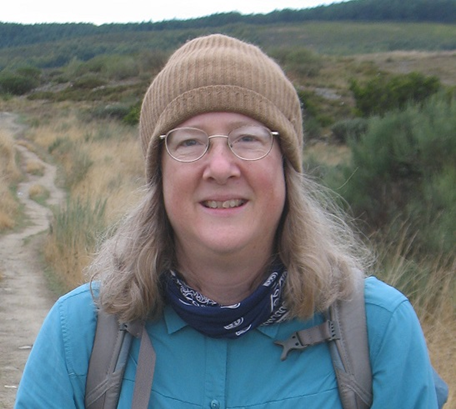
Please describe the courses you teach: Neotectonics and Seismic Hazards, California Geology, Advanced Geologic Mapping, Introductory Geology, Senior Seminar, Graduate Seminar, in addition to undergraduate and graduate research courses in geology.
Describe your teaching philosophy and any research interests related to your discipline or teaching. I seek to provide students the tools and scaffolding they need to be successful in the course. I see the hands-on laboratory activities as the most important part of my Neotectonics course, and most of the lectures are designed to prepare students to understand what we are doing in the lab. In the labs, students develop skills in recognizing and interpreting geologic relationships from remote imagery and in the field, particularly related to analyzing active faults and their seismic hazards. I provide extensive feedback to students as I grade the lab exercises and exams, and I tailor future lectures and lab exercises to reinforce concepts with which students are struggling.