Calculus 1, MATH 109
Calculus 1, MATH 109
Purpose: to help other instructors teaching the same course
Common Course ID: MATH 109
CSU Instructor Open Textbook Adoption Portrait
Abstract: This open textbook is being utilized in a mathematics course for undergraduate or graduate students by Dr. Kamila Larripa at Cal Poly Humboldt. The main motivation to adopt an open textbook was to help our students save money. Most student access the open textbook online, but it can also be downloaded for free as a PDF.
Course Title and Number - Calculus 1, Math 109
Brief Description of course highlights: Limits, continuity, derivatives, integrals and their applications. Additional information: This course explores the basic concepts of limits (including indeterminate forms), derivatives, and integrals. The topics covered will include graphs, derivatives, and integrals of algebraic, trigonometric, exponential, logarithmic, and hyperbolic functions. Applications will be covered, including those involving differentials, related rates, graphing, and optimization.
https://catalog.humboldt.edu/preview_course_nopop.php?catoid=10&coid=56939
Student population: This course has a prerequisite of Precalculus (MATH 102) or Trigonometry (MATH 101T) and serves students in various STEM majors, such as mathematics, data science, chemistry, physics, and engineering.
Learning or student outcomes: Upon completion of this course, you will be able to:
- compute limits of algebraic, exponential, logarithmic, and trigonometric functions.
- calculate derivatives of algebraic, exponential, logarithmic, and trigonometric functions.
- evaluate integrals of algebraic, exponential, logarithmic, and trigonometric functions.
- apply derivatives and integrals to solve physics, economic, geometric, and/or other problems.
- prove basic theorems related to limits, continuity, and differentiability, including delta-epsilon proofs.
- reduce a general problem to a specific answerable question
- synthesize and present results of analysis in written and oral form
This course is also an Area B GE Math & Quantitative Reasoning course and therefore upon completion students will: - use skills beyond the level of intermediate algebra to solve problems through quantitative reasoning.
- apply mathematical concepts and quantitative reasoning to problems.
Instructor Name - Dr. Kamila Larripa. Associate Professor of Mathematics at Cal Poly Humboldt. 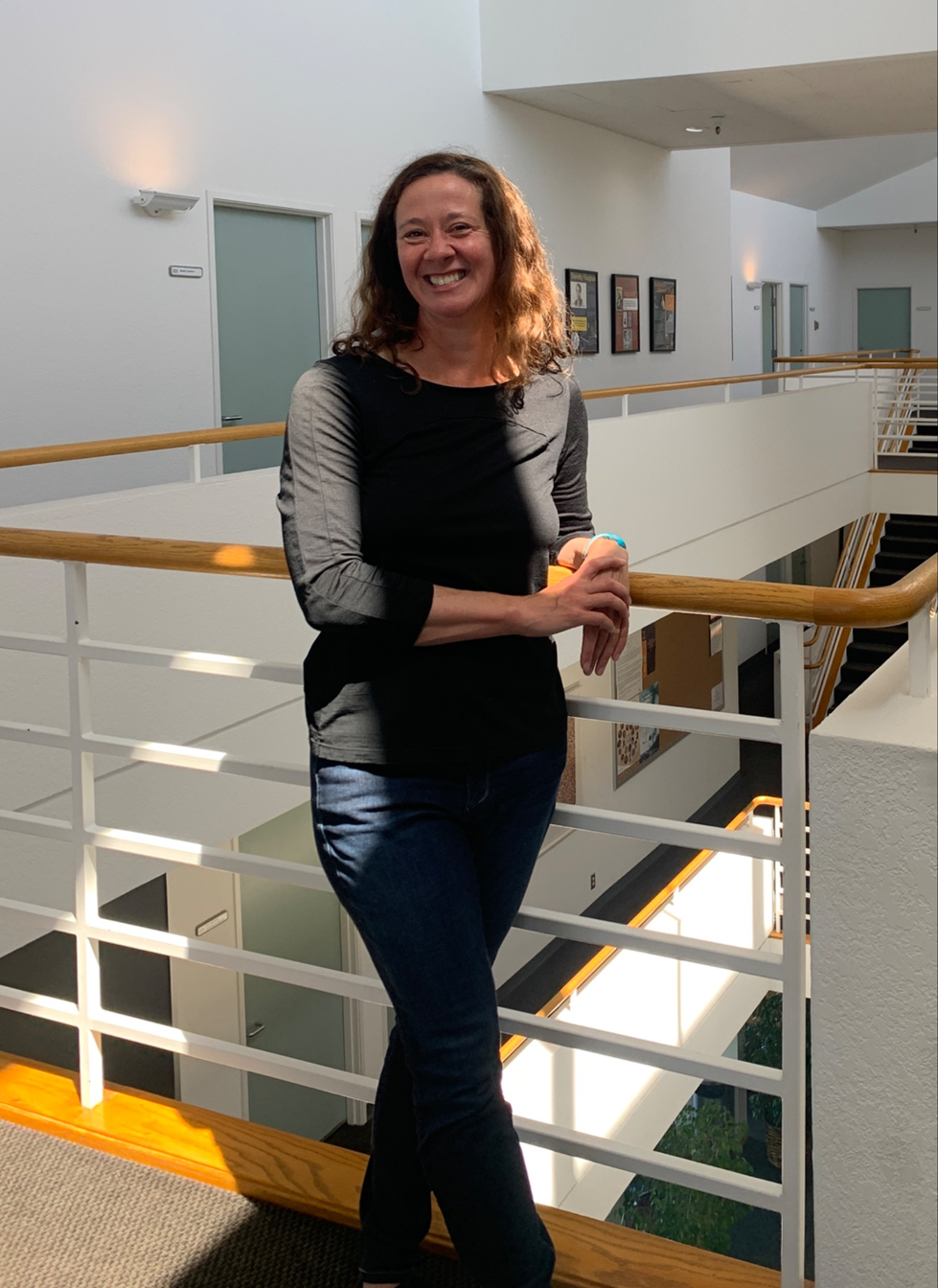 Please provide a link to your university page.
https://sites.google.com/humboldt.edu/kamilalarripa
Please describe the courses you teach I teach both major and nonmajor mathematics courses, and teach introductory as well as advanced courses. My favorite courses explore how mathematics can capture the complexity of systems.
Describe your teaching philosophy and any research interests related to your discipline or teaching. I am an applied mathematician working at Cal Poly Humboldt in Northern California. I regularly teach Precalculus, Calculus, Linear Algebra, Ordinary Differential Equations, Mathematical Modeling, and our Introduction to Data Science course. My research work is motivated by biological problems. Some of my current projects include developing and analyzing models related to cancer cell metabolism, macrophage phenotype commitment, and stem cell signaling. I especially love working collaboratively with biologists and including undergraduate students in my research projects. When I teach, I love to show students relevant applications of mathematics to other fields.
OER/Low Cost Adoption Process
Provide an explanation or what motivated you to use this textbook or OER/Low Cost option. Our department made this decision for all our calculus courses to save students money and make the class more accessible.
How did you find and select the open textbook for this course? Our department evaluated a number of textbooks and collaboratively chose this one.
Sharing Best Practices: It is great to share resources and information with other faculty. Canvas Commons and Merlot are two nice resources for sharing materials.
Textbook or OER/Low cost Title: Calculus, Volume 1
Brief Description: This textbook is designed for a typical two or three semester general calculus series. Volume 1 corresponds with the first semester of calculus. Problems from the textbook are integrated into our Canvas class page under assignments using MyOpenMath. This means the online homework system is free for students and relates to the topics in the text.
Please provide a link to the resource https://openstax.org/details/books/calculus-volume-1
Senior Contributing Authors:
Gilbert Strang, Massachusetts Institute of Technology
Edwin “Jed” Herman, University of Wisconsin-Stevens Point
Contributing Authors
Joseph Lakey, New Mexico State University
Elaine A. Terry, Saint Joseph’s University
Alfred K. Mulzet, Florida State College at Jacksonville
Sheri J. Boyd, Rollins College
Joyati Debnath, Winona State University
Michelle Merriweather, Bronxville High School
David Smith, University of the Virgin Islands
Nicoleta Virginia Bila, Fayetteville State University
Valeree Falduto, Palm Beach State College
Kirsten R. Messer, Colorado State University-Pueblo
William Radulovich, Formerly at Florida State College at Jacksonville
Erica M. Rutter, Arizona State University
David Torain, Hampton University
Catherine Abbott, Keuka College
Julie Levandosky, Framingham State University
David McCune, William Jewell College
Student access: Students can access the textbook from our Canvas class page. It is also available for free online without using the course management system through the OpenStax webpage.
Supplemental resources: Supplementary resources are homework problems from the text integrated into our Canvas class page using MyOpenMath, which makes the online homework free for students.
Provide the cost savings from that of a traditional textbook. Before adopting this book, our department used the James Stewart Calculus book, which covers the three semesters of calculus. It is currently $219 from Amazon.
License: Calculus Volumes 1, 2, and 3 are licensed under an Attribution-NonCommercial-Sharealike 4.0 International License (CC BY-NC-SA), which means you can share, remix, transform, and build upon the content, as long as you credit OpenStax and license your new creations under the same terms.