Queer Across Cultures ANTH 329
Queer Across Cultures ANTH 329
Purpose: to help other instructors teaching the same course
Common Course ID: ANTH 329
CSU Instructor Open Textbook Adoption Portrait
Abstract: A variety of educational materials are being utilized in an anthropology course for both undergraduate or graduate students by Henry Solares at Cal Poly Humboldt. The materials utilized are sourced from the course reserves and general holdings of the Cal Poly Humboldt Library, chapters from books accessed through Interlibrary Loan, and departmental holdings of films and videos through Panopto. The main motivation to adopt an open textbook was to keep a special topics course straightforward (both for new scholars to the field and those not within the discipline) and to ensure access to course materials for students with little to no economic resources for books and supplies. Most student access the materials through a well designed canvas course that has links to accessible files, films/videos, and open source repositories of images and resources.
Course Title and Number: Queer Across Cultures ANTH 329: Special topics in anthropology
Brief Description of course highlights: Special Topic: Queer Across Cultures - A survey course on understandings of queerness across culture areas, the intersections of racism/disability with queerness, indigenous queer embodiment, and how AIDS has impacted cultural beliefs around queerness.
Student population: Historically my courses have gathered students from Psychology, Individualized Degrees, Anthropology (from the four sub disciplines), and from select master’s programs. Teaching in an online only format lends itself to working with transfer students, non-traditional students, and students from across California. I get a majority Anthropology students in my courses but the other majors taking my courses keep me honest to keeping the course accessible to folx outside of the major. This semester is no different.
Learning or student outcomes: List student learning outcomes for the course.
- (SLO 1) Apply anthropological concepts to describe how cultural systems and structures construct reality differently for diverse human groups.
- (SLO 3) Analyze anthropological data in order to explain the processes that shape biological, behavioral, and cultural change.
- (SLO 5) Apply anthropological skills and knowledge to address problems and issues in classroom, field, research, and in applied settings.
Key challenges faced and how resolved: Working with free, library based resources, and the like provide their own pedagogical challenges in terms of making sure that as an instructor you are offering dynamic assignments that actively reflect the purpose of the readings/films/videos you are presenting. For the courses, I am teaching there are not specific textbooks (that I have seen or heard of) as they are special topics which requires leaning on other folx and mentors about how it might have been taught in the past, finding appropriate and free resources that help tell the “story” of the course, and weaving them all together to tell a coherent story for the students alongside recorded lectures to do the heavy lifting of the context students are missing.
Textbook or OER/Low cost Title: Low cost/free resources available through Interlibrary Loan, Panopto reserves, Kanopy, campus library holdings (physical and digital), other campus’ open resource holdings, and the Internet Archive as is accessible and available. Those resources were linked via Canvas. I also have utilized skillshops in collaboration with our librarians here on the Cal Poly Humboldt campus. I have provided a few examples of resources I have used for this semester.
Brief Description: The low cost options utilized reflect a pedagogical approach that tries to utilize older films and then provide modern contexts to said films with either follow up films, websites, taped interviews, social media posts, and the like. Pairing older materials with fresh materials allows students to see change over time and what stands still.
Please provide a link to the resource
Video 1081: Orientations by Richard Fung, 4th AAIVF: Asian CineVision Records: NYU Special Collections Finding Aids This film is a nice compliment to the modern film Reoritentations by Richard Fung made/published in 2016. The Reorientations film is a follow up documentary that interviews folx from the original film.
Welcome - SkillShops - Research Guides at Cal Poly Humboldt I used the one about how to do research using our oncampus OneSearch research portal and also assigned an optional skillshop on how to read scholarly articles for those who might not have had the practice.
How Naomie Harris Filmed Her Stunning Moonlight Role in Just 3 Days
"Moonlight" writer on its origin and critical success An article and youtube video that contextualized a film that I assigned in the course to supplement understanding the importance of the the films impact and what makes it relevant to anthropological inquiry. I had to get the YouTube video transcribed by the ARC (Accessibility Resource Center) but it was worth it for the students to understand the perspectives of those involved with the chosen film.
5 Queer People on Why Coming Out and “the Closet” Are More Complicated Than You Think | Them An article that helped update expectations around american concepts of what it means to be queer (in the reclaimed use of the term).
BAAITS Powwow - YouTube I also utilized some recordings from the BAAITS (Bay Area American Indian Two-Spirit) Powwow youtube channel that is available to the public but that I have utilized at least one video captioned and transcribed for accessibility purposes. Given that many cultures are often described from without, the youtube channel utilized by the BAAITS allows my students the chance to hear from indigenous people themselves about practices and experiences they have honed and developed for their communities.
Student access: The students access all of the materials via the Canvas LMS and through our university based streaming service Panopto. Students are given links that allow them to access course materials from their phones, laptops, and tablets through a simplified and effective lesson based page that overrides the need for modules. I was taught by my department chair and the instructional designers to make the canvas pages I have lined up in either unit form or in lessons. In other words, trying to make sure students have an easy way to navigate multiple disparate resources either housed by links to outside websites (properly vetted), files uploaded to the course, or links to campus based streaming resources.
Supplemental resources: One supplemental resource that has been supportive to students has been my custom glossary which I learned about from Val Marjorie’s Essential of Online Course Course Design. It takes effort and focus on course/discipline specific terminology but when you integrate the glossary into your quizzes or assessments (making sure that you let them know about the glossary and that they will be quizzed by the contents), it becomes something they will actually use. The course design book informed me that it allows new-to-the-field learners and English as a second language learners the chance to have a living resource that allows them to overcome English idioms, your definition vs discipline definitions, and saves you explanation time.
Provide the cost savings from that of a traditional textbook. It is a special topics course with no equivalent traditional book to compare. But if comparing it to the average cost of a textbook for this course, the savings is $105.37.
License: Curated materials with various licenses.
OER/Low Cost Adoption Process
Provide an explanation or what motivated you to use this textbook or OER/Low Cost option. I utilized low cost resources or OER resources because I wanted to save money for the students I work with, especially as I have been teaching special topics courses and the books that are available would be cost prohibitive and too specific for the average undergraduate student. There are many different majors that take our courses in anthropology and so having books and materials that are too major specific could alienate other students.
How did you find and select the open textbook for this course? I consulted with research/collection specialist librarians extensively to find and/or purchase film/books/articles, borrowed several books from the InterlibraryLoan system to check out books ahead of time and then borrow selected chapters as is appropriate/legal to share with students, looked on our library’s website related to OER resources to help understand the capacity for OER resources, and leaned on an old syllabus which utilized classics that were provided via online course reserves which gave students access to either print or peruse via their devices.
Sharing Best Practices: Planning ahead is always a consideration of course planning but when it comes to making sure resources are accessible, it requires you to have backups in terms of text resources if your visual resources aren't processed in time or you forget to send them over!
Describe any key challenges you experienced, how they were resolved and lessons learned. Accessibility of the resources you use is both a legal requirement and a challenge in terms of gathering free or low cost resources, we can’t assume works sourced from ILL or articles via JSTOR and other databases are screen reader friendly. In addition, recording your own short lectures can really push you to know your resources and material but making sure that those lectures are captioned correctly for those who need it requires long term planning and coordination with your local Accessibility Resource Center (or campus equivalent). Having a good relationship with your ARC staff allows for clear communication around busy times (when they have a lot on their place) and when they don’t have as much on their plate (so that they can process your documents or visuals with ample time).
In addition, a large challenge of teaching with low cost and OER components means knowing your materials really well and trying to make sure as you are doing course development, that you integrate them well. By that I mean making sure that the course’s “story” is weaved well throughout all of the resources you are providing, so that even if it is patchwork, often times you can find a thread in your resources that connects them all to your course description if not final project/presentation. This takes time to do, when juggling new courses, this means taking notes on your readings (from a course design/flow perspective) and also not being afraid to double dip on resources if there are components or chapters that might work well for assignments in other courses you teach.
Another challenge with OER resources and specific sub fields is that your materials available that are OER might be older but that shouldn’t limit its inclusion. Its really time consuming but I think its rewarding to look into the resources and authors of said books or article writers and see if they have improved on their past works or can lead you to others who might have taken their work and pushed it forward.
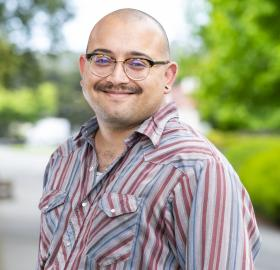
Instructor Name - Henry Solares
I am an Anthropology professor at Cal Poly Humboldt.
 Please provide a link to your university page.
https://anthropology.humboldt.edu/people/henry-solares
Please describe the courses you teach - ANTH 329 Visual Anthropology: Applications in Ethnography: Anthropology is often written but not always seen. This course explores comics, film, photography, and marketing as subjects and tools for the multi-media anthropologist; in America and beyond. This was the first course I taught and the most challenging for that reason, I had some experience in course design through an undergraduate work experience opportunity in instructional design, so it wasn’t impossible.
ANTH 329 Queer Across Cultures; A survey course on understandings of queerness across culture areas, the intersections of racism/disability with queerness, indigenous queer embodiment, and how AIDS has impacted cultural beliefs around queerness. This is my second course and is both a call back to an old course I took when I was in undergraduate and a push to test my skills in working with a difficult topic during this time. I have found it worth the effort but extremely difficult.
ANTH 329 Critical Archival Studies: Critical Archival Studies engages with archival studies via post-colonial theory and study of power in the historical record. The course reviews Humboldt’s Special Collections, digital archaeology, tribal constitutions, and more. This course is going to be a favorite of mine because it reflects a commitment to understanding the power of material knowledge in the same way that Michel Foucault navigates archival and historical record. The difficult part will be in making it accessible for both undergraduate and graduate students that will be enrolling in the course.
ANTH 676 Anthropological Engagements: Explore forms of anthropological engagement, such as: collaboration, advocacy, activism, support, and education. Evaluate approaches to engaging the public, community partners, and clients. Study methods for informing, designing, and facilitating events, meetings, courses, workshops, and informational resources. This is a new course that I am designing but I am excited to give insight into how to do applied anthropology on the more nuanced side of what it means to be a leader, in terms of technical and soft skills.
Describe your teaching philosophy and any research interests related to your discipline or teaching. My teaching philosophy is inspired by my mentors in my bachelor's and master's programs (who focused on applied perspectives and the importance of listening to indigenous folx/knowledge builders), Small Teaching principles, radical pedagogies, indigenous teaching philosophies (like those from Vine Deloria Jr), a strong focus on the fundamentals of teaching, and consistent evaluation beyond just the end of semester surveys but also working closely with instructional designers to evaluate practices. I am determined to spend my teaching career continuing to develop my teaching competencies in the online realm and when I get the chance to teach in person, I will be taking advantage of either flipped classrooms or with short lectures in tandem with practical activities.