
ES 100: The Earth and Its Place in the Universe
ES 100: The Earth and Its Place in the Universe
Purpose: to help other instructors teaching the same course
Common Course ID: ES 100
CSU Instructor Open Textbook Adoption Portrait
Abstract: This open textbook is being utilized in an Earth Science course for undergraduate or graduate students by Heather Cook at CSU San Marcos. The open textbook provides quality information related to course topics. The main motivation to adopt an open textbook was to increase student engagement with weekly readings while saving them money. Most students access the open textbook online.
Course Title and Number: ES 100: The Earth and Its Place in the Universe
Brief Description of course highlights: Provides an introduction to the various areas of earth science including our place in the universe, structure and composition of the earth, earth’s atmosphere, and earth’s water systems. Subjects to be covered include: astronomy, geology, seismology, plate tectonics, the seasons, climate, weather, tides, oceans, and the characteristics of rivers, lakes, and estuaries. This course satisfies the earth science content requirement for candidates in the Multiple Subject Teaching Credential Program. https://catalog.csusm.edu/content.php?filter%5B27%5D=ES&filter%5B29%5D=100&filter%5Bkeyword%5D=&filter%5B32%5D=1&filter%5Bcpage%5D=1&cur_cat_oid=1&expand=&navoid=13&search_database=Filter#acalog_template_course_filter
Student population: There are no prerequisites for ES 100. Liberal Studies and Environmental Studies majors have the option to take this class as part of the subject area requirements. Most students are freshman or sophomores, but students of all levels enroll each semester.
Learning or student outcomes:
General Education Learning Outcomes: Upon successful completion of this course, students will be able to:
- Describe and/or apply principles and methods that are necessary to understand the physical and natural world.
Course Learning Outcomes: Upon successful completion of this course, students will be able to:
- Explain Earth’s place in the universe.
- Identify basic Earth materials.
- Discuss the transfer of matter and energy between various Earth systems and reservoirs.
- Summarize the dynamic processes of the solid Earth, oceans, and the atmosphere.
- Define geologic time and identify significant events in Earth’s history.
- Demonstrate appreciation for the Earth as a system and as our home.
Key challenges faced and how resolved: It was challenging to find a single open-source textbook that covered the content necessary for ES 100. Instead, a selection of credible websites and selected chapters from OER books are used.
Syllabus and/or sample assignment 2024-25 ES100_H.Cook_ Syllabus.docx
Textbook or OER/Low cost Title: A variety of educational and government websites are used in ES 100 in addition to selected chapters from An Introduction to Geology by Chris Johnson, Matthew D. Affolter, Paul Inkenbrandt, and Cam Mosher at Salt Lake Community College. The full list can be seen above.
Brief Description: For ES 100, I used a collection of education and government websites in addition to selected chapters from an OER text. I selected readings that are accessible, information-dense but understandable, and come from a variety of sources to try to maximize student engagement and participation in reading.
Please provide a link to the resource Please see the list in the the syllabus section (attached)
Authors: Please see the list in the the syllabus section (attached)
Student access: Students access the materials either through links embedded in the syllabus or links provided in the weekly modules in Canvas.
Supplemental resources: In addition to the cost-free readings, students are asked to purchase ($30) access to the learning tools associated with Earth Science 3rd edition by Marshak and Rauber by W.W. Norton Company. The learning tools include videos, animations, and access to guided learning explorations.
Provide the cost savings from that of a traditional textbook. $140
License: An Introduction to Geology is an open textbook with 
The other readings listed are copyrighted but available freely online through government and educational websites.
OER/Low Cost Adoption Process
Provide an explanation or what motivated you to use this textbook or OER/Low Cost option.
During and after the pandemic, I noticed that students were not regularly engaging with assigned readings in the textbook. This coupled with the fact that the bookstore refused to offer the textbook as the much cheaper online digital package I requested, prompted me to switch to a low-cost option. I hoped to both save students money and increase student engagement with readings by offering a variety of engaging sources customized for each week’s content.
How did you find and select the open textbook for this course?
I consulted with our librarians, browsed OER sites, and evaluated websites to find reading for ES 100.
Sharing Best Practices:
I wish I had embraced a piecemeal approach sooner. When searching for an OER option for ES 100, I initially tried to find a single online textbook. I eventually realized that my students would be better suited using a collection of resources, and I am happy with the result.
I was also initially hesitant to use any for-purchase options, but I do ask that students purchase access to the learning tools associated with a textbook. This costs $30 and provides students with a wealth of resources and study aids including videos, animations, quizzes, and real-world scenarios. It is a nice compliment to the readings, and I assign content from the learning tools package every week.
Describe any key challenges you experienced, how they were resolved and lessons learned.
It was challenging to find a single open-source textbook that covered the content necessary for ES 100. Instead, a selection of credible government and educational websites and selected chapters from OER books are used. While my initial goal was to find a single OER textbook, I am happier with the selection of readings I now use.
Instructor Name: Heather Cook
I am a Earth Science professor in the Department of Chemistry and Biochemistry at the California State University San Marcos. 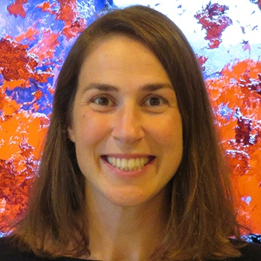
Please provide a link to your university page.
https://www.csusm.edu/
Please describe the courses you teach
I teach ES 100: The Earth and Its Place in the Universe. The class introduces students to the fields of geology, oceanography, meteorology, and astronomy.
Describe your teaching philosophy and any research interests related to your discipline or teaching.
I believe in engaging, student-centered teaching that stimulates curiosity and leads to a greater understanding of and appreciation for the natural world. I teach Earth Science classes. My research interests are in volcanology.