
Ancient Egyptian Archaeology
Ancient Egyptian Archaeology
Purpose: to help other instructors teaching the same course
Common Course ID: History=Anthropology 3360
CSU Instructor Open Textbook Adoption Portrait
Abstract: Instead of students purchasing a textbook, students read articles on specific topics written by the specialist, and they read a few select chapters from the standard textbooks. This allowed students to engage more with the primary data of the class and understand how history is written. Additionally, students engaged in multiple contradictory histories written by different authors that they then discussed and debated. All PDFs were provided on Canvas taking into account all proper copyright issues.
Course Title and Number: History=Anthrpology 3360, Ancient Egyptian Archaeology
Brief Description of course highlights: People around the world recognize Egypt’s fascinating pyramids, temples, and tombs, but it also had cities, fortresses, palaces, potters, granaries, and even interesting trash. The exceptional archaeological record of ancient Egypt informs us greatly about daily life, crafts, and the economy. In this class, students will study the Egyptian archaeological record to learn about that society’s history, culture, and religion.
Because ancient Egypt’s archaeology represents 5000 or more years of history and culture, we cannot study everything. This class will abandon the traditional chronological telling of Egyptian history. Instead, lectures will focus on influential case studies and themes, each of which investigates how archaeology gives us insights into the history and society of the past. This approach will enable us to delve into the details of other fascinating archaeological subjects, and it will also enable students to understand why archaeology is important for understanding ancient societies; these are themes that can be applied to many other civilizations.
Additionally, students’ semester long projects will revolve around evaluating Wikipedia and improving Wikipedia’s entries dealing with Ancient Egyptian archaeological sites. This high impact practice will teach students transferable skills that help them contribute to universal knowledge while giving students the tools and confidence to understand and contribute to Wikipedia.
Student population: History and Anthropology majors
Learning or student outcomes: List student learning outcomes for the course.
Knowledge
1.1 Students will acquire knowledge of relevant archaeological contexts to help understand the history, society, religion, and culture of Ancient Egypt.
1.2 Students will gain the ability to frame historical and archaeological questions.
1.3 Students will demonstrate an awareness of archaeological interpretative differences.
Research
2.1 Students will demonstrate the ability to use a broad range of historical and archaeological sources.
2.2 Students will demonstrate the ability to evaluate and analyze primary historical and archaeological sources.
2.3 Students will demonstrate the ability to develop an historical interpretation based on evidence.
Communication
3.1 Students will demonstrate the ability to write clearly, in written assignments.
3.2 Students will demonstrate the ability to speak clearly, through discussion and presentations.
Key challenges faced and how resolved: Individual articles are great, but they offer varying types of information from different voices. So my short lectures were necessary to bring together the content.
Syllabus and/or Sample assignment from the course or the adoption [optional]: To illustrates how the open textbook is used in the course.
Textbook or OER/Low cost Title:
Brief Description: I have eliminated the textbook and chose to read scholarly articles instead. None of these individually break copyright. And the continuity comes through my teaching. The Old Book: Most other classes on Ancient Egyptian archaeology assign students: Kathyrn A. Bard, An Introduction to Ancient Egyptian Archaeology, second Edition, $57.95 on amazon. This book is both expensive and partly out of date.
Please provide a link to the resource It is helpful to provide a link to the resource(s) for others wishing to implement your OER.
Authors:
Student access: Students were provided access to all the course materials as PDFs on Canvas for free. All of the PDFs were OCRed and accessible for visually impaired students
Supplemental resources: We are also incorporating a Wikipedia assignment where they are using primary sources for their research and checking books out of the library.
Provide the cost savings from that of a traditional textbook. In Fall 2024, 16 students were enrolled in History=Anthropology 3360. This practices saved the students a total of $927 for that term alone. This class is taught every two years. Over the next decade, our students will save over $5000.
Instead of having students purchase this book, I implemented three, free strategies to assist with student learning:
- Reading and discussion of more primary texts and original archaeology reports for students to analyze themselves
- Reading and discussion of articles written by specialists on specific topics
- Lectures overviewing large subjects and reading of occasional chapters from the textbook for continuity of the course material.
License: Specify the license for the material. (i.e. Creative Commons license). For more information on CC license go to https://creativecommons.org/
OER/Low Cost Adoption Process
Provide an explanation or what motivated you to use this textbook or OER/Low Cost option. I wanted the students to save money and to learn from the original source and original scholar who worked on that problem.
How did you find and select the open textbook for this course? I’m an academic and know how to search for things in my field on my own. But for others, start with the Online Egyptological Bibliography.
Sharing Best Practices: Focus on your learning outcomes for the students. Often the textbook only teaches content. Approaching the class from a different direction teaches skills.
Describe any key challenges you experienced, how they were resolved and lessons learned. By providing lots of articles from different scholars, there is not overarching narrative for the students to follow. So many of my lectures are connecting the readings, then we do deep dives in the readings.
Instructor Name; Kate Liszka
I am a History professor at the California State University, San Bernardino. I teach lots of classes on Ancient Egypt including history, art, and archaeology.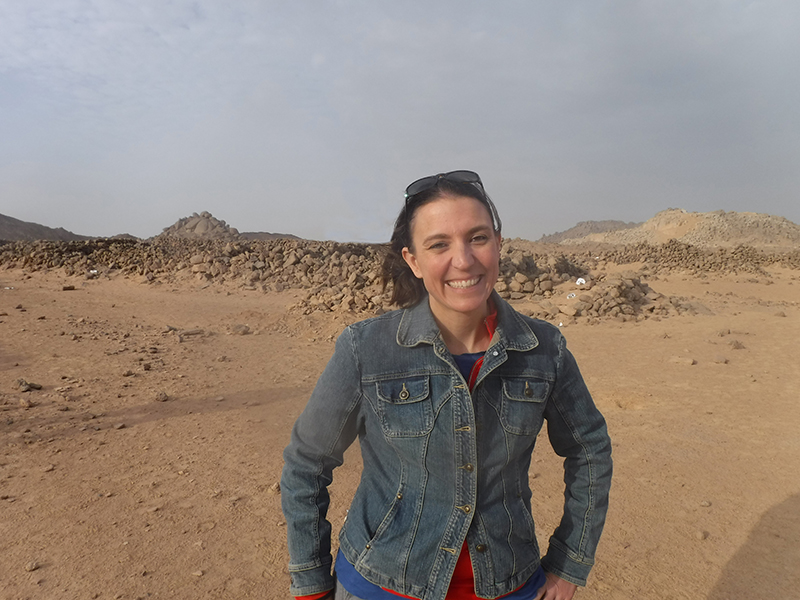
Please provide a link to your university page.
https://www.csusb.edu/profile/kate.liszka
Please describe the courses you teach: I teach a lot of fun and engaging courses on ancient Egypt where students use primary sources to write their own versions of history.
Describe your teaching philosophy and any research interests related to your discipline or teaching. I have nearly 15 years of experience teaching a variety of courses on Ancient Egypt to various sizes of classes, to students on a variety of levels, and both in person and online settings. My courses are designed pedagogically for students to learn both the primary data/content of the course and why scholars argued for their specific versions of history. I pursue these goals using a variety of exercises. In advanced classes, students are taught to make their own arguments and create their own versions of history from the primary data. Students are graded, less on the reiteration of historical content, but rather on their use of primary data and the quality and logic of their arguments about the past. For example, when I teach the History of the Egyptian New Kingdom, students spend a week reading five different versions of the decade of history after the death of Akhenaten. This was a tumultuous time, and most scholars disagree with each other even on the basic facts of what happened. In class, we then debate what primary evidence is significant for establishing these basics, and we analyze the use of the primary evidence in the scholars’ arguments. Students then write their own versions of that decade of history specifically paying attention to why they support their particular version.