
Reading Apprenticeship Inspired Assignment or Lesson
Reading Apprenticeship Inspired Assignment or Lesson
Conversation helps learning by allowing individuals to actively process information, articulate their thoughts, receive feedback, clarify concepts, and build upon existing knowledge through a dynamic exchange with others, essentially creating a deeper understanding by engaging in a two-way dialogue rather than passively receiving information; it also promotes critical thinking, vocabulary development, and social skills.
Building academic language in biology ignites neural processing capacities; conversations about biology literally change the way our brains think about biology. In Reading Apprenticeship, the social and personal dimensions overlap with the cognitive and knowledge building dimensions. This work emphasizes to connections that students are making:
Building a community of readers:
Encouraging students to see themselves as part of a group working together to understand texts, where everyone's contributions are valued.
Peer interaction and collaboration:
Utilizing group discussions, partner work, and other collaborative strategies to learn from each other's perspectives and insights.
Respecting diverse knowledge:
Recognizing that students come from different backgrounds and experiences, and valuing the unique knowledge they bring to the reading process.
Metacognitive conversation:
Engaging in discussions where students actively reflect on their own thinking processes and strategies while reading, helping them to understand how others approach texts.
This course is the first semester of a two-semester core biology series. The course examines cell structure and function; cellular respiration and photosynthesis; cell signaling and reproduction; transmission and molecular genetics, transcription and translation; control of gene expression; biotechnology; comparative animal form and function; and animal development. Weekly during the semester, students identify a term from class lecture or discussion. They use that term in a conversation with someone outside of class. It could be a family member or a friend or even a stranger. Then, the student summarizes the conversation in a metacognitive journal entry (see examples below), detailing the word, the chapter it was from, a description of the conversation, the response from the person they were talking with, a link to media using the term, and what the term means to them.
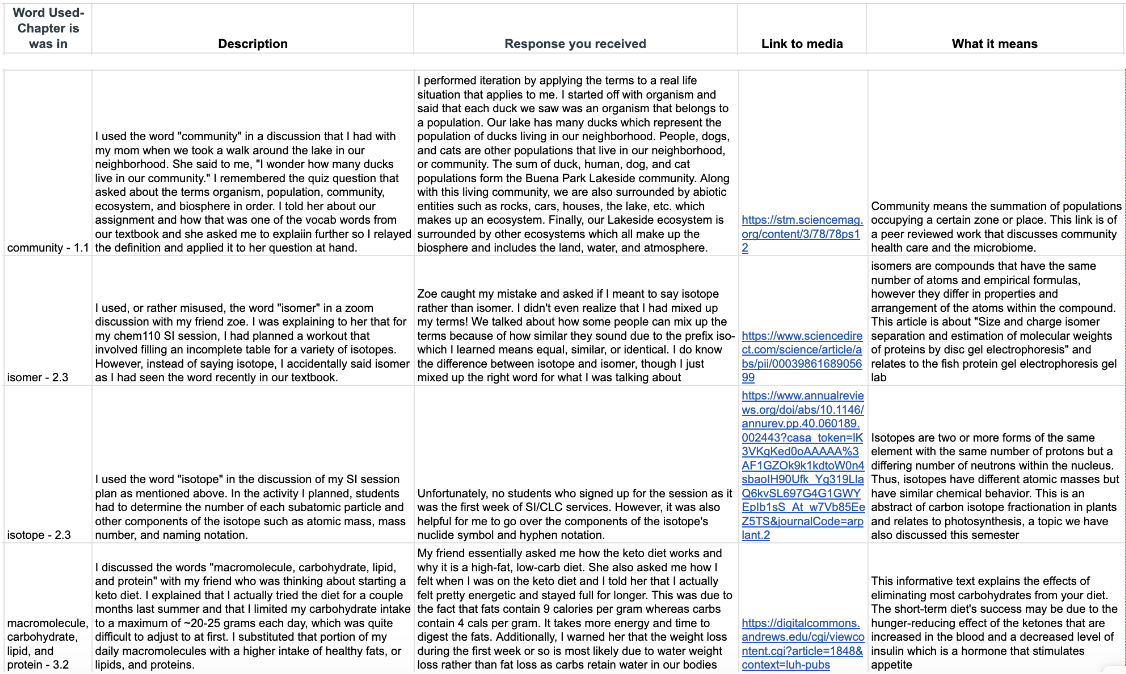
While this assignment could be scored using a rubric, in this context students complete the assignment and earn 5 points per entry. In my syllabus, this represents 9% of their total grade in the course.

In “biology conversations”, we are being intentional and taking time to talk about what we are learning. These conversations lead to more opportunities to gather new points of view, think, and reflect. By doing so, students often generate their own insights. The reflection time and the self-generated insights helps increase their understanding.
In this activity students integrate metacognitive awareness through its four dimensions, helping learners monitor and reflect on their own thinking processes while learning. For conversation, it provides a structured approach for meaningful dialogue by: balancing social interaction with personal reflection; incorporating explicit cognitive strategies; and building shared knowledge through discussion.
Using a google doc or a google sheet, students create a metacognitive journal recording their weekly conversations answering the following prompts: 1) What is the word or term from class?; 2) In what chapter of our text is the word or term found?; 3) Describe your conversation-What did you say?; 4) Describe the response you received-What did they say?; 5) Provide an example of media using the term; and 6) What does the word or term mean? Here is an example.
OpenStax CNX - Biology Over thirty open textbooks covering Biology.
Life: The Science of Biology Twelfth Edition. Authors: David E. Sadava, David M. Hillis, H. Craig Heller, Sally D. Hacker.
https://kids.frontiersin.org/articles/10.3389/frym.2022.639598