
Reading Apprenticeship Inspired Assignment or Lesson
Reading Apprenticeship Inspired Assignment or Lesson
In this activity, we evaluate claim, evidence, and reasoning statements as a method to activate metacognitive conversations. Students will gain additional perspective and learn to interrogate their thinking. The activity can be readily adapted to many different bodies of knowledge. Continuous improvement of argumentation involves making a claim, providing evidence to support it, and explaining how and why the evidence supports the claim. When students evaluate their own thought processes and monitor their own thinking, this is metacognition. As a learning strategy, this process helps refine cognitive abilities, and asks students to record "thinking about their thinking" by documenting their understanding, challenges, and approaches to a task or learning situation, allowing them to identify areas for improvement and better regulate their learning process.
This activity can be used at many different points during the term. This activity is appropriate any time in the semester, as long as group norms have been set and students are accustomed and comfortable with sharing their thinking in class. In Biochemistry, students utilize this inquiry associated with Pattern of Inquiry assignments where they are answering questions about content associated with Bloom’s Taxonomy: Remember, Understand, Apply, Analyze, Evaluate, and Create (Anderson et al., 2001). Often the first time a student answers these questions there are gaps or misconceptions. A metacognitive journal/log provides the opportunity for students to “think about their thinking” and address inconsistencies. Using this process, students identify areas for improvement, develop better learning strategies, and gain a deeper understanding of their own learning process.
Anderson, L. W., Krathwohl, D. R., & Bloom, B. S. (2001). A taxonomy for learning, teaching, and assessing: A revision of Bloom's taxonomy of educational objectives. New York: Longman.
Students apply claim evidence and reasoning (CER) to a topic. Then, students evaluate the CER using a metacognitive log. These questions help students chain walk through ideas and evaluate their merit. The instructor can get basic insights on student engagement in the activity on their learning management system. Then, during class conversation, more nuanced information about student questions and observations can be recorded. Here is the rubric used associated with claim evidence and reasoning.
This series of questions is designed to stimulate metacognitive conversations in class in three key ways. First, by introducing new ideas before class time, students have additional thinking time to engage with new ideas. Second, by exploring low stakes, "no wrong answers" discussion prompt to start a class meeting, students have an on-ramp to get talking early on, even with challenging complex ideas. Instructors have the opportunity to take the metacognitive conversation deeper in their facilitation. Follow-up questions can draw out more detailed responses or nudge students into deeper thinking about their thinking. Third, the metacognitive journal/log helps students to see the progression from their initial/prior knowledge through making connections to new knowledge and, ultimately, integrating and/or synthesizing information.
The first step in this activity is an out-of-class assignment: read a text and identify a golden line. This can be assigned at the end of one class meeting in anticipation of the next meeting. Putting the assignment online in a learning management system builds in some added accountability for students because students can be asked to share their golden line ahead of time. The second ingredient is a class discussion. Students should be placed into groups and asked to share both their golden line and why they chose it. From here, the instructor should facilitate a conversation, surfacing themes and questions that students identify. The third step is students use of the metacognitive journal/log to record the progression of their thinking.
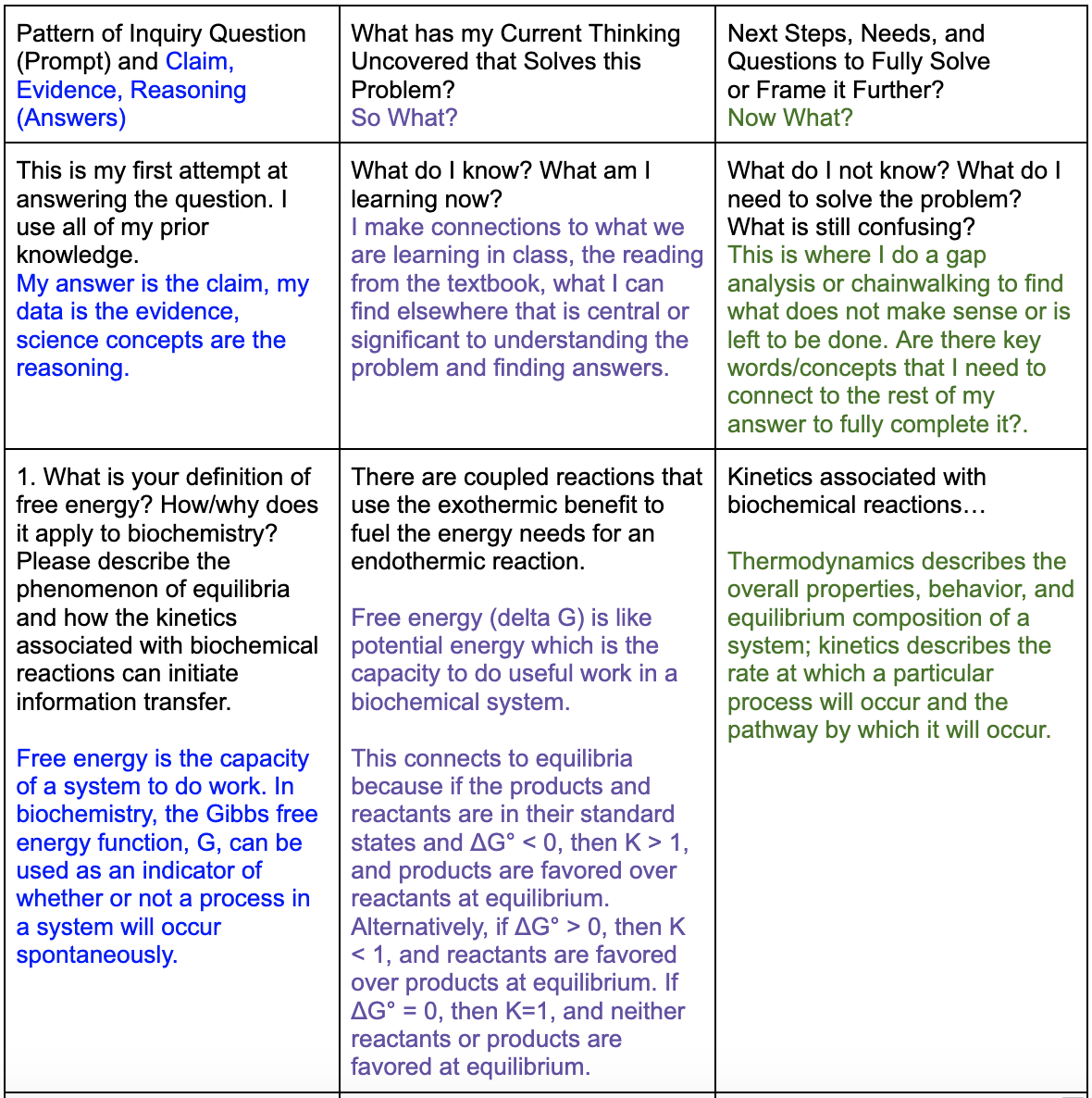
Assignment prompt: Create a claim, evidence, and reasoning statement. Where the claim is your “answer”, the evidence is your data or how you know, and the reasoning are the concepts or ideas that help your argument make sense.
Using Metacognition to Build the Layers of an Answer to a Problem like the Steps in Constructing a Layer Cake


For example, in our unit on bioenergetics and the transfer of energy, students explored the concept of free energy. Here is an example of their claim evidence and reasoning (CER) in response to reading about free energy in the context of biochemistry.
https://open.umn.edu/opentextbooks/textbooks/866
https://bio.libretexts.org/Bookshelves/Biochemistry
Mathews, C. K., Van Holde, K. E., & Ahern, K. G. (2000). Biochemistry (3rd ed.). San Francisco, Calif: Benjamin Cummings.
Nelson, D. L., & Cox, M. M. (2017). Lehninger principles of biochemistry (7th ed.). W.H. Freeman.
Berg, J.M., Tymoczko, J.L. and Stryer, L. (2002) Biochemistry. 5th Edition. W. H. Freeman Publishing, New York.
Voet, D., Voet, J. G., & Pratt, C. W. (2016). Fundamentals of biochemistry (5th ed.). John Wiley & Sons.