2023-2024 — Northridge— Online Course Services ePortfolio
2023-2024 — Northridge— Online Course Services ePortfolio
Proposal Summary: At CSUN, we proposed to continue to promote Quality Learning and Teaching (QLT) as the campus best practices framework by reaching more unserved faculty and new faculty across all departments and disciplines. We also sought to encourage more faculty peer-to-peer discussions of online best practices and equity-minded teaching through our faculty mentors. Last year, we served 39 faculty members in our two eLearning Institute cohorts, helping them conduct a QLT self-review and participate in an internal peer review/mentoring for their courses for the first time. We also piloted a new advanced version of the eLearning Institute for 16 faculty who wanted to continue to work on a course that they previously worked on in an eLearning Institute. Additionally, we created and implemented a QLT student survey in our eLearning Institute and collaborated with Online Course Services to pilot a QLT Core 24 Prep Review.
Campus Goals for Online Course Services
We established two primary goals for our campus:
The first goal was to continue to promote QLT as the campus best practices framework by reaching more unserved faculty and new faculty across all departments and disciplines. We achieved this goal by offering various professional development programming as well as creating and updating resources for faculty such as:
- eLearning Programs (e.g., Get Up to Speed with Online Teaching, summer and winter eLearning Institute).
- A webpage dedicated to QLT with updates about the CO's programs in the Faculty Development website.
The second goal was to encourage more faculty peer-to-peer discussions of online best practices and equity-minded teaching through our faculty mentors. The campus funds efforts for all the following activities:
- One-on-one mentoring and informal peer review of the courses of the faculty selected to participate in the summer and winter eLearning Institute cohorts.
- Train-the-trainer sessions to continue to provide faculty mentors with professional development to support their interactions with faculty, especially in regard to equity-minded teaching.
All of these activities closely align with broader campus priorities including the values of Faculty Development. Quality assurance is an integral part of the Faculty Development mission to adopt technology-enriched best practices for the development of our programming and our partnerships across campus.
Online Course Services Lead
- Hillary Kaplowitz, Senior Instructional Designer, eLearning Institute Program Lead
Supporting Campus Partners
The QA Faculty Lead is joined by the Office of Faculty Development team, all of whom are involved in training and are critical in support of the peer-to-peer professional development and the successful adoption of quality assurance methods to a growing number of online/hybrid courses and eLearning projects:
- Kaitlin Bahr, Health Sciences, eLearning Faculty Fellow
- Virginia Huynh, Child and Adolescent Development, eLearning Faculty Fellow
- Sue Magdziarz, Faculty Development, Instructional Designer
- Christian Reyes, Faculty Development, Instructional Designer
- Whitney Scott, Director of Faculty Development
We partner closely and collaborate with multiple units/offices across campus to design high-quality professional development to support faculty in learning both the pedagogy and technical skills for teaching online. These partnerships include: IT’s Academic Technology unit, Universal Design Center, The University Library, The Learning Resource Center, Institutional Research, Student Affairs, Faculty Affairs, and our Student Success Office.
Campus Commitment Toward Sustainability of OCS Efforts
- CSUN historically has been able to protect matching funding for eLearning Institute participants and peer reviewers. However, given the current CSU-wide budget reductions and restrictions, continued ability to match grant funds is unpredictable.
Faculty Development continues to develop programming around QLT.
Summary of Previous OCS Accomplishments
2022-2023: We continue to support online, hybrid, and technology-enhanced education through our programming. This year we updated our programs to reflect the updates in QLT 3.0, which involved an extensive redesign of our materials. We also drew from our materials to assist in contributions to the CSU Quality Assurance Resource Repository (QuARRy) from our experienced faculty. In addition, we collaborated with CSUN Academic Technology on a new project to develop a Canvas template for our campus, which was designed with QLT best practices. Lastly, we completed the final course review for our full course review pilot program.
2020-2021: As we pivoted virtual instruction due to the COVID-19 emergency, we encouraged as many faculty members as possible to go through our eLearning Institute with the allocated funds. That required a complete redesign of the eLearning Institute format incorporating a QLT self-review and peer review components. We created a QLT workbook and offered train-the-trainer sessions to prepare the selected eLearning alumni to be QLT peer reviewers. Later in 2021, CSUN also started piloting QLT course certification with a small group of faculty.
2014- 2019: Over the years, CSUN has made significant efforts to disseminate the QLT rubric among faculty and campus leaders. Some of the previous accomplishments include: integrating QLT in the face-to-face eLearning programs, such as the Institutes and the Online Teaching and Learning series; creating and maintaining a QLT webpage; holding a two-day retreat for department chairs; presenting at the Association for Educational Communication and Technology (AECT) Conference, and hosting peer review trainings and other types of QLT workshops on campus.
Dissemination of OCS Efforts— Conferences
Using Equity-Minded Instructional Design Practices To Create Anti-Racist Social Work Education, interactive workshop at the 2023 Annual Program Meeting of the Council of Social Work Education, Atlanta, GA.
- Jeanna Jacobsen, Walden University
- Rachel Wright, Appalachian State University
- Hillary Kaplowitz, California State University, Northridge
Efforts for Graduation Initiative and the Campus Success Plan
Part of our efforts with OCS includes supporting our campus student success plan, which includes the Road Map to the Future along with the CSU-wide Graduation Initiative (GI) 2025 to improve student, faculty, and staff experiences; foster belonging; and achieve equity.
Facilitate Holistic Student Success is one of the six strategic directions in the Road Map to the Future. Our OCS project proposal will support the eLearning Institute, one of the many programs that Faculty Development engages in to expand equity-minded professional development for faculty.
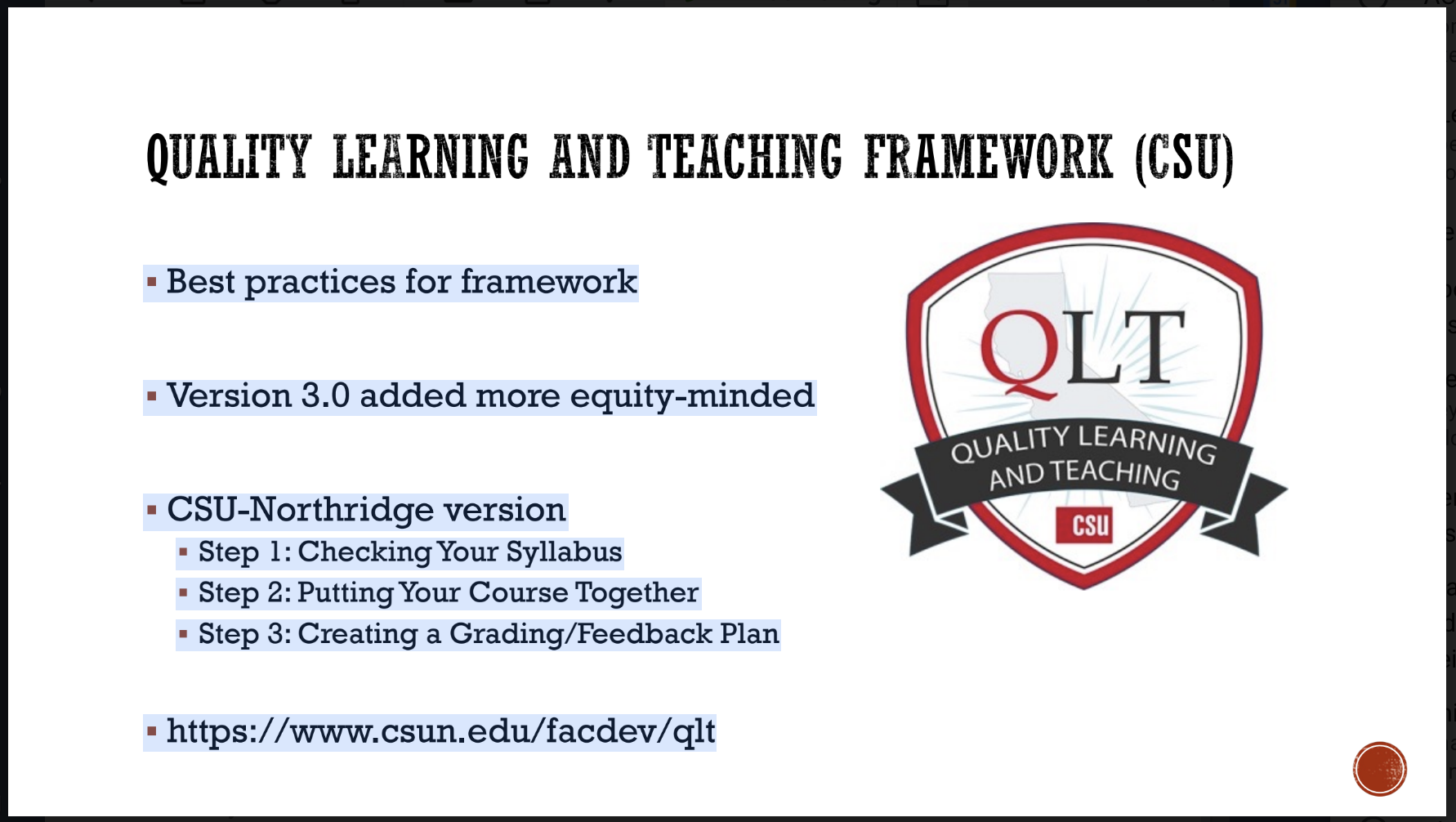
As part of the eLearning Institute, faculty use the QLT Framework to engage in quality course design for next semester’s online or hybrid course. Through that process, they reflect on equity-minded practices in their course and have conversations about equity with a faculty mentor in their peer review session. Throughout this process, faculty can develop culturally responsive and equity-minded teaching practices that can help improve teaching and learning outcomes for students.
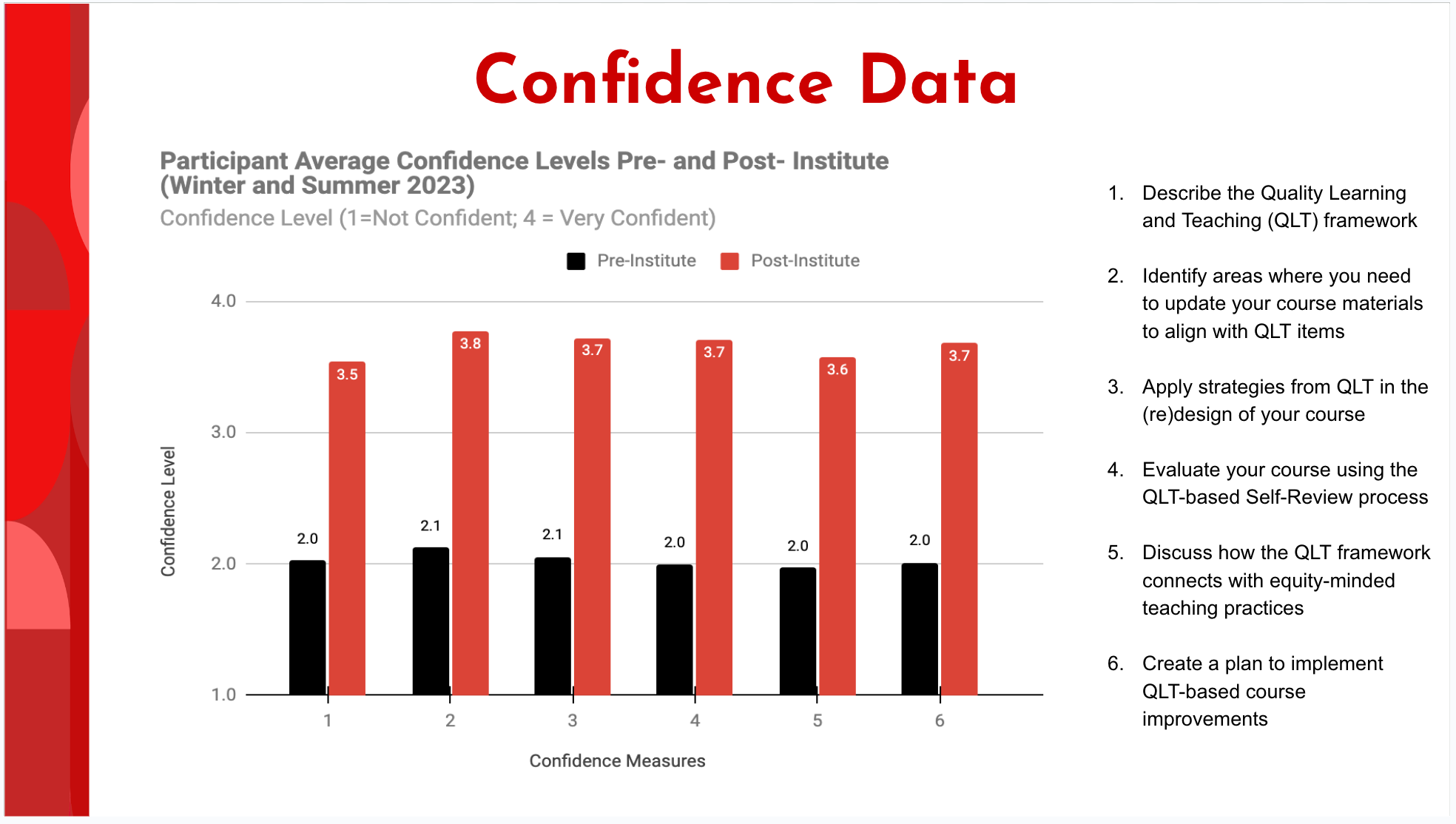
Faculty who completed our programming to learn how to integrate eLearning also gained confidence in the importance of considering equity in a more meaningful way in their course design. Faculty are asked to rate their confidence level in the program objectives before and after their participation. For the objective: “Discuss how the QLT framework connects with equity-minded teaching practices,” the average pre-program confidence level was 2.0 and post-program increased to 3.6 (1 = not confident, 4 = very confident).
Training Completions
CSUN eLearning Institute Completions Since 2020
Since 2020, 329 faculty have completed CSUN’s eLearning Institute. Evaluations showed that 96% of participants indicated high levels of agreement that the institute helped them learn how to use quality standards to design effective and engaging courses. Additionally, 92% found that eLearning Institute helped them find areas to update their courses to align with the CSU Quality Learning and Teaching (QLT) framework. Over the same period, 363 courses were enhanced with these best-practices.
What are faculty saying about the eLearning Institute?
Participant: “The value was providing the space and time for reflection and review of my course as well as providing real life examples from other faculty.”
Peer Reviewer: “You could tell that he was used to doing things a certain way for some time but left our meeting motivated to streamline in a way that could really benefit our students.”
Course Peer Review and Course Certifications
This year CSUN collaborated with Online Course Services to help design and pilot a QLT CORE 24 Prep Review process (similar to the one in place for Quality Matters). These CORE standards are identified as elements that should be present in a quality online course. The goal was to provide campuses with the option to get courses certified as meeting the QLT CORE 24 items with a single peer reviewer in order to make it more time and cost efficient for those who do not need a full certification or as a step on the way towards full certification. OCS created a badge and lists these courses on their website. Four courses were chosen for the pilot:
- Business Communication in its Rhetorical Contexts (ENGL 205) - Amber Norwood
- Language Development and Acquisition (LING 417) - Stephanie Kim
- Report Writing (ENGL 306) - Star Glover
- Queer Studies (QS 369) - Heidi Schumacher [still in progress]
Student Online Quality Assurance Impact Research
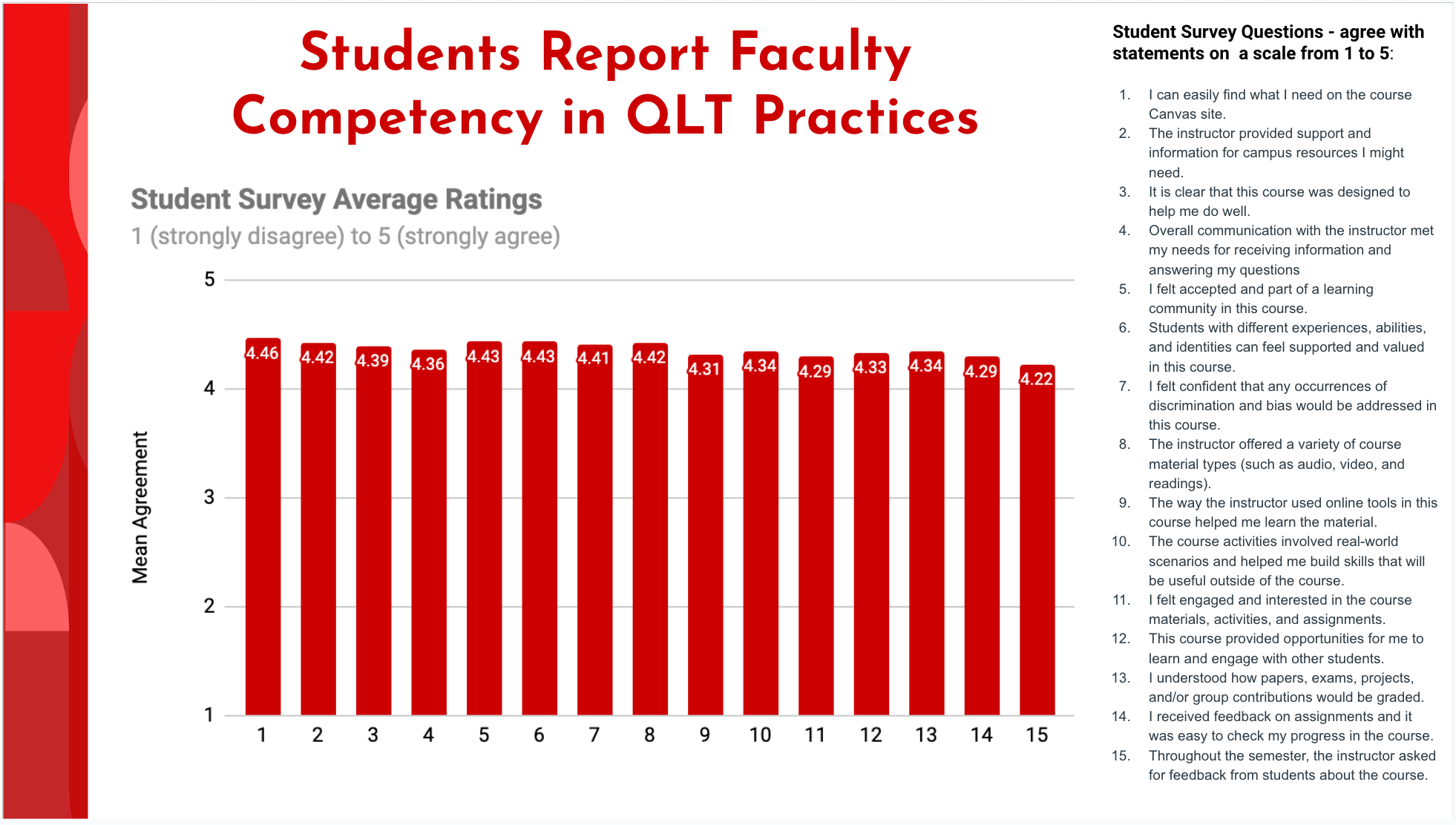
We measured student perceptions of our eLearning Institute participants’ teaching practices with an instrument we developed at CSUN using the QLT Framework. Items were created by the CSUN eLearning Team to capture QLT CORE item themes observable by students. During the last few weeks of the semester, students in courses taught by an eLearning Institute participant complete a 15-item survey to gauge the impact of the program.
- Students reported higher than a 4 (out of 5) on all items, indicating that faculty demonstrated competency in QLT practices.
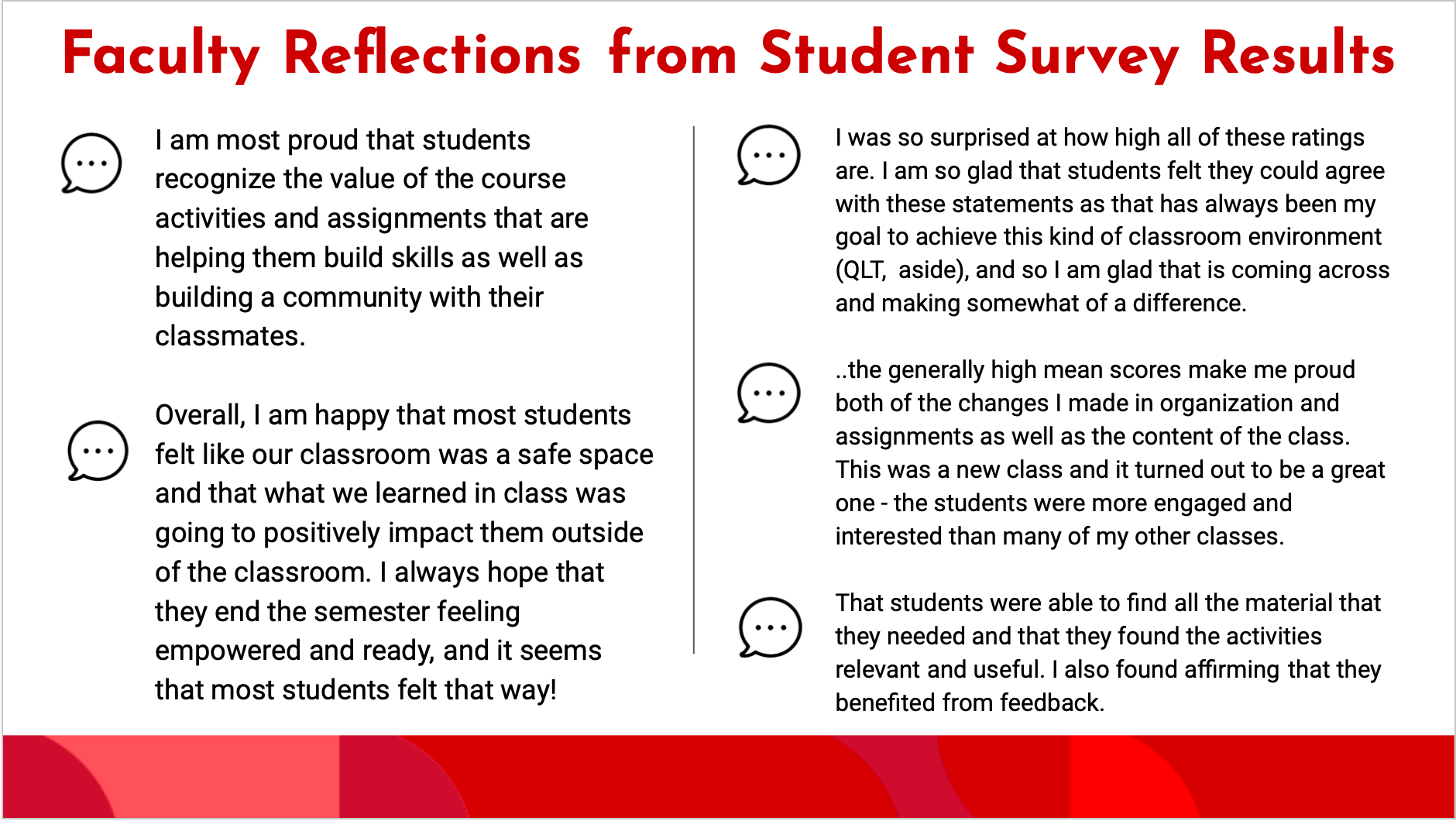
- Faculty were provided with survey results and asked to reflect on changes made in their course and to generate ideas for future improvements.
Development of Campus Online Course Services Resources
- Faculty Development's QLT page is the QLT hub used for dissemination of our CSUN specific QLT organization, links to the rubric, and hosting the dates of the CO QLT trainings.
- Faculty Development's programming page is continually updated with the most current programs that faculty can sign up at CSUN.
- eLearning Institute page explains how the program uses the QLT rubric for self-review and peer review of a course.
- Teaching Toolkit canvas site is a self-paced resource that features many resources to support faculty in their teaching.
Accessibility/UDL Efforts
In all our programming, we promote the use of the CSUN Canvas Template with QLT best practices, created by the Faculty Technology Center in collaboration with Faculty Development and Faculty Fellows.
The Canvas template was designed with a 100% accessibility rating and Universal Design for Learning principles that support student learning and user-friendly course design.
Next Steps for OCS Efforts
- Maintain our webpage dedicated to QLT with updates about the CO's programs on the Faculty Development website.
- Continue with QLT training and implementation by offering various professional development programming as well as creating and updating resources for faculty such as:
- Current eLearning Programs (e.g. Get Up to Speed with Online Teaching, summer and winter eLearning Institute);
- New Ad Hoc Peer Review Program for faculty who have previously completed an eLearning Institute and want to get a new course peer-reviewed or update their previous course and have it peer-reviewed.
- Keep recruiting and training eLearning Institute alumni for one-on-one mentoring and peer review of the courses of the faculty selected to participate in the summer/winter eLearning Institute cohorts, Ad Hoc program, and QLT Certification.
- Create a pathway for faculty to deepen their application of quality teaching from completing our eLearning Institute to next earning a QLT Certification. This could be explored if departments would be willing to provide the funding.