Cardinal Medical Laboratory: A Lesson in Laboratory Information Management Systems with Clinical Chemistry Cases
Cardinal Medical Laboratory: A Lesson in Laboratory Information Management Systems with Clinical Chemistry Cases
Campus: Andrews University Author(s): Cristy E. Moss, MBBS, MLS (ASCP)cm Date: 8/27/24
Project Abstract: Medical laboratory science is a health profession focused on the analysis of biological specimens and the dissemination of that information to clinicians for medical decision-making and treatment of disease. This field is rapidly growing, often including massive leaps in the integration of technology into the daily routine of an MLS. In particular, the laboratory information system (LIS) is software whose introduction into the laboratory was made necessary by the growth of the field and the implementation of increasingly automated methods for patient testing. The LIS allows the technologist to communicate with the automated analyzers, evaluate information sent from the analyzers, and send information to the patient chart for use by the providers while limiting the risks of transcription errors and increasing efficiency. Although the LIS is used ubiquitously in the field, university-based MLS programs have struggled to integrate this functionality into the student experience because of the stifling initial cost of implementation and ongoing cost associated with hiring specialized service professionals to manage the LIS.
Objectives:
This tool will enable users to:
- Link disease manifestations with laboratory findings.
- Navigate a student-centered LIS that introduces users to some of the features of laboratory information technology.
- Review questions related to each patient's case to demonstrate topic competence.
Background
- The Learning Problem: Clinical Chemistry students at our university-based MLS program had one observation when entering their clinical rotations: the stark difference between lab testing in college when compared to what is done in the hospital lab.
- We tackled this problem by introducing our students to modern laboratory automation through field trips before beginning clinical rotations and by creating a faux LIS to emulate the functionality of the system in the hospital.
Course History/Background
- This module was originally created to address the student concerns mentioned above and satisfy the course learning outcome about students understanding and utilizing laboratory instrumentation and automation (which includes laboratory information management systems).
- This is the second iteration of this project. I originally created a smaller module to occupy one laboratory lesson. I then shared the design at a national conference for MLS educators and the reception encouraged me to grow the project into one that can last through several lessons.
- The current version includes seven (7) patients, quality control to be evaluated, and follow-up questions based on each patient's diagnosis.
Student Laboratory Use
- First students are divided into groups. This encourages them to talk and reason through problems out loud with each other (iron sharpens iron).
- Then, I will assign them a patient. I print out a patient label with a QR code that can be scanned (our student labs have iPads) to take them to the patient's "chart". If you integrate the PDF with your university's learning platform, scanning should take the student directly to the page of interest. Otherwise, they can use the patient list to click the patient they were assigned that day.
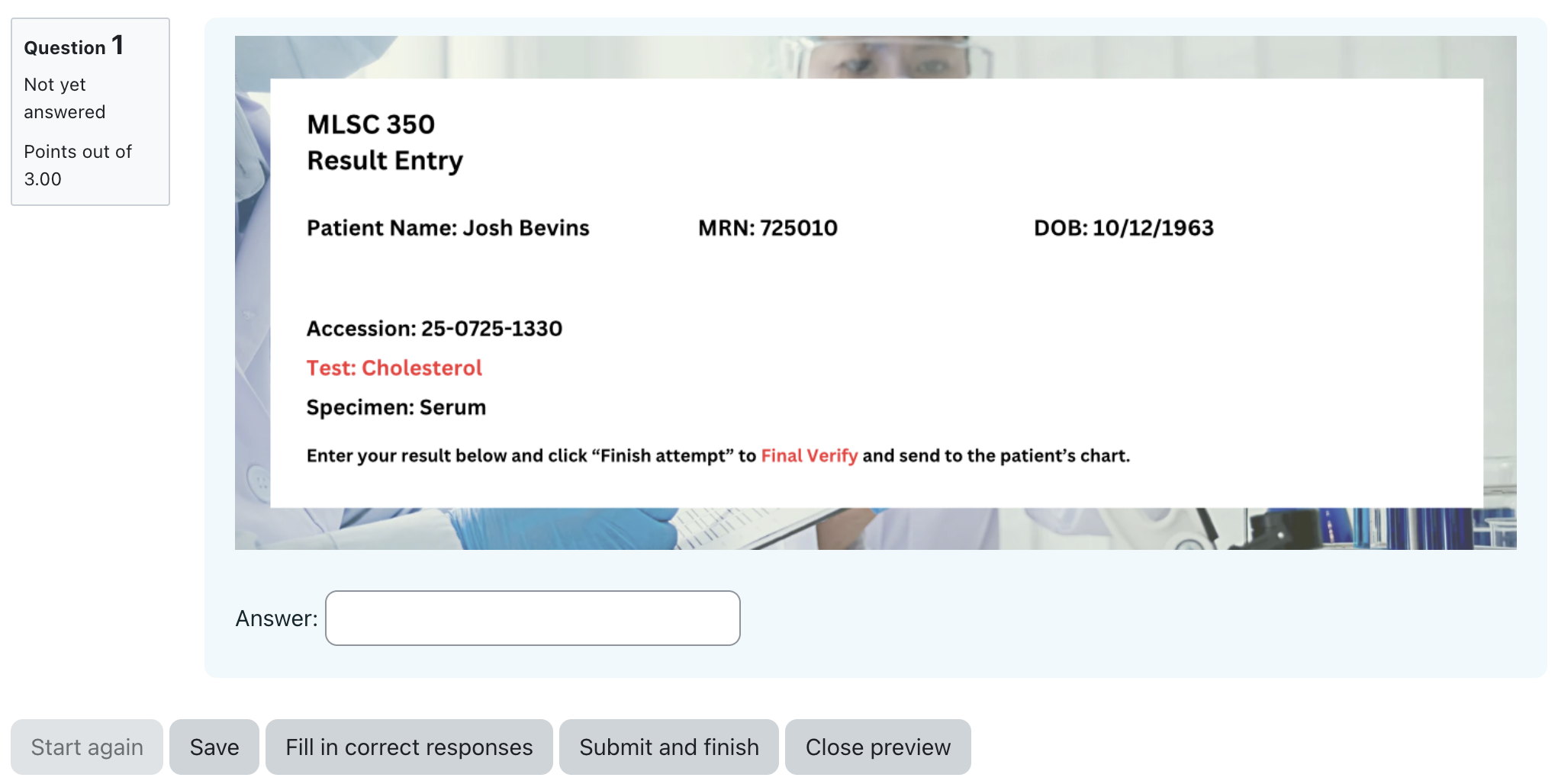
- The students are given some background about the patient and told which test was ordered for that sample, which they will run on the P180 QT analyzers we have in our student labs. (There is a separate area in our school's learning platform where I allow them to enter the results of their analysis to grade for accuracy).
- As part of their laboratory write up, they need to evaluate their result in light of the patient information available in the LIS. For example, your glucose value was 746 mg/dL on a non-diabetic whose glucose was 102 mg/dL 2 hours ago. What would you want to check in the chart? A look in the chart might show the patient receiving IV dextrose and the student would be asked to identify the sample as contaminated.
Other Ways to Use this Tool
- Ask students to evaluate the included Levy-Jennings chart to decide if they should be running patient samples or if they need to troubleshoot. (If you give them QC samples that have been doctored to be wrong until they recalibrate, they can walk through the troubleshooting process we often encounter in the lab. If a student "calibrates" and still gets the wrong result, they need to call customer service (the instructor) and I walk through what they did and what could have been done differently.)
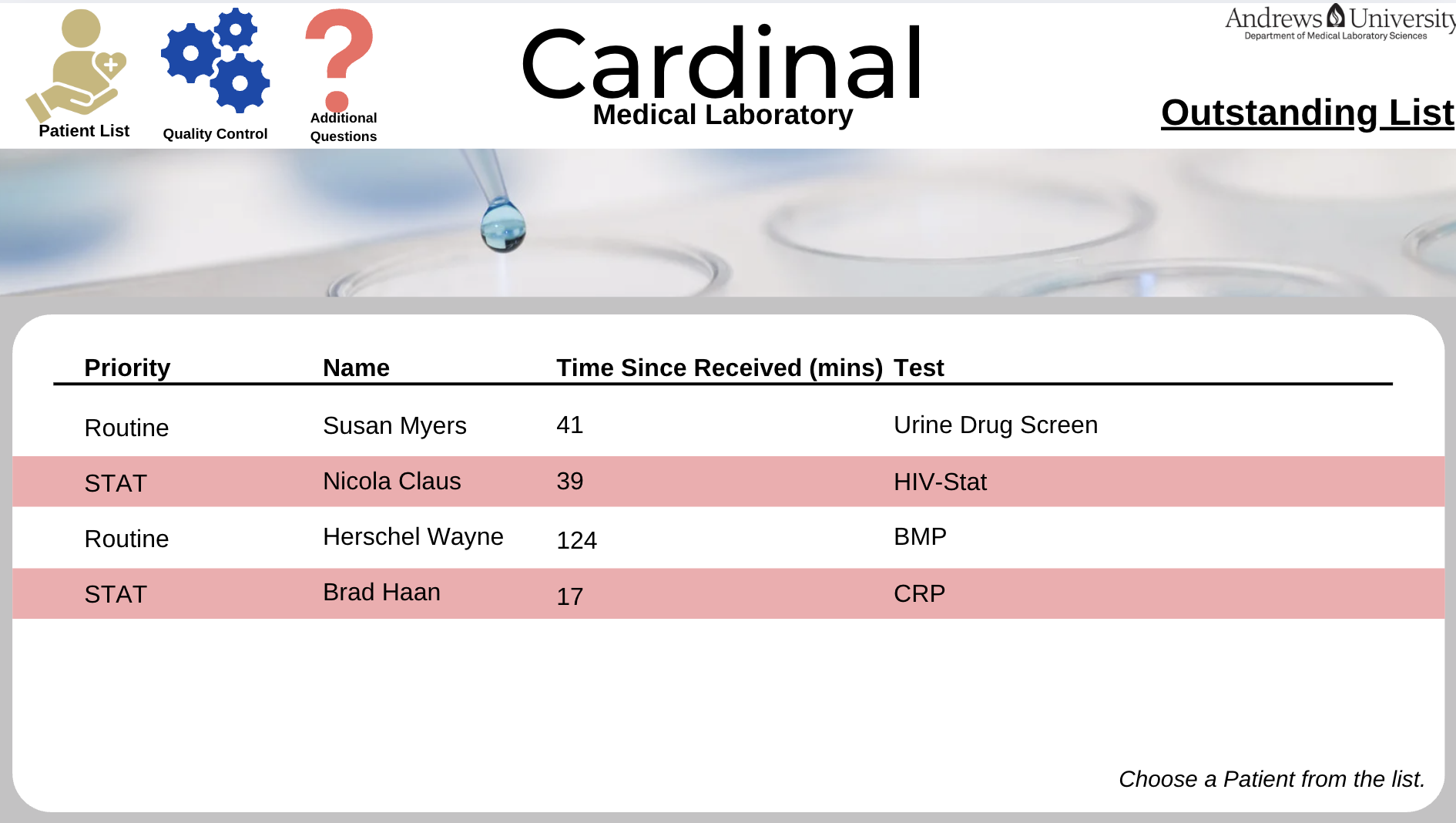
- I also teach immunology to the students, so you will also find that an HIV is included in the TAT monitor (which I keep projected on the overhead monitors). When students click that patient's name to enter results, it takes them to a result entry page where they put in results for that patient's rapid HIV, with follow-up questions about possible next steps (i.e. confirmation with a different method).

Please don't hesitate to reach out if you'd like help with programming or lab planning. I can be reached at cristy@andrews.edu.
To use this tool. Download and open the document in Adobe or your web browser. Enter full screen and navigate the document using the embedded links.
Click the image below to download a PDF version of this tool.
Enjoy!
Student Characteristics
- Our MLS program follows a 3+1 format, and in the senior year, we have a process in place to seamlessly integrate students from other affiliated universities who have not studied with us during the previous three years.
- Our senior year MLS cohort includes new seniors, second-degree seekers, and MLS certificate seekers.
- Our university is one of the most diverse in the nation, and the ethnic make-up of our senior cohort reflects that change. This diversity enriches the learning environment, providing unique perspectives and fostering a global mindset. In a class that does not exceed 30 students, we may have 5-7 countries represented at a given time.
Advice I Gave My Students to be Successful
- Read before, come with questions, read again! This is the recipe that students who find my courses 'easy' have followed and I encourage new students to adopt.
About the Instructor
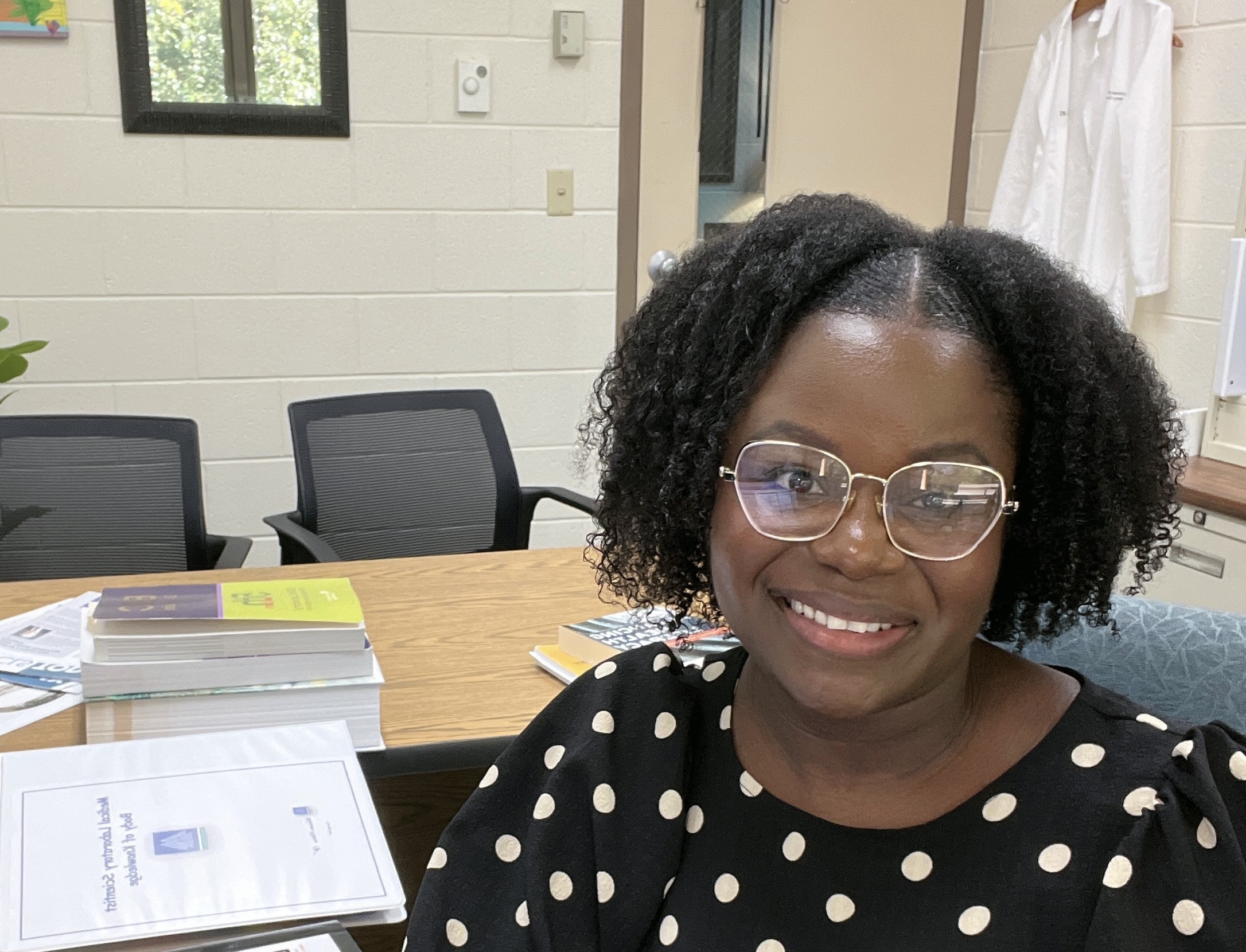
Dr. Cristy E. Moss, MBBS, MLS(ASCP)CM
I am a Medical Laboratory Scientist and former physician with 10 combined years in healthcare as a laboratorian, physician and educator. I know the massive difference competence in the medical laboratory makes in patient care. Laboratorians who can identify and correct errors, flag results appropriately for follow-up, and call the physician’s attention to tests whose results are unreliable for whatever reason save time in patient care and reduce healthcare costs. I am currently a clinical associate professor at a university-based MLS program. The unofficial motto in healthcare education remains “See One, Do One, Teach One,” which means even though I am still relatively new to academia, I have been teaching for the duration of my time in practice.
As a student, I never enjoyed lectures. Now as a professor, I try my best to supplement them with activities, games, online modules and videos that encourage the students to interact with course materials in a different way.
In my senior year clinical chemistry course, I used a rudimentary model for this project and received positive student feedback. I also presented this concept at a national conference for MLS educators, receiving equally positive feedback from laboratory educators.

Feedback
- Students have found this module engaging and reflective of modern LIS systems. Though limited, the click-through functionality does a good job of providing sufficient information for students to analyze the results provided to them critically.
- Instructors from other university-based MLS programs who have incorporated this module have not just found it beneficial, but have truly enjoyed the case-based approach and LIS-like feel, underscoring their integral role in the program.
Instructor Reflection
- I am thankful for the support of our university's library team who provided an OER grant to make this second version of this project possible.
- I am also thankful for the support of my coworkers and department chair, who always encourage my creative approach to university education.

About this tool: Cardinal Laboratories is a PDF-based laboratory information system (LIS) simulator designed to enhance clinical decision-making and laboratory education. This interactive teaching tool presents realistic patient cases and corresponding lab results to mimic the workflow and data interpretation challenges commonly encountered in medical laboratories. Cardinal Laboratories aims to bridge the gap between theory and practice by providing students with an immersive, case-based experience.
Additional resources and contact information are available upon request.
MERLOT-SkillsCommons Open Educational Practices Portal
Explore over 1,000 teaching and institutional ePortfolios and case studies capturing innovative educational practices and openly publishing them for you to reuse, revise, remix, retain, and redistribute.
MERLOT Pedagogy Portal
This Portal is designed to help you learn the variety of instructional strategies and issues helping you become a better teacher. The resources you'll find here should apply to teaching a variety of disciplines.
MERLOT
MERLOT is a collection of free and open online teaching, learning and faculty development services contributed and used by an international education community. The collection of open resources spans across a wide variety of disciplines and education levels. What sets MERLOT apart is a combination of peer reviews, member comments, learning exercises and other valuable information and metadata associated with the materials.