Math 110 - Math for Liberal Arts Students
Math 110 - Math for Liberal Arts Students
Purpose: to help other instructors teaching the same course
Common Course ID: MATH 110
CSU Instructor Open Textbook Adoption Portrait
Abstract: This open textbook is being utilized in a Math course for undergraduate students by Bridget Druken at California State University, Fullerton. These open textbooks provide concept overviews and problem sets. The main motivation to adopt an open textbook was to reduce expensive textbook costs for first-year students who are not math majors. Most student access the open textbook from links in Canvas.
Course Title and Number: Mathematics for Liberal Arts Students - MATH110
Brief Description of course highlights: Survey of traditional and contemporary topics in mathematics, such as elementary logic, counting techniques, probability, statistics, and the mathematics of the social sciences. For non-science majors..
Student population: This is a general education course and is typically taken by incoming first year students. Common majors include psychology, art/studio, criminal justice, and more.
Learning or student outcomes: On successful completion of MATH 110, you will:
Understand and appreciate the varied ways in which mathematics is used in problem-solving and varied applications of mathematics to real-world problems via these concepts:
1. Demonstrate knowledge of fundamental mathematical concepts, symbols, and principles.
2. Summarize and present mathematical information with graphs and other forms that enhance comprehension.
3. Utilize and explain inductive and deductive mathematical reasoning skills in finding solutions. and these processes:
4. Explain both the overall process and the particular steps by which a mathematical problem is solved.
5. Perform appropriate numerical calculations, with knowledge of the underlying mathematics, and draw conclusions from the results.
6. Solve problems that require mathematical analysis and quantitative reasoning and demonstrate a sense of mastery and confidence while doing so.
This course satisfies the General Education learning goal of UPS 411.201 Mathematics/ Quantitative Learning B.4. A grade of “C-” or better is required to meet this General Education requirement.
Key challenges faced and how resolved: It is always hard for me to teach a new class – when I used this text it was the first time I taught the class. Some open source books have free homework practice areas and some do not. We did not use that aspect here, so that was a challenge that was resolved by not doing homework practice via a computer.
Syllabus from the course or the adoption: Here is my syllabus: https://docs.google.com/document/d/1h-cr07oJEGVntWQZKD3cHH6bd4PrXSxSlvxbUG6ielw/edit#heading=h.6ghjw2qowey6
Instructor Name: Bridget Druken
I am an associate professor of math at California State University, Fullerton. 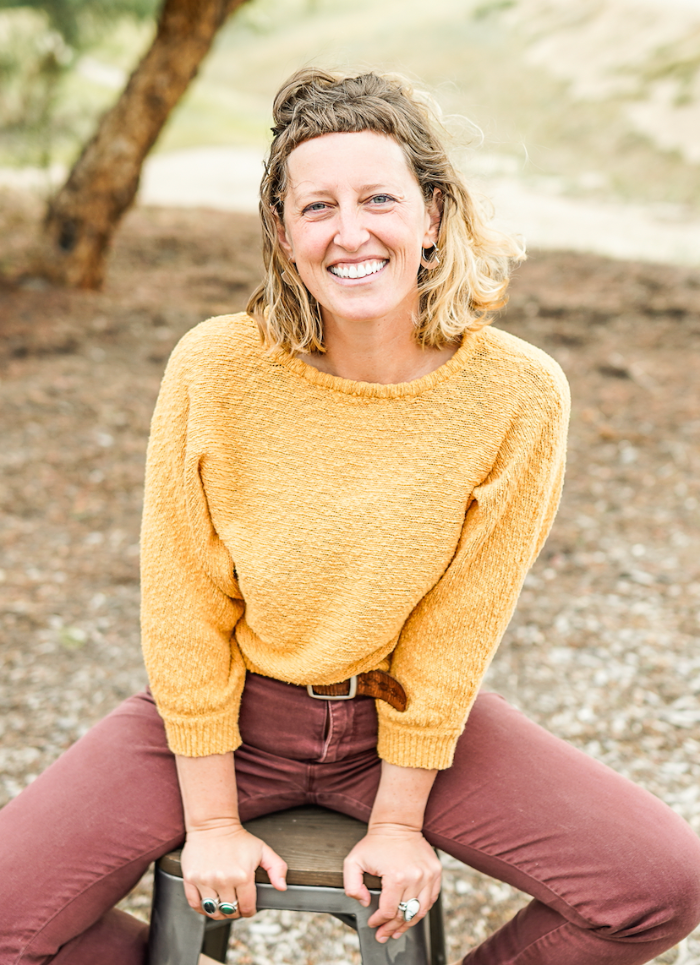
Please provide a link to your university page.
https://www.fullerton.edu/math/faculty/bdruken/
Please describe the courses you teach.
Math 303A: Fundamental Mathematics for the Elementary Teacher - Number and Operations and Problem Solving
- Structure and form of the mathematics that constitutes the core of the K-8 mathematics curriculum, including number sense, number theory and problem solving. Prerequisite: completion of G.E. Category B.4.
Math 303B: Fundamental Mathematics for the Elementary Teacher - Statistics, Probability, and Geometry
- Structure and form of the mathematics that constitutes the core of the K-8 mathematics curriculum, including the real number system, geometry, probability and statistics and problem solving. Prerequisites: MATH 303A with a “C” (2.0) or better; completion G.E. Category B.4.
Math 401: Algebra and Probability for the Secondary Teacher
- Mathematical topics relevant to the teacher of secondary mathematics. Problem-solving approach to different areas including algebra, number theory, combinatorics and probability, while maintaining a historical perspective. Prerequisites: “C” (2.0) or better in 12 units of upper-division Mathematics excluding MATH 303A, MATH 303B, MATH 338, MATH 380, MATH 403A or MATH 403B; or graduate standing. 400-level Undergraduate Course available for Graduate Credit
Math 403B: Fundamental Mathematics for the Middle School Teacher - Statistics, Probability, Geometry
- Content background in mathematics to help satisfy credentialing requirements for teaching mathematics at the middle school level. Focuses on gaining a thorough understanding of advanced algebra, geometry, probability and statistics and the use of technology. Prerequisite: completion of G.E. Category B.4; or graduate standing. 400-level Undergraduate Course available for Graduate Credit
Math 582: High School Algebra from the Advanced Perspective
- Topics relating to the high school curriculum from an advanced standpoint including algorithms, fields and polynomials. Prerequisite: MATH 302; or graduate standing.
Math 583: Introductory Statistics from the Advanced Perspective
- Calculus-based course designed to teach appropriate strategies and tools to effectively address problems in statistics. Project design, exploratory data analysis and interpretation, and effective communication of results. Prerequisite: MATH 338; or graduate standing.
Describe your teaching philosophy and any research interests related to your discipline or teaching. My teaching philosophy involves engaging learners in collaborative, real-world centered, active, hands-on learning experiences that provide students the agency to learn mathematical practices and content for teaching through whole-class discussions, individual reflection, and writing.
Textbook or OER/Low cost Title: Colleg Mathematics for Everyday Life
https://math.libretexts.org/Bookshelves/Applied_Mathematics/Book%3A_College_Mathematics_for_Everyday_Life_(Inigo_et_al)
Brief Description: This is a college level liberal arts math text. It covers concepts like statistics, probability, growth, finance, graph theory, voting systems, and geometric symmetry.
Please provide a link to the resource
Authors: Curated by Maxie Inigo, Jennifer Jameson, Kathryn Kozak, Maya Lanzetta, & Kim Sonier via source content that was edited to the style and standards of the LibreTexts platform; a detailed edit history is available upon request.
Student access: Students access these materials via website. I linked the free text in their Canvas course. Here is a screenshot of the teacher’s view.
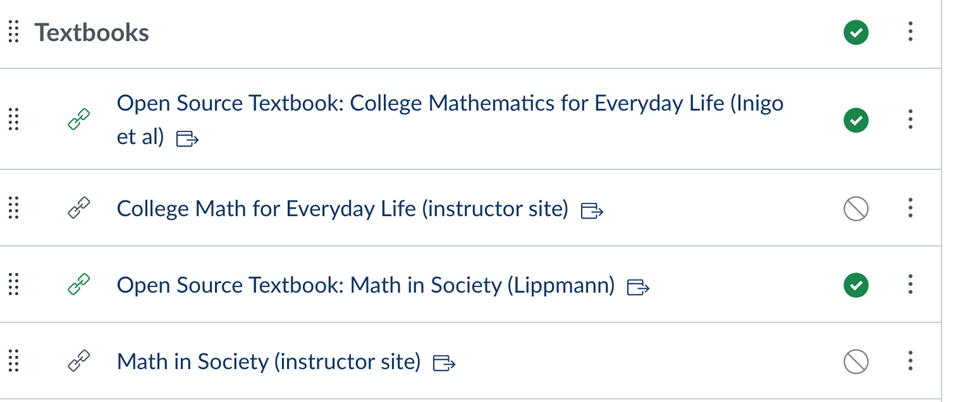
Supplemental resources: I also provided another similar textbook for students to use in addition to this book. - Math in Society (Lippman)
https://math.libretexts.org/Bookshelves/Applied_Mathematics/Math_in_Society_(Lippman)
Provide the cost savings from that of a traditional textbook. For this course, this saved students $175, which was the price of buying it at the school book store.
License: Both books are available under a CC BY-SA 4.0 license.
OER/Low Cost Adoption Process
Provide an explanation or what motivated you to use this textbook or OER/Low Cost option. I wanted students to have to NOT pay for their textbook as long as there was a great alternative free version online. Also, this textbook allows for me to infuse social justice concepts into the course, which previously it did not have that much space for.
How did you find and select the open textbook for this course? Michaela Keating helped me figure out how to search for these books in our grant. I originally signed up to look for a free source for a different course, but this opportunity came up to teach a summer class called Math 110, a general education course.
Sharing Best Practices: Keep looking for an option. Remember that students REALLY APPRECIATE paying no/low cost for text materials.
Go small – you don’t have to redesign your entire course at first. Do it bits at a time. Ask students to try out the resource for an assignment before you switch. Have them summarize and reflect on the material, ask them what they liked about it, and ask them how they prefer their textbooks. Collecting data about the situation can help inform your decisions.
Describe any key challenges you experienced, how they were resolved and lessons learned. It is challenging to do it when the course is coordinated, but not impossible. Since Math 110 was taught in the summer, I had flexibility to choose these course textbooks described above. I will teach from it again this summer and will be able to make the experience even better for students.