Creative Nonfiction - English 5300
Creative Nonfiction - English 5300
Purpose: to help other instructors teaching the same course
Common Course ID: ENG 5300
CSU Instructor Open Textbook Adoption Portrait
Abstract: These low-cost texts are being utilized in an English course for undergraduate students by Dr. Kate Simonian at CSUSB. The open resources include links to PDFs of stories, stories published online, teacher-generated worksheets, student texts, and writing websites. The main motivation to adopt these low-cost materials was saving students money and increasing the likelihood of students doing the readings. Students accessed the resources through the Canvas course page.
Creative Non-Fiction ENG 5300
Brief Description of course highlights: In this class, students are guided through the production of two short works of memoir and then a final third autoethnography pertaining to a sub-culture of which they are a part. Highlights include three sessions sharing work with peers, a whole-class workshop, weekly reading aloud of exemplary work, as well as a final class presentation open to the public. (From Course Catalog): Advanced-level writing workshop exploring historical and contemporary approaches to literary nonfiction, including but not limited to memoir, diary, autobiography, personal essay, and lyric essay. Students generate their own creative works and participate in critical workshop discussions. May be taken 3 times for a total of 9 units.
Student population: Generally, the undergraduate students are English majors doing a creative-writing minor. There are also graduate students in the English department, and incarcerated students.
Learning or student outcomes:
- CLO1. Understand and use a “creative writing” vocabulary when discussing non-fiction and cross-genre work.
- CLO2. Develop an appreciation of, and ability to discuss, features of longer works.
- CLO3. Articulate some major considerations specific to the practical creation of memoir/autoethnography.
- CLO4. Explain the ways in which their chosen work may be in conversation with more marginalized perspectives.
- CLO5. Identify enquiry questions that arise from their own aesthetics.
- CLO6. Switch effectively between the two major modes of writing--the generative fountainhead and the critical reviser--to write a longer work and bring it to a publishable standard.
- CLO8. Identify situations of moral and cultural ambiguity in texts, as well as articulate ethical questions raised by creative nonfiction.
- CLO9. Reflect on how social context affects meaning.
- CL010. Thoughtfully analyze the work of peers using a neutral observation method.
- CLO11. Find areas of their own experience that inspire, connect with, and uplift others.
Syllabus and/or Sample assignment from the course or the adoption
5300 Syllabus_Spring 2024.pdf
Final Portfolio 5300_Spring 2024.pdf
Key challenges faced and how resolved: A major challenge was deciding between the plethora of texts available for free online. I had some difficulty with texts I wanted to share with students that are published in a traditional medium, such as a book. One such example was Blake Snyder’s Save the Cat. I would have liked to share more than 10% of this book, but due to copyright was restricted to this. To compensate, I summarized texts such as these and made handouts.
Another challenge was that l had to generate many handouts with my own material, which was time-consuming.
The use of student-generated texts was effective, but there were sometimes students who were reticent to share their work with the class. I overcame this through using a very positive and affirming tone and manner of analyzing said texts, which made students much more likely over the course of the semester to allow me to use their work for group analysis.
There were some issues with incarcerated students being unable to access the open textbook online, which meant I had to make PDFs of all relevant pages and upload them. This was time-consuming.
Most of the assignments prompts had to be modified for the sake of clarity.
OER/Low Cost Adoption Process
Provide an explanation or what motivated you to use this textbook or OER/Low Cost option. The main motivation for the adoption was to save my students money. The adoption also forced me to use texts that students find more negaging because less traditionally “literary.” I foresaw that their ability to access the readings on their phones, as well as the perceived “fun” of the digital texts would increase the percentage of students who did the readings, and it did.
How did you find and select the open textbook for this course? To find the Open-Access textbook, I used online pedagogy forums on platforms like Facebook and searched for autoethnography-based textbooks online.
Sharing Best Practices: The open-access book has some great exercises. I did find a need to supplement it with discussions of ethics, modules on anecdotes, and instructions on how to interview. The prompts also required re-writing.
Describe any key challenges you experienced, how they were resolved and lessons learned. I learned that to teach a course like this involves getting creative with transmitting traditional creative writing wisdom to students, as any of the canonical books about writing are protected by copyright and/or inaccessible in an online format.
Making handouts is time-consuming but necessary; I recommend staggering the production of these over the weeks preceding the commencement of the course.
The use of student-generated texts was effective, but there were sometimes students who were reticent to share their work with the class. A positive and affirming tone and manner of analyzing said texts helped to increase participation.
I would recommend, time permitting, that the instructor does the writing exercises set during this course, and set loose word limits. I would also suggest introducing students to a neutral mode of observation-based workshopping, such as Liz Lermann’s Critical Response Process.
Share any curricular or pedagogical changes that you made as part of the Textbook/OER/Low Cost Adoption. In previous classes, I have relied on many more short stories and traditionally “literary texts.” Using low-cost materials found online opened me up to a range of texts that students found profoundly engaging. I did have to prepare more material and lesson plans to suit all the new and contemporary texts we examined. Tombro’s course gave me a much better way to ease students into writing about themselves.
Textbook or OER/Low cost Title:
Brief Description: Melissa Tombro’s Teaching Autoethnography: Personal Writing in the Classroom (OPEN SUNY, 2016) is an open-access textbook. It provided me with much of the inspiration for my course and several tried-and-true writing assignments. The writing is accessible. There are samples for nearly every assignment for students to look at, as well as a sample schedule. It is available to the public in PDF, E-book, and online forms, as well as a printed hardcopy obtainable through CSU library.
In addition, I used an assemblage of PDFs available online, stories published online, teacher-made resources, student-generated texts, and websites.
Here is the access to the open-access textbook, Teaching Autoethnography: Personal Writing in the Classroom, by Melissa Tombro: https://unglueit-files.s3.amazonaws.com/ebf/efd9e413bb334b75baa5cd9f4393d4b7.pdf
Supplementary texts were also used.
Authors: Melissa Tombro. Some authors whose work we read included Carmen Maria-Machado, Maxine Hong Kingston, Roxane Gay, and Tim O’Brien.
Student access: Students can access all materials via links on Canvas. There is an external link to the online Tombro textbook, as well as PDF scans of her work on Canvas. Self-generated and student-generated texts are posted entirely within the Canvas course site.
Supplemental resources:
- Teaching Autoethnography: Personal Writing in the Classroom, Tombro. M. Open SUNY, 2016.
- “Portrait of the Artist as a Young Stalker,” by Kate Simonian. Shenandoah, vol. 68, no.1, Fall. https://shenandoahliterary.org/681/a-portrait-of-the-artist-as-a-young-stalker/
- “On Finding the Why,” by Roxane Gay. New York Times, Premium Skillshare Original Resources, hosted on Youtube. https://www.youtube.com/watch?v=rml6KQlLIsA
Provide the cost savings from that of a traditional textbook. Texts usually cost around 100 dollars and in my class students had to pay nothing. One section of 5300 is taught each year, with 25 students. With 25 students per class, that’s a total saving of 2500 dollars per year.
License: The short-story PDFs and websites are copyrighted. Teaching Autoethnography is an OER, accessible to all.
Instructor Name: Kate Osana Simonian
I am an Assistant English professor at California State University, San Bernardino.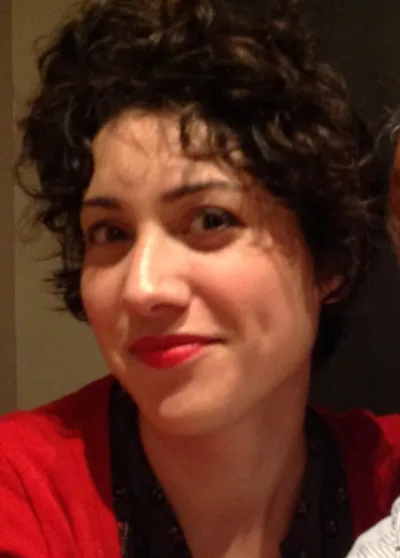
Please provide a link to your university page.
https://www.csusb.edu/profile/kate.simonian
Please describe the courses you teach.
ENG 2000--Introduction to English Studies
ENG 2500--Introduction to Creative Writing
ENG 3030--Analysis of Fiction and Nonfiction Prose
ENG 3500--Literary Movements: Aesthetics and Craft
ENG 4180--Intermediate Fiction Workshop
ENG 5130--Advanced Creative Writing in Specialized Genres
ENG 5190—Creative Writing Thesis
ENG 6210--Teaching Imaginative Writing
Describe your teaching philosophy and any research interests related to your discipline or teaching. How we see the world is often how we teach. My younger brother has an intellectual disability. In 2005, my mom, desperate to prop up his grades, asked me to tutor him. At first, the scenario played out badly. Close-reading, however “fun” the texts were, repelled him. Imaginative prompts yielded blank pages. So, what did I, a budding fiction writer, do? I turned to story.
Good stories move before they instruct, so I won him over emotionally. We wrote about his passion: cars. He was a visual learner, so we used diagrams to learn essay structures. We spoke of the mental “story” that an essay told and used anecdotes as mnemonic tools. He learned to not only re-frame his attitude into a growth-based model, but to stop seeing himself as defined by a perceived deficiency. Today, my pedagogy clusters around these same principles of storytelling, with the goal of re-writing how students see themselves.
Win Hearts, then Minds. Learning happens best in a safe space. In my Introduction to Creative Writing, I create this environment on the first day. Through a humorous confession of my own errors, I dispel some ideas that first-time writers might harbor; model the “critical kindness” with which I want students to approach their own work; and establish a norm whereby incorrectness is a corollary of brave writing. I then distribute a survey asking about past experiences and preferred learning styles, which springboards us into a discussion of how we’d like the class to be conducted. By giving students buy-in, I establish that the relationship between us will be two-way, not top-down. One of my objectives in any class is to show students that their interests are valuable. To get my creative writing students in this frame of mind, we have “Glimmer Days” throughout the semester, in which students share a moment, image, idea or situation from the preceding week that has stood out to them. This increases trust between group members; is a low-stakes way of getting reticent students talking; and establishes the habit of active noticing. When the primary focus of a class is on academic writing, my approach is different. In my ENG 110 composition class, for example, we discuss critical arguments for the “worth” of art—aesthetic, political, intellectual, canonical. The capstone essay is a defense of a student’s most beloved artist. Given the range of lenses we’ve discussed, why might we consider their work “art?” Being able to close-read friendship bracelets, The Wu-Tang Klan, or Deadpool shows students that art exists in their daily lives. Their wealth of knowledge on the chosen subject leads to a more nuanced discussion of socio-historical contexts. In sum, writing their passions lets students learn better, and leaves them empowered.
Show, Don’t Tell. I use active learning in the classroom, including field-work, transcribing overheard conversations, pair performance, games, collaborative stories, storyboarding, and cognitive mapping. One of my favorite exercises to use is debate. During my The Great Books Course, students studied The Odyssey. I assigned roles to each student (prosecution, defense, judge, witnesses) for a criminal case trying Telemachus for his murder of the maids. Quite apart from this being one of the most passionate teaching moments of my life, with students wanting to stay long after the period had ended, the exercise showed students how cultural values of a text may be received differently over time.
Everything Is a Story. In class, I make content memorable through narrative. I often start class with an open-ended question; like a good introduction, this hooks the class and primes them to look out for certain information. As a group, we may move through a provisional answer to the posed question, and then problematize it through Socratic questioning. We might split into four groups and re-define the question, then have each group report back. We may do a collective brainstorm on as-yet-unconsidered assumptions within the question and concretize our understanding with a “minute paper” that elaborates upon what we’ve discussed. Finally, we’ll return to the question that opened the class. Such structuring does more than let students know they need to think critically; it shows them how to. It shows them that the conclusions to which we come, not unlike a final story draft, are often only arrived at through a process of interrogation. Even then, the answers we reach are only provisional.
Revision Makes the Story. Revision is one of the hardest things to teach. I open the subject of revision with George Saunders’s video, “On Story,” in which he explains revision as a process of “active love” whereby we urge a work to higher, more complex, ground. To supplement this, workshops and critiques are a standard part of my classes. After a first assignment has been handed in, I hold an ongoing in-class “reading series” in which I have students read excerpts of their changed versions aloud. This normalizes the process of revision and, because I always choose students who have made substantial structural changes, lets students know that they should be making large-scale changes to their drafts.
Revision is also built into my teaching. Reflecting after each lesson; watching footage of myself teaching; harvesting ideas from literature, conferences, and peers; re-working assignments; and revising syllabi lends me the wisdom of multiple iterations of myself. Direct feedback is also invaluable. For example, this semester, in my Introduction to Creative Writing Class, students were asked to do a mid-semester course evaluation. When students said that they sometimes didn’t know what a given lesson was going to be about or what skills they were meant to have learned, I more directly identified objectives before and after classes, instituted “muddiest” point index cards for gauging confusion, and made more comprehensive rubrics. Through metacognitively discussing my teaching practice with students, I increased transparency, and showed them that learning is a never-ending process for me, too.
My teaching has changed since I tutored my brother, but my focus on narrative remains. A good lesson, like a good story, wins the student over emotionally, shows before telling, offers provisional closure, and stresses the importance of revision. In my classes, teacher and student are co-authors. We strike out in a direction, but end in no predetermined place. For me, that is the joy. That is what keeps me reading.