Write What Matters
Write What Matters
Course ID: ENGL 1010 (Intro to Comp) and ENGL 2010 (Intermediate Writing)
Instructor Name: Kyle Killebrew
Abstract: This open textbook has been adopted in two General Education composition courses for undergraduate students by Kyle Killebrew at Utah Tech University. The open textbook provides lessons, examples, exercises, and definitions in a variety of reading and writing situations. The main motivation to adopt an open textbook was to save students money and have more control over the course content. Most student access the open textbook as a PDF or Pressbooks link found in Canvas.
Concept and design by: MERLOT-SkillsCommons
© 2020- MERLOT-SkillsCommons
Questions? Email webmaster@merlot.org
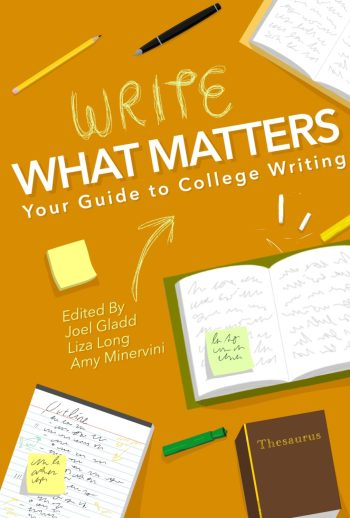
Textbook Title: Write What Matters
Description: From the authors: "Have you ever wished for a comprehensive source that would steer you in the right direction through all of your reading and writing assignments? This text aims to be that kind of guide. We included lessons, examples, exercises, and definitions for many of the reading and writing-related situations that you will encounter in your first-year writing courses as well as other subject-specific classes that require writing."
Authors: Liza Long, Amy Minervini, and Joel Gladd
Cost savings: $30 to $60
Course Number: ENGL 1010 & ENGL 2010
Description:
ENGL 1010: Partially fulfills General Education English requirement. Designed to improve students' abilities to read, analyze, and write expository papers. Provides opportunities to write and revise a number of essays. Activities, library research, portfolios, writing to a style guide, and tests may also be used to prepare students to write college level papers.
ENGL 2010: Partially fulfills General Education English requirement. Provides opportunities to analyze and write academic papers, including the research-supported essay, through writing and revising a number of essays. Other activities, such as portfolios, library research, and tests may be used to help students improve their writing of advanced-level papers. Successful students will demonstrate competence in the use of standard written English, in analyzing texts, in correctly paraphrasing, summarizing and quoting source material, and in appropriately citing the work of others.
Prerequisites:
ENGL 1010: ACT 17 or equivalent (see catalog for equivalencies)
ENGL 2010: ACT 18, ENGL 1010 (C or Higher), or equivalent (see catalog for equivalencies)
Learning outcomes:
ENGL 1010: At the successful conclusion of this course, students will be able to: 1. Evaluate evidence and logic - including the identification of underlying assumptions, biases, and fallacies - in various texts. 2. Apply relevant, convincing, and effective evidence and logic in a variety of oral and written interactions. 3. Participate in the process of collaborative learning as it relates to reading and writing. 4. Compose an essay with a precise thesis statement that controls the selection, structure, and presentation of material. 5. Create competent essays and paragraphs through the writing process using standard written English. 6. Incorporate research into essays through adequate quotation, paraphrasing and summarizing. 7. Explain and avoid plagiarism.
ENGL 2010: At the successful conclusion of this course, students will be able to: 1. Evaluate evidence and logic - including the critique of underlying assumptions, biases, and fallacies - in various texts. 2. Apply relevant, convincing, and effective evidence and logic in all oral and written interactions. 3. Engage in the process of collaborative learning as it relates to reading and writing. 4. Compose an essay with a precise thesis statement that controls the selection, structure, and presentation of material. 5. Create effective essays and paragraphs through the writing process using standard written English. 6. Incorporate research into essays, annotated bibliographies, research papers, and/or presentations through effective quotation, paraphrasing and summarizing. 7. Explain and avoid plagiarism.
Curricular changes: No significant changes were made. I found a book that worked with what I was already doing. Now I don't have to revise the course every time a new edition comes out.
Teaching and learning impacts: No assessment has been made on the impact of the OER textbook, but students seem to get a lot out of it and the materials support what they are doing.
I Collaborate more with other faculty Yes
I use a wider range of teaching materials: Yes
I believe my students' learning has improved Yes
I believe student retention has improved : Unsure
There have been unexpected results: Yes Sometimes links don't work or there are errors in the book.
OER Adoption Process
To save students money and give them access to the book right away. Also to find materials that best fit the curriculum and assignments rather than trying to mold the curriculum around a particular textbook.
Institutional Support for OER:
- The university supports OER adoption.
- There are specialists available to help wade through the sea of OER material.
-I enjoy collaborating with colleagues who are also using OER.
Student access: Students have access to the material free through Canvas on the first day of class.
Student feedback about using OER: Students have expressed appreciation for not having to spend money. Some students have been critical of errors and formatting issues and broken links. They are used to commercially produced textbooks that have been heavily edited by experts. It's likely that not many OER authors have much experience with designing online documents.
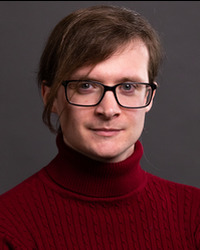
Instructor Name: Kyle Killebrew
Born in the suburbs of Chicago, I lived my whole life in the Midwest until 2020 when I moved to Cedar City to begin teaching at Utah Tech University. After receiving my Bachelor’s degree in Creative Writing from Illinois Wesleyan University in 2012, I went to Northern Illinois University for my Master’s in Victorian Literature.
My work with Postcolonialism led me to pursue my Ph.D. in Indigenous Literature and Film, which I completed in the spring of 2020. My research employs Indigenous and feminist methodologies to highlight alternative, Indigenous answers to colonialism and recent discourses of reconciliation in North America.
I have been teaching college courses in literature, film, composition, and grammar for almost a decade. My research into Indigenous methodologies informs my philosophy as a teacher. With feminist and Indigenist theorists of epistemology and methodology like Kathleen Absolon and Margaret Kovach, I believe that learning is a reflexive and holistic process. Comprehension requires understanding of the complex web of interrelationships that gives context to the world and our place in it.