Technical Writing Essentials
Technical Writing Essentials
Common Course ID: ENGL 2100: Technical Writing
Instructor Name: Chalice Randazzo
Abstract: This open textbook is being utilized in a technical writing course for undergraduate students by Chalice Randazzo at Utah Tech University. The open textbook introduces students to the basics of technical communication, including audience and task analysis in workplace contexts, clear and concise communications style, effective document design, teamwork and collaboration, and fundamental research skills. The main motivation to adopt an open textbook was to save students money and give them access to something on the first day of class. Student access the open textbook through Canvas as a PDF.
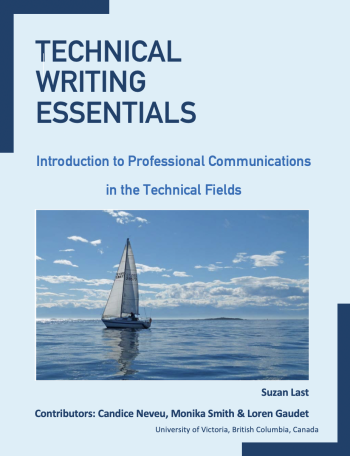
Textbook Title: Technical Writing Essentials
Description: This open textbook is designed to introduce readers to the basics of technical communication: audience and task analysis in workplace contexts, clear and concise communications style, effective document design, teamwork and collaboration, and fundamental research skills.
Authors: Suzan Last, University of Victoria
Cost savings: The previous textbook was $40 used or $100 new.
Course Number: ENGL 2100: Technical Writing
Description: Required for English majors pursuing an emphasis in Professional & Technical Writing, and open to students in science and technical disciplines who would like to increase their proficiency in writing. Provides students with opportunities to develop skills useful in professional, workplace settings. The course introduces students to technical formats, brevity and clarity strategies, and visual elements such as headings, lists and graphics. This course is designated as an Active Learning Community Service (ALCS) course. Students provide service in areas of public concern in a way that is mutually beneficial for both the student and community.
Prerequisites: C in ENGL 1010 or 2010 or equivalent (see catalog for list of equivalencies)
Learning outcomes: At the successful conclusion of this course, students will be able to: 1. Identify and critique structural and design elements in technical documentation. 2. Apply knowledge of technical writing, structure, and design to compose effective documents. 3. Combine and examine researched information in electronic and printed format.
Curricular changes: No changes were made to the curriculum to adopt this OER textbook.
Teaching and learning impacts: Using this OER textbook allows me to pick and choose content that is most relevant rather than feeling pressured to use as much of the book as possible so my students get their money's worth. There are a few things in the book that are missing or irrelevant (since the book is from Canada), so I have to supplement it with other OER materials, such as resumes, cover letters, and job materials relevant to the US.
I Collaborate more with other faculty No
I use a wider range of teaching materials: Yes
I believe my students' learning has improved Unsure
I believe student retention has improved : Unsure
There have been unexpected results: No
Share other lessons learned from using OER.
- When teaching a class for the first time, it is easier to adopt a traditional textbook. To adopt an OER textbook, instructors need to understand what they're teaching so they can find materials early enough for students to use.
- OER textbooks often aren't as polished as traditional textbooks. This is likely due to OER creators not having access to trained editors and other resources provided by publishers.
- Sometimes OER is not the answer. Some courses are impossible with OER. But English and technical writing courses are relatively low stakes (compared to something like nursing), so it isn't as risky to try OER materials.
OER Adoption Process
I adopted an OER textbook to save students money and to give them access to the textbook on day one (with no excuses).
Institutional Support for OER: The university supports and encourages the adoption of OER materials, but it doesn't require it, which is nice. There is no pressure. The department doesn't require standardization among multiple sections of any given course, which frees up instructors to try out different OER materials.
Student access: The textbook is posted as a PDF to Canvas so students can access it the first day of class. There are some accessibility limitations to the textbook in this regard. Students can adjust text size, but there is no alt-text for images. It's more accessible than print textbook, but not as accessible as other online materials.
Student feedback about using OER: Students haven't expressed liking or disliking the textbook. Perhaps no news is good news. Students used to complain about having to buy a book, but there have been no complaints about accessing the book as a free PDF.
 Instructor Name Chalice Randazzo.
I am an Associate Professor in Utah Tech University's English Department. My PhD is from Texas Tech University's Technical Communication and Rhetoric program, and my research considers the intersection of critical-cultural and practical outcomes. My most recent project explores silence in U.S. resumes and cover letters: what people say, why they don't say it, and how resume expectations can silence groups of people.