Responsible AI - Reading Apprenticeship Inspired Assignment
Responsible AI - Reading Apprenticeship Inspired Assignment
The “Socially Responsible Computing” assignments are designed to introduce
ethics and social impact topics broadly to students so that students are
familiar with these concepts when you are eventually faced with ethical design
decisions further down your CS journey.
The assignment is given to CSC 401 students in their advanced semesters to check their interest and comprehension of Artificial Intelligence concepts, which are fundamental for Computer Science students. Administered in March, it assesses students' familiarity with both data structure courses and AI principles.
This activity does not impact students' grades; its purpose is primarily to see students' enthusiasm for AI-related courses, as there is a demand for more of these courses in the CS department. Classroom discussions indicate a strong interest among students, as they recognize the value of AI concepts in advancing their studies and securing employment opportunities
The content was primarily text-based, featuring a video presentation in which a Google manager discusses responsible AI practices
At the end of this assignment students should be able to evaluate computational artifacts to maximize their beneficial effects and minimize harmful effects on society.
At the end of this assignment students should be able to evaluate the ways computing impacts personal, ethical, social, economic, and cultural practices.
At the end of this assignment students should be able to reflect on the ways that computing can offer opportunities for achieving communal goals (and be able to define the ways computing can be used to reach these goals)
The activity happend in real-time through classroom group work, accompanied by extensive whole-class discussions. The duration of the activity typically spans around 45 minutes.
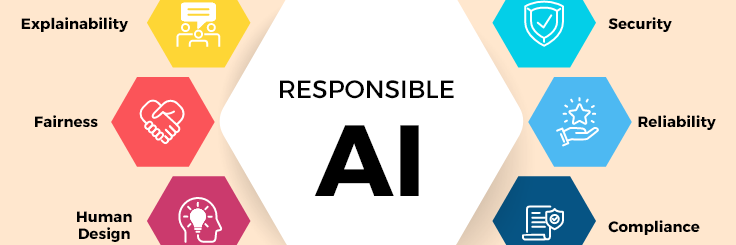
Abstract: Responsible AI refers to the ethical and conscientious development anddeployment of artificial intelligence (AI) technologies. It involves integrating
principles and practices that prioritize the well-being of individuals, society, and the environment, while minimizing potential negative impacts and risks associated with AI. Several key aspects are involved in ensuring the responsible development and
deployment of AI:
1. Ethical considerations: Implementing ethical guidelines and frameworks that prioritize fairness, transparency, accountability, and privacy in AI
systems.
2. Fairness and inclusivity: Ensuring that AI systems are developed and deployed in a manner that does not perpetuate or exacerbate biases and discrimination, and that they consider the needs and perspectives of diverse populations.
3. Transparency: Making AI systems understandable and interpretable to users and stakeholders, enabling them to comprehend the decision-making processes and potential implications of the technology.
4. Accountability and governance: Establishing mechanisms for accountability and oversight to monitor the development, deployment, and impact of AI technologies.
5. Privacy and data security: Safeguarding the privacy and security of user data by implementing robust data protection measures and adhering to relevant data privacy regulations.
6. Social and environmental impact: Considering the broader societal and environmental implications of AI deployment, and striving to minimize
any negative consequences while maximizing the technology’s positive contributions.
By integrating these principles and practices, developers, researchers, policymakers, and organizations can promote the responsible use of AI and
contribute to the development of AI systems that benefit society while upholding ethical and moral standards.
One interesting discussion was that students relate this activity to CSUDH hiring systems and we discussed the challenges present in the student hiring system at
CSUDH and explore the ways in which responsible AI can contribute to improving the student hiring process at the university.