CW Textbooks
Thiel, Diane. Winding Roads: Exercises in Writing Creative Nonfiction. Pearson Longman, 2008. ISBN 978-0321429896.
Winding Roads: Exercises in Writing Creative Nonfiction, written by Diane Thiel, focuses on the Creative Nonfiction genre in a short 287 pages. The book is divided into five parts: Beginning: Points of Inspiration; Exercises for Developing Craft and Technique; Exercises for Exploring Revision, Subgenres, and Frequent Concerns of Creative Nonfiction; A Collection of Creative Nonfiction; Writers About the Art of Creative Nonfiction. The first three parts make up the first 125 pages of the book and are similarly structured, each containing chapters that break down the main topics into smaller elements of writing and then provide discussion, mentor texts, and writing prompts for practicing each element. The fourth section contains the 23 mentor texts that are referenced throughout the book and makes up most of the second half of the book. The texts included are primarily contemporary examples by varied authors such as Amy Tan and Sherman Alexie, with a few classic pieces by Henry David Thoreau and Jonathan Swift included as well to round out a varied selection of texts. The fifth part includes essays written by contemporary creative nonfiction writers and provides an inside look at the process of writing from their perspectives.
Because of its design and the ample practice and modelling it provides, this textbook would be effective for upper-level secondary students and college students alike. Not only does it break down this challenging genre into manageable elements, it also explores each element and technique thoroughly and includes plenty of examples of how these techniques can be utilized in writing. Because this genre is based on memory and facts, beginning the book with techniques to spark memory and record thoughts is effective. However, because it is so important to the genre, more space could have been devoted to exploring pre-writing and inspiration for beginning writers.
Miller, Brenda, and Suzanne Paola. Tell It Slant: Creating, Refining, and Publishing Creative Nonfiction. McGraw Hill, 2019. ISBN 978-1-260-45459-8
There are four parts in this text, Part I Unearthing Your Material, Part II The Many Forms of Creative Nonfiction, Part III Honing Your Craft, and Part IV Anthology. The textbook transitions well from how to derive writing material, to how to turn those ideas into structured creative nonfiction, and then ultimately how to revise and publish your work. Throughout the text, many outside print and online resources are suggested and writing prompts and try it exercises are incorporated as well. The Anthology includes 12 contemporary published examples of different forms of creative nonfiction. I found Part II and Part III to be very useful, however Part I was less instructive. Part I centers around how to form ideas for writing and while there are some great concepts in this section, I think ultimately inspiration will be formed differently for each person, so that becomes a little harder to teach. For the most part, the book offers a wide variety of useful writing advice for beginning and experienced writers. The book provides plenty of opportunity to utilize in a learner centered classroom. I found this text, as a writer to be encouraging and inspirational, and I really appreciated the publishing advice and resources that were included. From a teaching perspective, I could certainly see this book being a very useful tool in the creative writing classroom particularly when teaching creative nonfiction. The book includes information about workshop, revision, and publishing which are all important in the learning process. I would also utilize some of the writing prompts as assignments in a classroom. There is an entire part of the book that focuses on instruction and developing craft which I think is vital in the creative writing classroom. I think the material is easy to understand and could be incorporated in many grade levels, from middle school to college.
This text is a general, comprehensive overview of poetry meant to guide novice and intermediate poets (academic or non-academic), likely applicable to high school age and above. (Experienced, successful poets could likely find some use in it as well, though less so than greener poets.) The body of the text is structured in three main parts: 1) Subjects for Writing, seven chapters which cover common topics, such as death, sex, and world events, on which many poems are focused; 2) The Poet’s Craft, ten chapters which cover literary elements of writing such as imagery, simile, metaphor, meter, different forms such as villanelles, revision, and more; and 3) The Writing Life, four chapters which cover aspects of operating in the world as a writer, from self-doubt and writer’s block to using electronics and getting published. Following the body is a collection of “Twenty Minute Writing Exercises” and four appendices of resources for the writer to draw further information.
Chapters in the first two parts are composed of expressivist, narrative-style explanations of concepts, followed by examples of these concepts in the poetry of canonical poets and poems, and focused analyses of these poems with subordination to the chosen subject. This formula is repeated multiple times per chapter, providing a wide range of examples in terms of both quantity and variety of demographic perspective. Each of these chapters concludes with an “Ideas for Writing” section, which provides writing prompts in the vein of the chapter subject. (The chapters of the third part, “The Writing Life,” are shorter, more straightforward essays on each topic.) The strength of this chapter structure is the specific analysis of the subject in great canonical examples, which provide a display of how to apply each concept at the highest level. However, teachers wishing to teach a unit on a particular concept in the book may want to draw from other sources for a more in-depth introduction to the concept before using this book for its strong examples. The “Ideas for Writing” are also applicable for assignments, and the wide variety allows the possibility of the teacher incorporating student choice and expressivism.
As the text is strictly a primer on the craft of poetry, rather than a classroom-specific guide for teachers, it does not address classroom elements such as workshopping or collaboration from a teaching perspective, but from a participating writer perspective. Also relatively untouched are in-depth descriptions of poetic history, time periods, and movements. As a final area of caution, the age of the book (published in 1997) leaves the risk of becoming increasingly outdated in the temporally important realms of electronics, getting published, and some resources. However, for the timeless areas that the book does cover, it is a great resource. A reading of the canonical examples almost feels like a quick trip through a BA poetry program, and the analysis is not only useful for shedding light on the concepts, but also as a great example of how to analyze poetry. If supplemented with other materials that provide more detail of history, poetry movements, introductions to the concepts, and more current assessments of electronics and publishing, this book could excel in the classroom, especially as a provider of examples and a kickstarter for prompts and assignments.
Behn, Robin, and Chase Twichell. The Practice of Poetry: Writing Exercises from Poets Who Teach. New York: William Morrow, 2005. ISBN 978-0-06-273024-4
Behn and Twichell’s poetry textbook provides a strong introduction to the practice of writing poetry, and as the authors note, the textbook is intended as an apprenticeship into the skills and strategies of the poet, divided into seven units. From the original germ of an idea – what and how do poets teach poetry – Behn and Twichell received input from poets, and the results spread out a smorgasbord of offerings for the poet to try out. The authors even suggest that in this apprenticeship offered to the reader, poets and teachers pick and choose the menu that works for them.
This menu of poetry in practice involves seven samplings. The first lays out ways to start a poem, and then moves into the second area, using physical reality of the senses as a bridge into deeper meaning. The third part deliciously advocates creation of poetic voice, my personal favorite with my background in drama and character, while the fourth stews up an interesting mix of the nonrational mind into the language of poetry. Fifth, these poetic exercises invite the reader to partake of a delightful diet of structure in the language which leads well into the next course:, rhythm, rhyme, and line. The final dessert, although some beginning poets might argue the final disaster, is the focus on revision in the seventh part. Helpfully, the book concludes with appendices for both the poet and teacher: a list of sources for poetry books (although this list is probably now defunct in this Amazon age), a list of referred works in the text, contributor’s notes, and an index. The entire book offers a wide selection of poetic dishes meant to expand the palate and experience of the writer or teacher.
With the structure of the book divided into exercises provided by poet-teachers, each exercise is about two-to-four pages long. Some of these include poems as exemplar texts, but most do not. If there exists one weakness in the text, it is that most of the text only hints at poems to read as models for students, but even here, the introduction cautions that the reader should find a good anthology to pair with the text. Also, most of the poetry that is referred to belongs to 20th century males, with smatterings of multicultural and female poets thrown in. Surprisingly, one little piece de resistance came in the chapter on “Musical Matters: Sound, Rhythm, and the Line.” I had never come across the poetic form of the ghazal, a Persian form of poetry structured around couplets, and Agha Shahid Ali’s introduction to the form was a sublime treat, and totally unexpected.
For poets and teachers teaching poetry, this text invites the practitioner to engage in precisely what its authors intended: apprenticing to become better. Through this collection of exercises, written from perspectives of vastly different poets who teach poetry, a writer could nibble on dozens of new ways to approach, create, explore, and revise poetry. This is where the strength of the book lies, and as an English teacher, I found numerous exercises that I will take with me into the secondary classroom. However, if any weakness exists, it is that the text itself would need supplemental material. For the secondary teacher, this would mean finding poems that appeal to teens as exemplar readings, in addition to more exhaustive and complete texts or materials that introduce students to basic concepts of poetry such as figurative language, prosody, form, and the like. For a college-level teacher or serious writer, this would mean finding anthologies and materials to provide more depth and examples for the various concepts. One strength of the book, however, lies in its constructivist approach, that bit-by-bit, ingredient-by-ingredient, the writer or student will develop skills to become a better poet. Definitely, this book offers that spread of writing exercises that the student, poet, or teacher can partake in, without it being overwhelming, especially given the choices in approach to writing that are given.
With all of this in mind, and with a personal response here, the book offers the most to those who plan to write or teach poetry, either the teacher of creative writing, or students in a workshop or poetry-writing class, and less to those of us who are generalists in teaching English. The very-focused exercises will give the poet enough choices to try out a multitude of practices, while a secondary teacher, teaching general education classes in English, will need to pick and choose from the mix. For instance, Anne Waldman’s “Intriguing Objects Exercise/ “Show and Tell” is one that would work well for composition classes and descriptive writing, as would Richard Jackson’s “Five Easy Pieces,” Elizabeth Spires’ “Writing the Spectrum,” and Roger Mitchell’s “Getting at Metaphor”– all of which present imagery exercises. “Quilting in the Ditch” by James McKean could lend itself well to word usage in either a composition or general English class. In general, the chapter “The Things of the This World” Image and Metaphor” applies most readily to the secondary generalist’s teaching.
Still, several exercises intrigued me as a teacher, and I hope to put them to good use this coming year. David St. John’s “Dramatic Monologue: Carving the Voice, Carving the Mask,” is one that my Speech and Drama students would love, as well as one I would love to teach my PreAP students when we discuss voice in writing. Several of the exercises in the section on voice are ones that would appeal to my students: “The Widow” by Maura Stanton, “The Peasant Wedding” by Mary Swander, “Who We Were” by Edward Hirsch, “Your Mother’s Kitchen” by Rita Dove, “The Night Aunt Dottie Caught Elvis’ Handkerchief When He Tossed It from the Stage of the Sands in Vegas” by David Wojahn, and “Not the Oprah Winfrey Show” by Garrett Hongo. It’s perhaps no surprise to those of us who teach at the high school level that these very visual and dramatic exercises would engage teens readily.
Like any good smorgasbord, this text is a feast. I already plan to incorporate about half of the exercises in my classes, especially where they will work for “bell work” at the start of class. For prosody, for my PreAP students, I will have them memorize “The Meter Reader” written by who-knows-who but offered as a catchy appetizer for learning meter in Thomas Rabbitt’s “The Meter Reader.” Plus, I will put out a spread of the aforementioned exercises for description and imagery in several of my composition classes. And as with any good smorgasbord, the diner leaves with a satiated self, delightful memories of the best offerings, and the desire to return. Behn and Twichell’s text, The Practice of Poetry, definitely leaves the reader with all of these qualities.
 Starkey, David. Creative Writing: Four Genres in Brief. Bedford/St. Martin’s, 2017. ISBN 978-1-319-03533-4.This comprehensive textbook, written by veteran college creative writing instructor David Starkey, instructs post-secondary students on how to write poetry, short fictional stories, short creative non-fiction and 10-minute plays. His premise is that it is easier for teachers to engage students in discussions and in-depth analysis when examining short forms of these creative works (V). Each section of this 375-page text describes one of the genres and uses previously published literary examples to teach the reader about elements of that genre, including literary devices, organization, structure and design. At the end of each section, a rich anthology of readings, diverse yet all in short form, can be read and discussed. The anthology includes 29 poems, 13 short pieces of literary fiction, 10 works of creative nonfiction, and 5 ten-minute plays. Checklists ranging in topic from revising work to structure and design to elements of storytelling are interspersed in the lessons, reinforcing key points made in the text, and providing a handy reference for checking over your own pieces. Each of the four chapters features kick-starters, which are essentially prompts instructors and student writers can draw on to practice and further develop skills taught in the book. Toward the end of the book is a useful glossary of writing terms that appear frequently throughout the text.
Creative Writing: Four Genres in Brief serves post-secondary students well by covering the technical structure of many traditional styles of poetry, as well as free verse, character development and ethical considerations when writing about real people in a nonfiction piece. Students and instructors will find a lot of interesting prompts and ideas in the checklists and kick-starter sections. While thorough and robust, the textbook falls short on specifically providing helpful direction for facilitating workshop discussions and peer review, although the checklists could be used to assist with both these common creative writing pedagogical practices.
Thiel, Diane. Crossroads:Creative Writing Exercises in Four Genres. New York, Pearson, 2005. ISBN 0-321-12761-7.
Crossroads acts as an entry level college textbook rather than a handbook or a guide to the beginning write: a semester’s curriculum in about 400 pages. Beginning with definitions and practice exercises of creative writing basics like diction, point of view, and figurative language, the text then moves on to practicing these basic skills in larger works including creative nonfiction, fiction, drama, and poetry. Thiel follows with a solid selection of sample readings and then finishes with a small collection of writers on writing The readings and reflections are well balanced in both authorship and era. Thiel’s chapters begin with a reminder to review or read from the collections in the back and then are broken into smaller lessons followed by “Suggestions for Writing” that can be used as either as jumping off points for discussions or writing prompts. The text starts the writers off slowly, using exercises and examples to build “Craft and Technique” and is followed in Part Two with the exploration of “Specifics of Different Genres”.
Each Chapter in Part Two that explores genres is broken into many exercises that with workshopping could build into larger, more polished pieces. The sheer variety of subsections and exercises allow for student choice, or more specifically, allows the teacher to choose the skills with which her/his students might need remediation or refinement. Each genre chapter builds to a last section that foregrounds revision in this process and craft-driven text. The Poetry section is most extensive, reflecting the many different forms of the genre, while the Fiction section is the shortest, most likely because it shares some crossover from the creative nonfiction skills that were built in the chapter before. The text is hefty, over one half of the pages are invested in Part Three and Four, the suggested readings and writers on writing. These essays and writings are referenced multiple times in order, according to Thiel, to build the skill of “‘reading as a writer.’”
Crossroads is a solid choice for a new teacher of an Introductory Creative Writing course, but with a multitude of individual lessons and exercises in building craft, the text would also be a great resource for a seasoned teacher, or a secondary teacher who wished to add variety and to supplement her/his typical non-fiction curriculum.
Ehrhard, Michelle, editor. The Portable MFA in Creative Writing: Improve Your Craft with the Core Essentials Taught to MFA Students. Writer’s Digest Books, 2006. ISBN-13: 978-1-58297-694-5.
This book contains an introduction, appendix, and five chapters, which focus on fiction, personal essay and memoir, magazine writing, poetry, and playwriting. Each chapter, written by an author belonging to the New York Writer’s Workshop, gives practical advice regarding the writing, revision, and publication of each type of literature. These chapters use short excerpts from literature as examples for what the author is discussing, but most of the text is from the authors’ point of view. Exercises are also included to help aspiring writers generate topics to write about, and resources for further reading and research are included at the end of each chapter. While five genres are discussed, an emphasis is placed on fiction, the short story in particular. Generative activities and an emphasis on the importance of repeatedly practicing reading and writing indicate the authors are proponents of a process-driven approach to writing. The Portable MFA is meant for individuals who already have a background in English, journalism, or a related field and want to improve their writing skills without obtaining a graduate degree. The text gives useful and plentiful information regarding generative exercises, the literary elements of each genre, and how to get writing published. This information would be useful to anyone looking to become a writer, but it would also be useful as a supplemental text in a university writing class because it discusses elements of fiction and how the elements can be applied in different types of writing. The section in the appendix titled “How to Give Feedback” has useful information for teachers who are organizing a writing class because five specific things to keep in mind while providing feedback are listed.
While this book claims to contain all information traditionally included in an MFA program, its use of specialized vocabulary and specific directions may not be understood by a person lacking enough background knowledge. Also, the importance of revision is emphasized throughout the book, but the text lacks practical revision advice, so someone unfamiliar with how to revise would not benefit from this.
Sellers, Heather. The Practice of Creative Writing: a Guide for Students. 3rd ed., Bedford/St. Martins, 2017.
ISBN: 978-1-319-04016-1
This textbook is broken down into four major components: Basics, Strategies, Genres, and The Writing Life. Each section has its own chapters that break down these major points more specifically with various subsections under its umbrella. The entire textbook aims to be an introductory book for students of creative writing. Each chapter within the textbook starts by introducing each concept by giving advice and instruction. Following these are writing practice prompts so the student can model and apply that concept. At the end of each chapter, there are readings from notable authors and writers modeling and/or providing examples over the concept(s) of the chapter. The sections Basic, Strategies, and Genres are rather useful in this book. They break down what a writer needs to know while constructing and considering creative writing pieces. The last section is probably the least useful. It is mainly about publishing work and “getting noticed” which is usually not a tangible goal for a beginner creative writing student. The textbook’s chapters provide more narrative instruction rather than step by step or an expository approach. The textbook does not provide any structure for completing a writing project or practice in any certain way, it only suggests using the guidelines mentioned, opening up an individual interpretation for writing, instilling more practice opportunities for students. However, it does not mention to the teacher or class how these practices will be presented to the class. No workshop nor class discussion strategies are discussed so the teacher is left to configure how to embed them. The intended audience of this textbook can range from high school to adults. It's reading level is easy to follow and seems personal when reading however its laid back demeanor could be new and confusing to a high school creative writing class who is used to rigorous textual structure. This textbook can also help students and individuals who want to learn the basics of fiction and poetry. It outlines the major literary elements of stories that can be useful in analyzing fiction. As a teacher, the book is more personal to read and easy to follow which allows for better student understanding. It also provides many prompts and practices for students to use as a teacher. The readings are also intriguing and do a good job of referring back to the concept being taught. However, there are many subsections to this textbook that it can be super confusing. It needs to have small, broad sections to layout terms and elements to creative writing so a student can compartmentalize components to creative writing. It jumps from concepts such as form to energy to patterns, to focus, without itself focusing on one thing. Students could become overwhelmed when trying to learn basic concepts and strategies because there are so many categories within them. The textbook also seems to encourage writing for self-expression and personal improvement when creative writing is more about craft and its audience. While certain parts of the textbook can be used for reading material and instruction, it may not serve as the main text for a creative writing course.
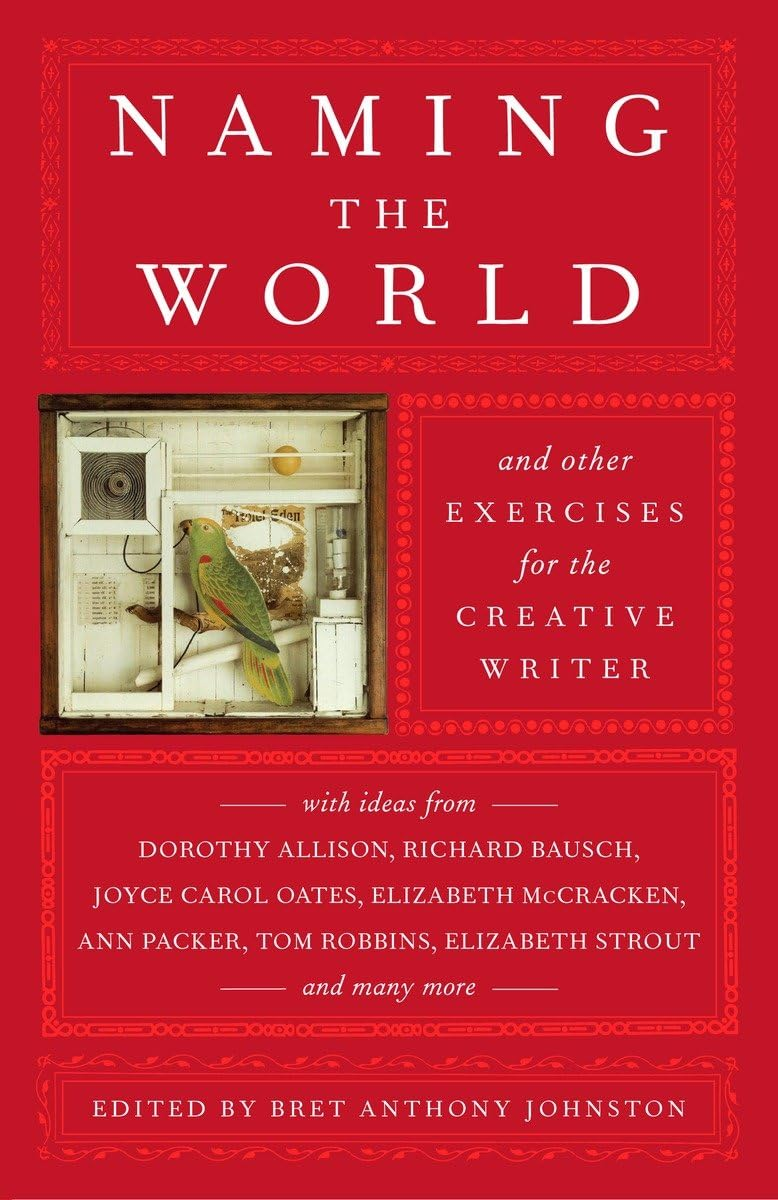
Johnston, Bret Anthony editor. Naming the World: and Other Exercises for the Creative Writer. Random House, 2007. ISBN# 978-0-8129-7548-2
The eight sections of this book offer various prompts to help improve or encourage different areas used to create fiction stories. Each section has an introduction about the topic that will be discussed. The introduction for each section written by Bret Anthony Johnston is followed by various writers including published writers and faculty at notable institutions giving input on writing and exercises for fellow writers to work on in writing including starting a story , character, point of view and tone, plot and narrative, dialogue and voice, descriptive language and setting, revision, and Daily Warm-ups. This book is created for any adult who would enjoy writing a book that want set exercises to improve their ability to generate story content. The specific prompts instruct writers to take some time to practice whichever element of writing the author that has written about focuses on. Precise exercises encourage writers to write about different scenario to improve skills and attention to detail on the chapter’s given element. Although the book is geared to anyone with a desire to write, it could help generate prompts in writing classes where stories are created, and fiction is the focal point. Prompts found in the book could be used to start conversations or in journal assignments to improve outlook on writing as there are prompt that would only take a matter of minutes while others could take up a class period. I believe students would respond to the writings of most of the contributors as they pull the reader in with their thoughts on writing or anecdotes about why they created their exercises. The book could be used as a text book for class, but instructors would most likely best serve their students by choosing some of the exercises for their students to try.