Health and Media: PH 2100
Health and Media: PH 2100
Purpose: to help other instructors teaching the same course
Common Course ID: PH 2110
CSU Instructor Open Textbook Adoption Portrait
Abstract: This open textbook is being utilized in an environmental health science course for undergraduates by Dr. Evelyn Alvarez at CSU, Los Angeles. The open textbook provides a series of online readings that align with weekly topics in environmental health that are also covered in the course’s films. The main motivation to adopt an open textbook was to provide a no-cost course experience to students. Most student access the open textbook in hyperlink format through the course Canvas shell.
Course Title and Number: PH2110 Health and Media
Brief Description of course highlights: PH 2110, Health and Media, is a Race and Ethnicity Diversity Course and fulfills the General Education (GE) component Social Science (Category D). In this course, you will:
- Explore the interplay of the environment and health in a variety of environmental films, podcasts, short stories, and experimental music.
- Study the causes of environmental and health issues that disproportionately affect low-income ethnic minorities and other lower SES (socio-economic status) groups.
- Learn about toxicants in the environment and how they disproportionately impact communities of color
- Critically examine evidence presented in the aforementioned media to defend arguments related to environmental justice issues.
- Learn about jobs in the field of environmental health and environmental justice.
- You will learn how to mobilize yourself, family and friends to take action against environmental injustice issues including how to protect yourself from environmental hazards.
Course Catalog Link: https://ecatalog.calstatela.edu/portfolio.php?catoid=73&add=1&coid=539526#
Student population: Typically, non-public health students interested in public health will take this course. This course has no prerequisites and is a lower division GE course.
Learning or student outcomes:
- Identify ways film can explain health and make it more accessible to the general public.
- Explain how society reflects messages in film and how film reflects messages in society.
- Describe how health messages in film have changed over time.
- Identify and evaluate health messages in film.
- Discuss how various communities are presented in film.
Key challenges faced and how resolved: I don’t think that the Reading List within the Canvas online learning system is the best way to reflect the readings to students so it was a challenge navigating that. I believe the easiest way is to include them is in the modules within the main Canvas page as students have trouble navigating the various access options within Canvas’ Reading List.
Textbook or OER/Low cost Title: PH2110 Reading List
Brief Description: The Reading List for this course is an open source collection of various public news articles and podcasts.
Please provide a link to the resource
https://csu-la.alma.exlibrisgroup.com/leganto/public/01CALS_ULA/lists/6068404920002911?auth=SAML
Authors:
- A Shadow Economy Lurks In An Electronics Graveyard.(Audio file). (2015). In Weekend All Things Considered. National Public Radio, Inc. (NPR).
- Andersen, K., & Kuhn, K. (Eds.). (2014). Cowspiracy : the sustainability secret [Video]. In Cowspiracy : (p. 1 videodisc (approximately 91 min.) :). AUM Films.
- Bruce Friedrich: How Is Eating Meat Affecting Our Planet?(co-founder and executive director of The Good Food Institute). (2019). In NPR: Environment. National Public Radio, Inc. (NPR).
- Can Fast Fashion And Sustainability Be Stitched Together?(Audio file). (2019). In Weekend All Things Considered. National Public Radio, Inc. (NPR).
- Climate change is a risk to national security, the Pentagon says. (2021). In NPR: Environment. National Public Radio, Inc. (NPR).
- Cut emissions quickly to save lives, scientists warn in a new U.N. report. (2023). In Morning Edition. National Public Radio, Inc. (NPR).
- Former Anti-GMO Activist Says Science Changed His Mind.(Mark Lynas on genetically modified organism)(Broadcast transcript). (2013). In Weekend All Things Considered. National Public Radio, Inc. (NPR).
- How Senegal’s artists are changing the system with a mic and spray paint. (2022). In NPR: Environment. National Public Radio, Inc. (NPR).
- E-Waste Is Becoming a Big, Global Problem.(Audio file). (2013). In Talk of the Nation: Science Friday. National Public Radio, Inc. (NPR).
- PFAS “forever chemicals” are everywhere. Here’s what you should know about them. (2022). In NPR: Environment. National Public Radio, Inc. (NPR).
- Sullivan, L. (2020). How Big Oil Misled The Public Into Believing Plastic Would Be Recycled. In Morning Edition. National Public Radio, Inc. (NPR).
- The Drought In The Western U.S. Is Getting Bad. Climate Change Is Making It Worse. (2021). In NPR: Environment. National Public Radio, Inc. (NPR).
- Urgent action is required if losses to nature are to be reversed, WWF report shows. (2022). In NPR: Environment. National Public Radio, Inc. (NPR).
Student access: Course Management System (Canvas)
Supplemental resources: Students get to work on their own screenplay for an environmental film of their choice, and I host an in-class film editing workshop using iMovie where students learn film editing basics in a computer lab so that they can bring their assignment film idea to fruition. Access to the computer lab is free, and the training I provide is part of our classroom learning experience. There are also weekly faculty-only resources such as in-class activities and lesson plans using the board. Some of these included hosting an in-class Clothing Swap, where I bring in a garment rack on wheels and students each bring in an old item of clothing they no longer want and trade amongst themselves. This exemplifies some of the lessons learned in class regarding fast fashion and how it’s associated with environmental emissions and unethical work practices abroad.
Provide the cost savings from that of a traditional textbook. ~$100/per semester
License: Openly licensed and available to the public.
OER/Low Cost Adoption Process
Provide an explanation or what motivated you to use this textbook or OER/Low Cost option. To save students money and to provide a more interactive, non-textbook learning experience where news articles and podcasts could be used in concert with in-class activities and assignments.
How did you find and select the open textbook for this course? Browsed OER sites.
Sharing Best Practices: It doesn’t take that much of an effort to think creatively about how you can enhance a classroom learning experience for a new course by giving up a textbook and instead looking online for interesting, level-appropriate articles. I recommend to any instructor looking to do this to think about how those online readings (and podcasts) could be linked to classroom activities and/or assignments.
Describe any key challenges you experienced, how they were resolved and lessons learned.
My challenge was mainly the Canva Reading List framework, which I don’t believe is the best way to make readings/podcasts available to students. I prefer including them in separate modules within Canvas but that might be a personal preference.
Instructor Name: Dr Evelyn N. Alvarez
Assistant Professor, California State University, LA
Please attach a photo of you (or link to where it appears)
Please provide a link to your university page.
https://www.calstatela.edu/faculty/dr-evelyn-alvarez-mph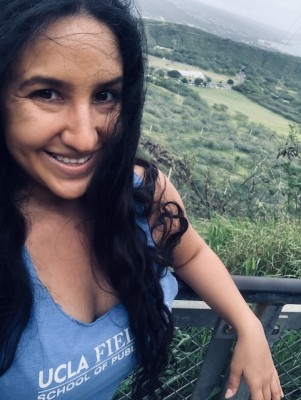 Describe your teaching philosophy and any research interests related to your discipline or teaching. My teaching philosophy is influenced by my experiences not just as a student and teacher but as a mentee. The mentors I have had range from PhD colleagues, post-doctoral scientists, professors, and my grandparents. The lessons they have taught me form the foundation of my teaching philosophy: to encourage first gen students to get out of their comfort zones, exercise free agency, and leverage their strengths by using modern, innovative curriculum so that they represent the Cal State LA B.S. degree in Public Health with dignity, honesty, and dedication. Through this, my students will achieve upward mobility. Through them, I will also grow.
Description of my research agenda: Dr. Evelyn Alvarez, PhD, MPH (she/her/hers) is an environmental health professor, environmental health/geospatial scientist, and her research agenda largely focuses on web-based/smartphone environmental community science applications to address environmental justice issues. She recently graduated from UCLA with a PhD in environmental health science where she focused on the hospital environment and copper antimicrobial surfaces, hospital-acquired infections, and pediatric isolation. She earned her MPH in environmental health sciences, molecular toxicology track from Columbia University. Her research interests also include examining underrepresented narratives in the climate change dialogue and demystifying and making sustainability more accessible to lower socio-economic populations.
Please describe the courses you teach: I teach PH4140 Principles of Environmental Health Science, PH3770 Environmental Justice, PH5130 Environmental Health Science (for masters students), and PH2110 Health and Media. PH 4140 is a required core course for undergraduate students seeking a Bachelor of Science in Public Health with a focus in Community Health. PH 3770 is a GE course that is not required for our students but is offered through our department to fulfill the Natural Science component of Race, Diversity and Justice theme, and with Dr. Zelman’s approval, can serve as a substitute for a Community Health elective if students are having trouble finding a third course outside the major. PH2110 is an elective GE that non-PH majors can take to be introduced to public health in a creative way. PH5130 is a required core course for our graduate program (MPH).