Branches of Ecocriticism: Posthumanism
Branches of Ecocriticism: Posthumanism
Defining posthumanism proves to be a bit of an elusive task, namely, because the term has been used to describe a wide range of theoretical orientations in diverse fields such as philosophy, science and technology studies, literary studies, critical theory, theoretical sociology, and communication studies (Bolter 1). In brief, posthumanism denotes a break away from traditional humanist thought that has operated under the assumption of "man [being] an autonomous agent, separate though still engaged with nature" (Bolter 1). Posthuamists problematize this notion by insisting that humans constitute a continuity rather than a separateness from the natural world (Bolter 3). Thus, the lines between human, animal, and even cyborg—are blurred.
Donna Haraway is an American Professor Emerita in the History of Consciousness Department and Feminist Studies Department at the University of California, Santa Cruz. She is considered one of the most foremost philosophers in the field of cultural posthumanism. Her most famous work, an essay for the Socialist Review entitled "A Cyborg Manifesto," articulates how developing technologies have challenged our idea of the human and the natural. "Late twentieth century machines," she writes, "has made thoroughly ambiguous the difference natural and artificial, mind and body, self-developing and externally-designed, and many other distinctions that used to apply to organisms and machines. Our machines are disturbingly lively, and we ourselves frighteningly inert." Solidly postmodern in ideological orientation, Haraway is also famous for her idea of "situated knowledges," or the idea that knowledge comes from positional perspectives. Taken together, both of these concepts help inform her postmodern understanding of biological processes.
Rosi Braidotti is a continental philosopher and feminist theoretician who currently serves as a Distinguished University Professor at Utrecht University in the Netherlands. Born in Italy yet raised in Australia, Braidotti holds dual Italian-Australian citizenship. Her studies in philosophy began at Australian National University in Canberra in 1970s. From there, she went on to pursue her doctoral degree in philosophy at Sorbonne, which she completed in 1981. Braidotti is most known for her ideas about subjectivity and the posthuman condition. Her 2013 book entitled The Posthuman, lays the groundwork for the ideas that Braidotti further develops in her later publications. The book explores how new technologies have consequently blurred the lines between the technology, nature, and humankind. Taking this into account, Braidotti rightly points out the need to reevaluate humanism and the humanities so that new ways of producing knowledge can continue in our posthuman world.
Cary Wolfe is an English professor at Rice University. He has written on a variety of subjects, including American poetry, critical theory, and bioethics. He is a significant voice in the burgeoning interdisciplinary field of animal studies, which makes use of poststructuralist theory to reevaluate the human/animal distinction. Wolfe calls the rise an animal studies an "academic expression of a larger democratic impulse toward great inclusiveness of every gender, or race, or sexual orientation, or—now—species" (Wolfe 568). Wolfe's contributions to the field of animal studies makes him a significant figure within posthumanism as well. In fact, he is the series editor for Minnesota Press' Posthumanities Series.
According to philosopher Francesca Ferrando, posthumanism is an umbrella term for various theoretical positions concerning human nature. She identifies seven definitions, outlined below:
Antihumanism: Used to describe a widearray of postmodern theories that are critical of traditional humanist ideas. Acknowledges the "death of Man" in light of the postmodern condition.
Cultural Posthumanism: Branch of cultural theory that is critical of long-established humanist theories of art and history. Challenges esstentialism and the prevailing concept of "human nature."
Philosophical Posthumanism: Focuses on the ethical and more implications of cultural posthumanism. Animal rights are a frequent topic of discussion.
Posthuman Condition: The "deconstruction of the human condition by critical theorists."
Transhumanism: An ideology that champions the integration of technology into humans in order to enhance their biological functioning.
AI Takeover: A more radical version of transhumanism that envisions AI technologies replacing human beings in the future.
Voluntary Human Extinction: An environmental movement that argues for the gradual extinction of the human species. Seeks a post-human world.
The Canadian pop artist Grimes frequently incorporates elements of posthumanism both in her visual style and the lyrical content of her songs. And her latest album, Miss Anthropocene, is no different. In fact, I would argue that of all Grimes' albums, Miss Anthropocene is the most overt in terms of its posthumanist themes. The album's eleventh track entitled "We Appreciate Power" is a case in point. Throughout the song, Grimes references several concepts that are central to transhumanist thought. In the bridge of the song, Grimes alludes to brain uploading: "And if you long to never die / Baby, plug in, upload your mind / Come on, you're not even alive / If you're not backed up on a drive." Though the plausibility of mind uploading has been highly disputed in the scientific community, the concept does highlight both the aims and philosophical ramifications of transhumanist ventures. For if we continue to improve our bodies through technological advancements as transhumanists would have it, at what point do we consider ourselves to be no longer human? Grimes continues to explore the frequently blurred line between technology and biological systems in the song's outro: "Neanderthal to human being / Evolution, kill the gene / Biology is superficial / Intelligence is artificial." Thinking like a transhumanist, Grimes ostensibly champions artificial intelligence in the final lines of the song, calling into question those processes we typically consider to be exclusively "natural."
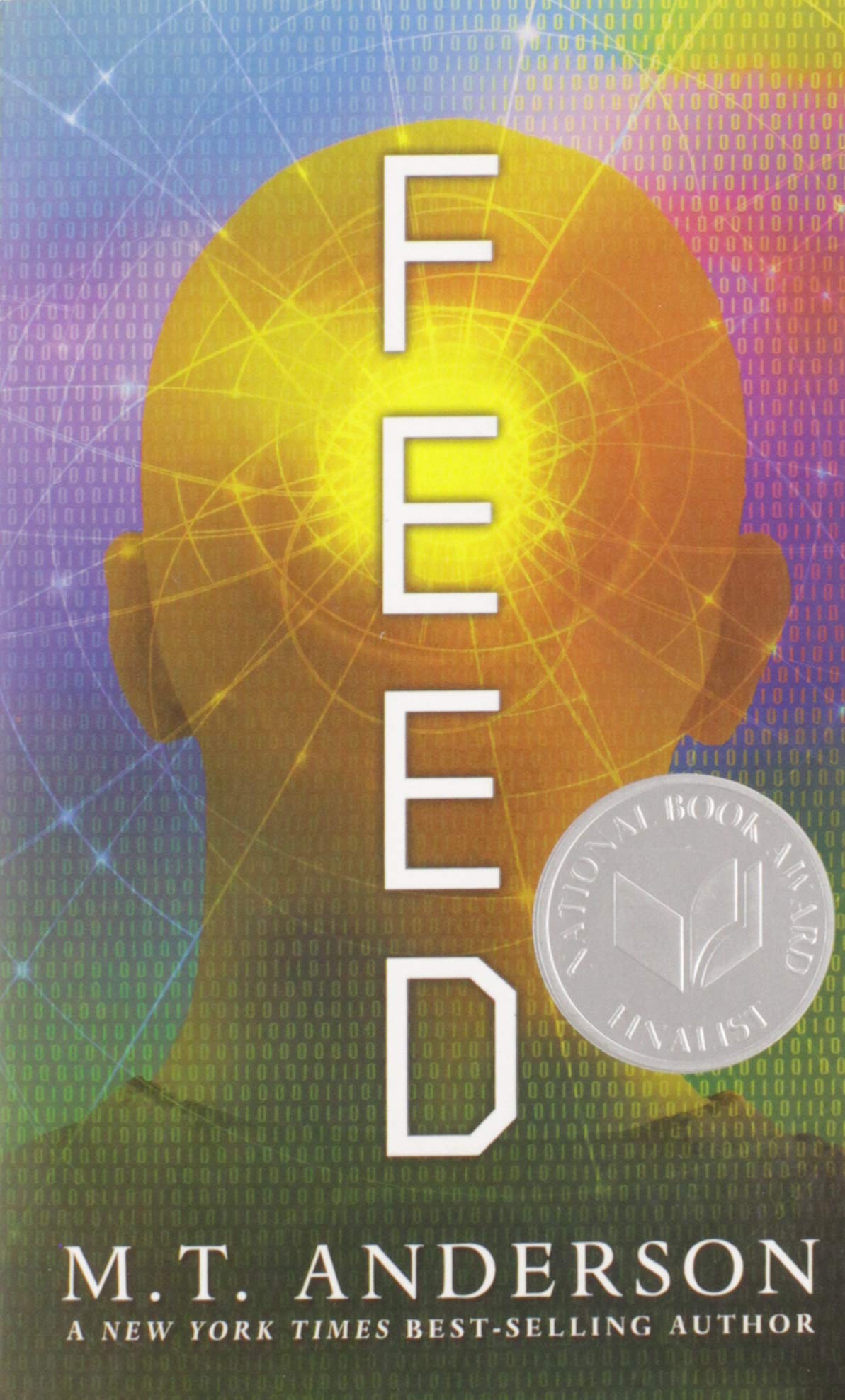 A young adult novel might seem an unlikely place to discover posthumanist themes, but M.T. Anderson's Feed does a remarkable job at crafting a story that explores how humanity is co-constructed through technology. Set in a dystopian future, Feed depicts a world that is completely transformed by technological innovation. One of the most advanced technologies in this dystopian world takes the form a feed that is installed in one's head. The feed allows people to connect to the internet, send messages, and on a rather negative note, be subject to a slew of corporate advertising.
The main character in the book, Titus, happens to have one of these feeds installed in his head, giving young readers a concrete picture of what posthumanist Donna Haraway refers to as the "cyborg." In addition, the lines between the natural and the artificial are blurred throughout the novel. At one point, Violet, Titus' girlfriend, states that "the natural world is so adaptable...[that it makes you] wonder what's natural." Though this blurring of lines between the natural and artificial may seem to paint a gloomy picture, the book's subject matter affords readers the opportunity to sketch ethical frameworks for their own posthuman future. As scholar Richard Gooding puts it, "Viewed as a critical dystopia...Feed sustains readings that are considerably less bleak than the critical consensus suggests: the very technologies the novel resists point to the possibility of developing new kinds of ethically mature subject positions in a posthuman world, a possibility that inheres most forcibly in the ways the posthuman condition troubles Titus' narrative style" (Gooding 113).