Chapter 3 Section 2
Chapter 3 Section 2
Section 1
Introduction: Physical Activity Overview
Learning Objectives |
|
Physical Activity and Exercise for Health and Wellness
The purpose of this chapter is to provide the Nurse Practitioner with evidence-supported information about the potential health benefits of physical activity and exercise for adults to use when guiding patients and for self-care. These benefits include improvement in cardiovascular and pulmonary function; reduction in cardiovascular disease risk factors; decreased morbidity and mortality; enhanced well-being, quality of life, and sleep; improvements in some aspects of mental health, among others (American College of Sports Medicine, 2022).
U.S. Public Health Guidelines for Physical Activity
The 2018 U.S. public health messaging for physical activity (Figure 1) is backed by the best available evidence reviewed by some of the country’s leading experts on exercise, public health, epidemiology, and behavior change. The 2018 Physical Activity Guidelines Advisory Committee Scientific Report (2018 Physical Activity Guidelines Advisory Committee, 2018) has a wealth of information about exercise types, subpopulations, and clinical conditions. This report has also strongly influenced the current generation of physical activity research.
The current U.S. Department of Health and Human Services (DHHS, 2018) guidelines for physical activity state that for substantial health benefits adults need at least 150 to 300 minutes of moderate-intensity or 75 to 150 minutes of vigorous-intensity aerobic exercise per week and muscle strengthening activity on two or more days per week. (cdc.gov accessed June 11, 2023). Persons with chronic health conditions and disabilities who are unable to meet these recommendations are advised to be as active as possible and avoid inactivity. For adults aged 65 years or older, balance exercises are also recommended.
Figure 1
Physical Activity Guidelines, CDC. Health.gov/PAG_MYW_Adult_FS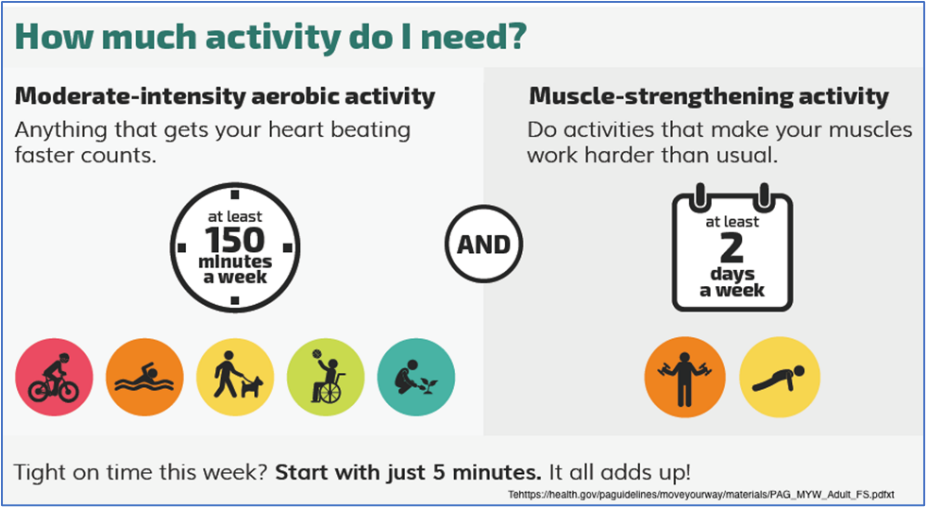
Although this chapter focuses on adults, the physical activity recommendations for children are
modified for age and motor skill development. In the age group of 3 to 5 years, children should be physically active throughout the day and encouraged to play. For children aged 6 to 17 years, 60 minutes of moderate-intensity aerobic exercise daily, with high-intensity exercise on at least 3 days per week. Muscle-strengthening exercises (e.g., push-ups) and bone-strengthening exercises (e.g., jumping) are recommended on at least 3 days per week. See the CDC website for further information.
Physical Activity Participation in the U.S.
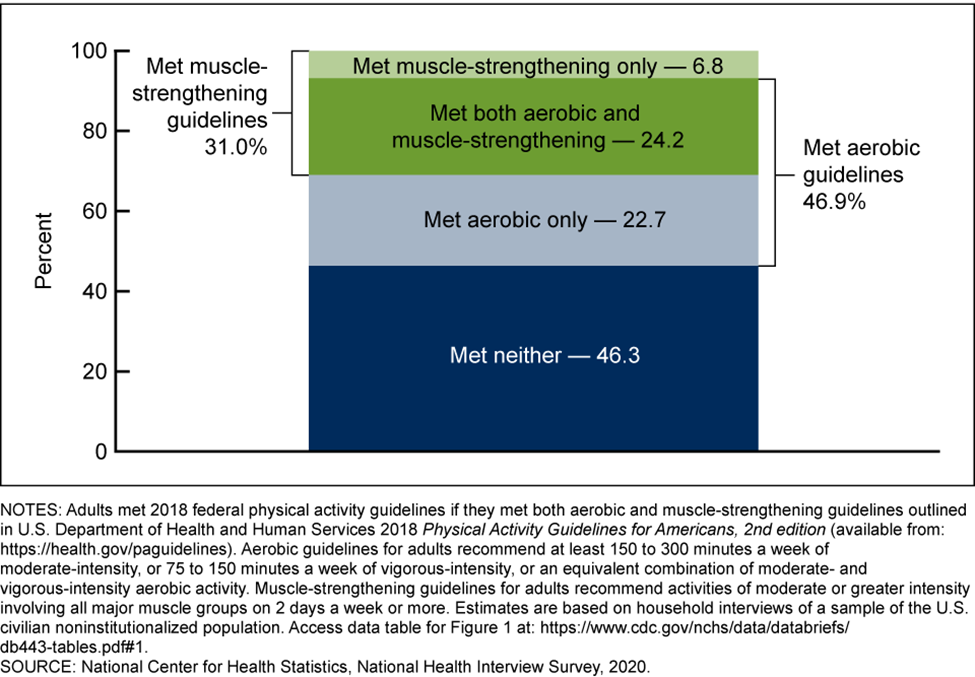
Despite public health messaging extolling the health benefits of physical activity, the majority of the U.S. population is inactive. In 2020, only 24% of adults met both aerobic and muscle strengthening guidelines whereas 46% did not meet either guideline (Elgaddal et al., 2022). Among physically active people, more are likely to meet the aerobic (47%) than muscle strengthening (31%) guidelines. The percentage of adults meeting both physical activity guidelines (Figure 2) decreases with age and is lower in women than men, in Hispanic men compared to Non-Hispanic White and Black men, in Hispanic, Non-Hispanic Black, and Non-Hispanic Asian women compared to Non-Hispanic White women, and persons with the lowest income (Elgaddal et al., 2022).
Figure 2.
Percent distribution of adults aged 18 and over who met 2018 Physical Activity Guidelines for Americans for aerobic and muscle-strengthening activities: United States, 2020
Participation in physical activity also varies by geography (Abildso et al., 2023). The U.S. Census Bureau West region had the highest prevalence of adults meeting the aerobic, muscle-strengthening, and combined guidelines (52, 35, and 28%, respectively) and the South region the lowest (43, 29, and 22%, respectively). Residents of the most rural counties were the least likely to meet the guidelines (38% aerobic, 21% muscle-strengthening, and 16% combined). Given these statistics, the nation is not meeting the physical activity guidelines recommended for health benefits. the provider.
Before delving into some of the many health benefits of exercise, the provider must realize and accept that exercise is a behavior, and behavior change is difficult. It is helpful to meet patients “where they are” and to suggest small changes in daily physical activity that are enjoyable, or at least tolerable, and provide opportunities for small successes to maintain the behavior. The CDC has excellent tools for the general population and professionals seeking to instill and maintain an exercise habit (cdc.gov accessed June 11, 2023).
The nurse practitioner must be aware of the characteristics of the patients and the community in which they live, work, and play when discussing physical activity. |