Flipping Short Course in Calculus for Natural Science Majors - e-porfolio
Flipping Short Course in Calculus for Natural Science Majors - e-porfolio

Flipping Short Course in Calculus for Natural Science Majors
Sunny Le
California State University, Fullerton
Course Name & Description: Math 130 Short Course in Calculus. Survey of differential and integral calculus and applications. For students of biological and social sciences, business and economics.
Project Abstract: Short Course in Calculus is a “bottle-neck” math class for various natural science majors. This project is to redesign a traditional lecture class into a flipped classroom model. The primary goal is to improve passing rate and to reinforce our campus commitment that “every enrolled student will experience at least two High Impact Practices (HIPs) classes.”
GE Credit: 4 credit hours.
Instructional Delivery: In-class
Pedagogical Approaches: Flipped, Supplemental Instruction and Clickers.
Class Size: 30
About the Course Redesign
Background on the Redesign
Short Course in Calculus (Math 130) has been identified as one of the high demand and low success courses among the 22 CSU systems. In the fall 2015 and spring 2016, among 441 of our enrolled students, about 150 of them (more than 34%) received a repeatable grade. Since this percentage is particularly high, the need to redesign the course is imperative. Most natural science major students need to successfully pass Math 130 in order to take upper division classes required in their disciplines, such as Statistics Applied to Natural Sciences (Math 338), Volcanology (GEOL 408), or Principles of Physiology and Ecology (BIOL 274). Redesigning the course will have a positive impact on improving academic success, retention, and most definitely graduation rates. In addition, since CSUF has been identified as the model campus for High Impact Practices (HIPs), once successfully implemented and redefined, such redesign course in Short Course in Calculus can then be shared and adopted among CSU system-wide.
Purpose for Course Redesign
A major learning problem often arises in this course at our campus is that Math 130 covers a large breadth of topics from limits and derivatives (Calculus 1) to Integration (Calculus 2) and Differential Equations and Multivariate Calculus (Calculus 3) in a limited 16-week instruction. Both the instructor and students are forced to rush through course contents too quickly. This creates the lack of deeper learning and prevent students from retaining the necessary knowledge and skill sets to better prepare for their next class. Hence, the main objective of redesigning the course is to significantly reduce the amount of class time devoted to lecture and to increase the time of active learning and problem-solving techniques. In fact, the redesign class will transform classroom environment from instructor-centered-and-lecture to student-centered and peer-collaboration. It’s especially important to provide students in-class time to practice and expand their understanding on new mathematical concepts. Also, the redesigned class will provide the instructor more time in class to interact with students to either provide early intervention and additional assistance or to simply assess each student’s level of competence on the daily targeted learning outcomes.
Preredesigned syllabus
Syllabus used for the course before the redesign
About the Students and Instructor
Student Characteristics:
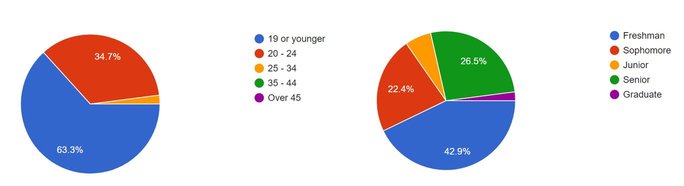
A survey of student characteristics was conducted in all Math 130 classes during the Fall 2017 semester. The results are shown below:
1. Age Group and Classification: Most students are freshmen and met the prerequisite to take Math 130 during the first semester.
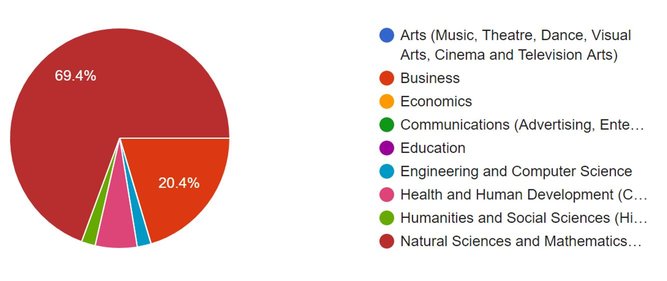
2. Major: Almost 70% of the students is a Natural Science major. These students are less likely thrilled about Math and always struggle with the topic.
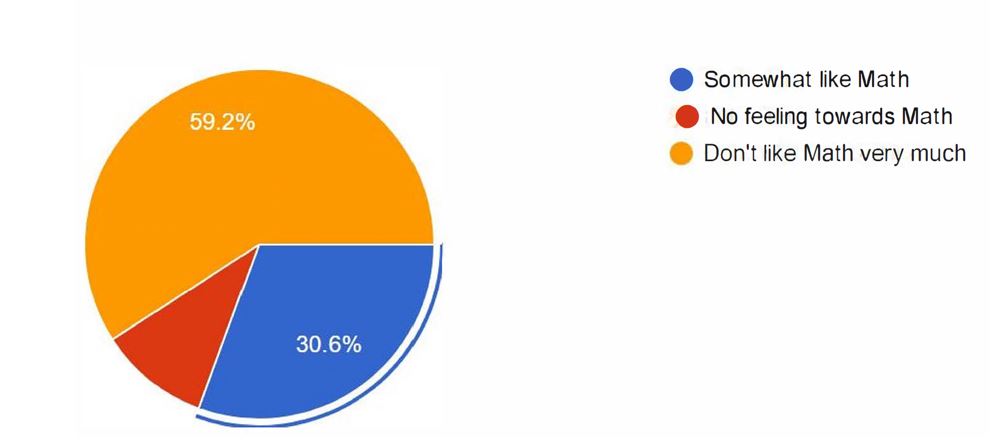
3. How do you like Math?
More than half students admitted that they don't really like Math due to many reasons. Because of the fear and dislike the subject, many students are held back and cannot perform well in a Math class. This is why it's important to redesign the course to improve student's success.
Advice to Students:
- Plan ahead. Check-in class two-to-three days prior to the semester. Professors normally send out welcome email several days before to the start of a semester. Research about the flipped class if the class was assigned as “flipped”.
- Watch a 5 minutes clip made by the campus about a flipped class and its benefits. Students will have access to the first chapter video modules and the first section TITD to prepare for first class meeting.
- Always come to class prepared.
- Utilize online discussion board to collaborate and/or ask general questions about the course.
- Don’t let yourself fall behind. Get help as soon as possible. Familize yourself with all the resources on campus. Visit the tutoring center, be sure to know where and when the professor holds office hours.
- Find a study buddy and/or form study group first week of class.
- Make an appointment to meet your professor after each exam/midterm to check academic progress and/or to seek guidance. There is always room for improvement.
Impact of Student Learning Outcomes/Objectives (SLOs) on Course Redesign
This one-semester course is designed to be an introductory course in calculus centered around classical and contemporary applications from the business, economy, and life sciences. The course will emphasize the following topics:
- Curve-fitting and predictive mathematical models.
- Construction of linear and exponential functions.
- Classical and contemporary applications of linear and exponential functions.
- Discrete and continuous rates of changes of populations.
- Classical and contemporary models of differential equations.
Alignment of SLOs With Course Redesign
- The course contents and SLOs will not change. However the material assessements need to be adjusted carefully to measure the success of this new course as well as students' success.
Assessments Used to Assess Students' Achievement of SLOs
- Before class: Students will watch online module with/without embeded quizzes and to complete a quick 3-4-question Ticket-to-the-door (TITD) prior to coming to class. In order to earn access to the TITD, students need to score at least 70% on the embeded quiz. Students may take the quiz as many time as needed.
- In-class: First, the instructor will briefly review the topics covered in the online video and answer "muddiest point" questions. Then pre-selected student(s) will present the TITD on the board while the whole class carefully confirm and/or correct the answers accordingly. After that, students work in pre-assigned groups of 3-4 on in-class worksheet. Informative assessment may be used as the instructor walk around the class to check student's work. Before the end of each class session, students will present in-class actitivites to each other.
- After class: Students will complete the online homework and prepare for the next class meeting.
- Take-home project: About 3-4 projects will be assigned per semester. Students are to apply what learned in the course (derivative, differential equations, exponential equations, integration) to a real-life question. Students have a choice of choosing a small project in the back of each chapter, or write a summary of what the topic is about.
- Midterm and Final Exams: Three midterm and one final exams will be used to assess students' overal achievements of SLOs and course contents. The exams will be designed to test students' understanding of the concepts being covered in the course. This means that the exams will not consist solely of problems that closely resemble homework problems. Instead, they may contain problems that combine two or more different concepts from different text sections.
Accessibility, Affordability, and Diversity Considerations
Accessibility
- The online video modules are recorded using either Camtasia or Adobe Captivate in segments that are about 10-20 minutes with caption. Additional lecture notes and extra video links will also be posted and shared with students.
Affordability
- The online video modules, in-class actitivities worksheets, and additional lecture note resources will be posted on TITANIUM at no cost.
- The cost of ebook with online homework is approximately $104.
Diversity
- The pedogogial strategy combining online video module and collaboration learning have been proven to better engage underrepresented, unprepared and underprepared students in Math classes.

About the Instructor:
My name is Sunny Le, and I have been a part-time lecturer at CSUF since Fall 2012. I earned both Bachelor and Master of Arts Degree in Applied Mathematics and have taught a variety of courses from Algebra, Calculus and Statistics. Growing up with only one dream in mind: to become a Math professor, I have always wanted to be that professor who, even after decades in the classroom, still leaves each session asking how the next could be better, or how to better engage and inspire this group of students. It is my hope to inspire some students to pursue higher level math courses, but in general to have as many as possible walk away with the confidence that they can succeed. Thus, I'm always searching for a new teaching pedagogy to improve students' success in a Math classroom.
Course Redesign Planning
Implementing the Redesigned Course
Aspects of Redesigned Course
- I used to lecture with some question/answer for 90 minutes and group activities for 30 minutes. Now I "flipped" the classroom and have the students solve problems in groups of 4 during class after I present a 10-15 minute mini-lectures.
- After students finish in their groups, each group will write the complete solutions on the board and the rest of the class will have to check the solution.
- Students are actively working in their groups, and never hestitate to ask questions.
Adopted Technologies
- I use Adobe Captivate and Camtasia to create the video and load them to Moodle.
- Students are also given pdf files of the video slides in which they can take notes as watching the modules. Students may print hard copy or save an electronic version on their tablet.
- Homework is done using publisher website.
Professional Development Activities Participation During Course Redesign
- I attend Professional Learning Community (PLC) webniars and the Math cohort meetings whenever I can, and/or watch the archived recording of the PLC webniars.
- Some key learning concepts that I applied to my course redesign are student's retention, student's engagement in class, and how to make the video more student's friendly.
Additional Resources for the Redesign
- I have talked to my colleagues who teach the same class to see if they are willing to compare the result of student's success at the end of the semester.
- I have also contacted the campus technology center to make sure the videos work well on the LMS system.
Revised Syllabus
Syllabus used after the course redesign
Redesign Results
Course Redesign Impact on Teaching and Learning
- The course redesign strategies have completely transformed the teaching and learning pedagogy from passive traditional lecturing to a student-centered and active learning approach. Lectures usually take 10-20 minutes with the remaining 100-110 minutes of group work activities. Non-math science majors are now given the opportunity to explore and practice the math concepts in class. As the result, students with weaker skills get the immediate assistance from peers and myself as the instructor. This one-on-one interaction has helped both the students and instructor identify the strengths and weaknesses. Students also learned how to write complete and correct solution to a problem while working in groups.
- Prior to the beginning of the course, I have carefully aligned all the learning outcomes and built them in embedded video module quizzes (to assess student's understanding while learning the material) , the ticket-in-the-door (to assess learning outcomes afterwards), and written exams. While partial credits are not given in the quizzes and ticket-in-the door, little-to-none was given on written exams. Students need to pass the video module quizzes with a 70% or better before they have access to the ticket-in-the-door. This helped them to become better note-takers and always check their work before submitting an answer. Since immediate feedbacks were given during in-class activities, minimal partial credits were needed on written exams.
- In my experience from teaching both the non-flipped and flipped version of the course, students are far more successful in the flipped course. They quickly formed study groups and take their success seriously in the class. I feel that the peer pressure motivated them to take charge in their own learning and thrive to be better. When asked to present the solution on the white board, students were very eager to "show off." They worked well in groups, and were willing to help their peers to succeed.
Assessment Findings
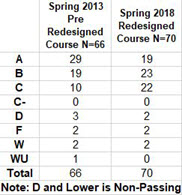
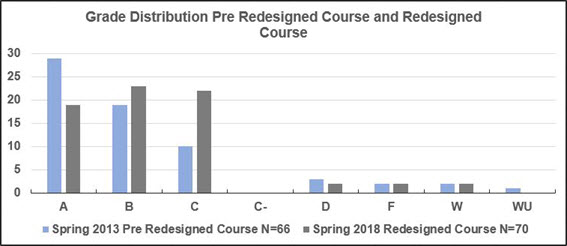
Since I don't have access to the department's statistics yet, I used classes that I taught in Spring 2013 and Spring 2018 to measure the outcomes of the flipped model. Not to my surprised, the flipped classes did much better than the non-flipped classes. In the Spring 2013, C or above was considered passing, and there was no C- or D given. In the Spring 2018, D or above was considered passing for General Education requirement. Although there may be an argument of the increase in passing grade due to this change, I still see significant improvements in student's learning in the flipped model. 91% of students passed in Spring 2018 compared to 88% in Spring 2013. All students in flipped classes received a grade higher than a D. There are 7 sections of Math 130 in Spring 2018, the average GPA of all sections is 2.27, and the GPA of flipped classes alone are 2.74 and 2.76. This is a great indicator to show the effectiveness of flipping this course.
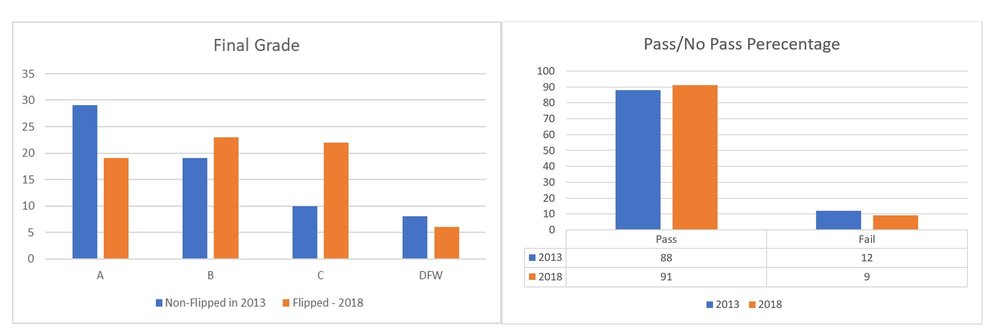
The table and graph below show the actual count of the course before and after the redesign broken out by specific grade distribution.
Student Feedback:
From a google form class evaluation survey at the end of the semester:
- What aspects of this course were most useful or valuable?
- Group work
- Worksheets in class, homework, and teacher’s explanations
- More professor-student time. If there were questions, she could help me right away and take her time rather than rush through and not help me.
- the review before going over the titd
- Working with my classmates and getting assistance from the professor.
- I thought the class groups were very helpful as we worked out the problems together. The flipped classroom itself was useful because it allowed me to better my math skills as the instructor was there guiding me.
- the classwork was very helpful in understanding math concepts.
- The time spent in class where we were able to ask questions and get a lot of examples so we could better understand the material.
- Being able to collaborate with our group when working on classwork.
- The TITD because I had to try before class and can see how far I got and what I needed to work on for the day.
- Effective use of class time to work through problems and ask instructor for help.
- The ability to take as much time as I needed to understand a topic.
- The fact we did the modules before the class so we could only focus on the material that gave us the most trouble.
- Review at the beginning of class, it cleared up any unanswered questions we may have had.
- Knowing what we were leaning ahead of time.
- I liked teaching ourselves and being able to have the class time to ask questions.
- We got extra extra on the lesson at home and in class.
- The way the class was structured was great.
- The online modules and the tickets in the door.
- The online lecture videos before class.
- The activities and the ticket through the door
- The teacher.
- The videos! And how thorough the class was because it offered a lot of time for questions.
- The classwork
- How would you compare this course to a regular lecture course or another flipped course that you had?
- Professor cares.
- flipped courses are nice because there os more teacher-student interactions
- Lectures take more time but the explanations are sometimes easier to understand than the videos. Flipped courses take up more time in a way that as students we had to also find time to watch the videos rather than the homework.
- I am a huge fan of the flipped course. I feel that I have more time to study the material and work on practice problems rather than sit through a lecture.
- I liked it better than the regular lecture course because practicing problems is more effective than taking notes for me.
- This course was more difficult compared to my previous flipped math class, most likely because the topics covered in the class were all new to me. This class was less enjoyable for me compared to the previous flipped math course I was enrolled in.
I think the time is used wisely in flipped courses because it gives more time for students to better their skills as well as ask questions. - I did much better in this kind of math course than if had done a regular math course.
- A flipped course was definetly better than a regular lecture styled class and in the future, I will certainly prefer taking a flipped class than a regular one.
- It is better, because we already knew the gist of the material prior to coming to class and when the professor would go over the material we knew what she was talking about. It was better than a previous regular lecture math course .
- This flipped class has allowed me to pay more attention in class.
- Longer class periods allowed more student teacher interaction. Previous flipped course I had was for 50 minute classes. Fifty minute classes do not provide enough time to work through lots of examples.
- I think they were fairly similar because during lecture there is still a review portion that explains any questions I had about the module. This was my first flipped course and I thought it went very well.
- I liked it a lot more. I actually performed better in this flipped classroom than my previous regular math classes.
- this is my first flipped course but compared to the other math lecture classes I have taken this was better being that the video broke down the concept and the class ingrained it in our mind.
- it helps in learning the material more efficiently.
- It's a little bit more difficult.
- This one was actually more helpful surprisingly.
- It made me more engaged in the class.
- I have not had a math course that was not flipped so I am not sure but compared to other classes such as biology it is much easier to learn through the videos and the worksheets.
- I am able to grasp concepts a lot easier with the flipped course.
- this flipped course was great I would like more of a lecture still in it but having to be able to learn it on our own is good because first students will actually have an idea on what they will be learning for class and it helps to create a better schedule because we can do the work on our own time not on a specific date.
- It was significantly better! I like the fact that the course offered a lot of opportunities to recall information. It helped me retain the information a lot easier.
- I passed this one and not the other... But this class actually interested me and i was motivated to pass because i was actually understanding the material unlike my other class which i had failed.
- I actually enjoyed this flipped course because you are able to understand the material that you don't understand more. You also won't have to listen to the professor lecture all class time.
Challenges My Students Encountered
- Technology: Some video modules took longer to load, and/or froze suddenly. Some students experienced difficulty with the module not recording their progress.
- Time management: Some students couldn't complete the online modules before class and/or homework after class due to the lack of time management skills.
Lessons Learned & Redesign Tips
Teaching Tips
- The key success in flipped class is how the instructor presents his/her belief in this redesign course at the beginning of the course. When the students see the excitement in their instructor, they will do better.
- The instructor must also make sure that all course materials and activities are aligned to course standards and competency prior to developing the video modules. The video modules need to be condensed enough to cover the section's objectives as well as to maintain student's attention. It's good to create a large pool for in-class activites prior to the semester and adjust them according to student's level in each class.
Course Redesign Obstacles
- At the beginning of the course, it was a bit challenging to convince students to like the flipped course. This is why the instructor plays an important role of how students will succeed in a new course. Some students have already experienced an unsuccessfull flipped course, they tend not to believe in this model. As they saw my enthusiam about this course redesign, they started to believe as well.
- Another obstacle is making students to work in groups. Some students prefer working alone, and I usually respect that. I tend to create a longer worksheet to encourage them to work at least in pair to finish all the problems.
Strategies I Used to Increase Engagement
Several strategies were employed to increase student's engagement in class:
- Significantly decrease the traditional lecture time to about 1/8 to 1/6 of the time period.
- Group activities.
- Short presentation of group activites using the white board and/or Google docs. After completing the group activities, teams of students are responsible to load the correct answers on Google docs to share with the whole class.
- Early interventions. I circulated throughout the classroom during group activities to make sure all students were engaged and productive as well as to offer help to those that are struggled.
Instructor Reflection
Overall, thanks to the redesigned course, students took charge of their study and became far more active in the learning process. Group-based activities and one-on-one interaction with the instructor has helped students to understand and master the course competency and prepared them for the next course.
At first, I was worried that the flipped course wouldn't be as effective as I had envisioned. I was concerned about how to keep students engaged in group-based activities in such a long class (1 hour 50 minutes). Little did I know, students were actually excited working in groups. I really enjoyed circulating around the classroom and saw the excitement in each group and how students would find different ways to tackle a problem. This new experience will definitely change the way I teach in the future.
- I would like to thank the Chancellor's Office for this amazing experience. All the Professional Learning Community and discipline-based meetings have enlightened me to many great teaching pedagogies and helped me to improve as a professional.