3R Framework and 3R Rubric
3R Framework and 3R Rubric
In recent years, there has been considerable interest in using Generative AI. In particular, students may use it for doing assignments (e.g., essays and programs). Therefore there is a strong need to take into consideration the use of Generative AI in grading assignments. Here, a 3R framework is proposed to facilitate the grading of Generative AI-related assignments.
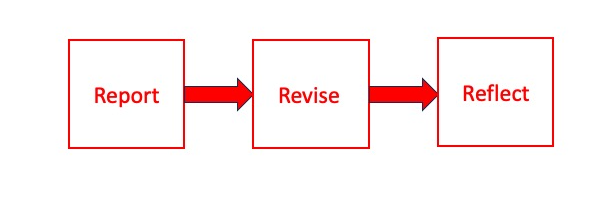
The 3R framework consists of three core elements:
(1) Report: Students should report what and how they have used the Generative AI tool(s), including an overview of the Generative AI output. The original Generative AI output should be provided.
(2) Revise: Students should revise the Generative AI output based on their own work. The revised output should be provided.
(3) Reflect: Students should reflect what they have learned (i.e., learning reflection).
In addition, the following 3R rubric with suitable weightings is proposed for assessment purposes (i.e., to determine a grade taking into consideration the 3R elements with suitable weightings):
| A+/A/A- | B+/B/B- | C+/C/C- | D+/D/D- | F | |
|---|---|---|---|---|---|
| Report | Full report with comprehensive information showing in-depth understanding | Clear report with most information showing clear understanding | Acceptable report with sufficient information showing basic understanding | Weak report with barely adequate information showing weak understanding | Poor report with insufficient or unclear information showing poor understanding |
| Revise | Transformative or significant revision showing excellent contribution | Major revision (possibly with minor deficiencies) showing good contribution | Basic revision (possibly with acceptable deficiencies) showing satisfactory contribution | Little revision showing weak contribution | Inadequate revision showing poor contribution |
| Reflect | Critical reflection showing excellent learning | Clear reflection showing good learning | Basic reflection showing satisfactory learning | Weak reflection showing little learning | Poor reflection showing insufficient learning |
Note: Suitable weightings should be assigned to each 3R element. D- may be optional.
The effective grade is then determined by the following GPT formula:
G* = G x PT
where
G* is the effective grade (i.e., the student's final grade)
G is the grade of the submitted output (i.e., Generative AI output together with the student's input)
PT is the proportion term (0 to 1) as determined by the 3R rubric
Let's consider the following example. Suppose that we have the following PT table:
| GPA based on the 3R Rubric (Band) | PT |
|---|---|
| 0 | 0 |
| 1 | 0.3 |
| 2 | 0.7 |
| 3 | 0.9 |
| 4 | 1.0 |
If a student can get 4 based on the 3R rubric, his/her grade is not affected. However, if a student gets 2 based on the 3R rubric, the effective grade will be reduced by 30% (i.e., by a PT of 0.7). Note that it is a general approach as teachers can determine the weightings and PT table based on their needs (e.g., nature of assignments).
Based on the 3R Framework and 3R Rubric, below please find a report form to facilitate the grading of Generative AI-related assignments/projects. You can use/adapt/modify the form based on the corresponding Creative Common License.
Report Form for the Use of Generative AI
If you have any comments or suggestions, please email them to Henry Chan at cshchan@comp.polyu.edu.hk.