Latin American Bildungsroman/SPAN 5503
Latin American Bildungsroman/SPAN 5503
Purpose: to help other instructors teaching the same course
Common Course ID: Latin American Bildungsroman/SPAN 5503
CSU Instructor Open Textbook Adoption Portrait
Abstract: These open texts are being utilized in a literature course for undergraduate or graduate students by Dr. Esteban Córdoba at CSUSB. These open texts provide students with a greater understanding of the theme of the Bildungroman, or the coming-of-age narrative, which can be used in the context of Latin American literature and culture. The main motivation to adopt open texts was to save students money. Most student access the open texts directly on the Canvas page or via hyperlinks on the course syllabus.
Course Title and Number: Latin American Bildungsroman SPAN 5503
Brief Description of course highlights: Capstone seminar focusing on representative themes in the field of Spanish American literature, culture, theater or film. May be taken 2 times for 6 units.
Semester Prerequisites:
SPAN 3301 and SPAN 3302, SPAN 3303, SPAN 3305, SPAN 3307 or SPAN 3309, Span4401 and SPAN 4402, SPAN 4403 and SPAN 4404.
Student population: As this is an upper division seminar course, all the students were Spanish majors. Two of the students were in their first year of graduate studies.
Learning or student outcomes:
Define the Bildungsroman literary genre, as well as describe anthropological and psychological interpretations of coming-of-age stages.
Discuss the varying ways the theme of bildungsroman has been explored in Latin American literature, film, and culture.
Identify the most important iterations and aspects of the bildungsroman in Latin American literature, film, and culture.
Demonstrate effective skills in analyzing and interpreting written and audiovisual materials.
Create an audiovisual project from scratch - from outlining to writing, and from filming to editing.
Key challenges faced and how resolved: Maintaining active student engagement as this was an asynchronous course. The way I resolved this was by being hands-on and available throughout the semester.
Textbook or OER/Low cost Title:
Margaret Mead, Coming of Age in Samoa:
Michel Montaigne, “Of Age”
https://www.gutenberg.org/files/3600/3600-h/3600-h.htm
Franco Moretti, The Way of the World
https://archive.org/details/wayofworldbildun0000more
Brief Description: These texts an essay and an anthropological study.
Please provide a link to the resource
Authors: Margaret Mead; Michel Montaigne; Franco Moretti
Student access: Course management system (CANVAS),
Provide the cost savings from that of a traditional textbook. These texts on average would have cost anywhere from $20.00 to $40.00 (each one).
License: Openly licensed
OER/Low Cost Adoption Process
Provide an explanation or what motivated you to use this textbook or OER/Low Cost option. I wanted to save students money and improve their retention and success in the course, for the cost of books/textbooks is a rather big financial burden on them.
How did you find and select the open textbook for this course? I spent hours browsing a myriad of websites until I found ones that I thought would be an ideal fit for my class. Having identified an OER text, I continued to search for other versions of it until I found the one with the best quality.
Sharing Best Practices: . I think that patience and flexibility are necessary when embarking on OER texts or Low-Cost materials. Dedicate the time to do the necessary research of these materials and be willing to adapt your planned/perspective readings based on what you were able to find.
Describe any challenges you experienced, and lessons learned. Besides the time spent searching for the texts online, I didn’t really experience other challenges. Sometimes an OER text would not have a properly legible font but that was easily fixable.
Instructor Name: Esteban Córdoba
Asst Professor of World Languages
California State University, San Bernardino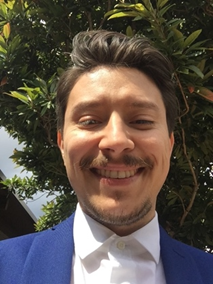
Please provide a link to your university page.
https://www.csusb.edu/profile/esteban.cordoba
Please describe the courses you teach.
SPAN 3302
SPAN 3303
SPAN 3309
SPAN 3310
SPAN 4409
SPAN 5503
SPAN 5507
SPAN 6630
SPAN 6653
Describe your teaching philosophy and any research interests related to your discipline or teaching. My teaching philosophy is based on two principles: create an atmosphere propitious and safe to learning, in which critical thinking is the cornerstone, and understand the needs and goals of the students, as well as their learning styles, in order to craft relevant ways of introducing content. In this regard, I am convinced the Margaret Mead; Michel Montaigne; Franco Moretticommunicative approach to language teaching, which facilitates the creation of learning environments where culture and language are mutually embedded, is an effective and empowering method that proves to be successful in non-language classes too.