Twilight Struggle
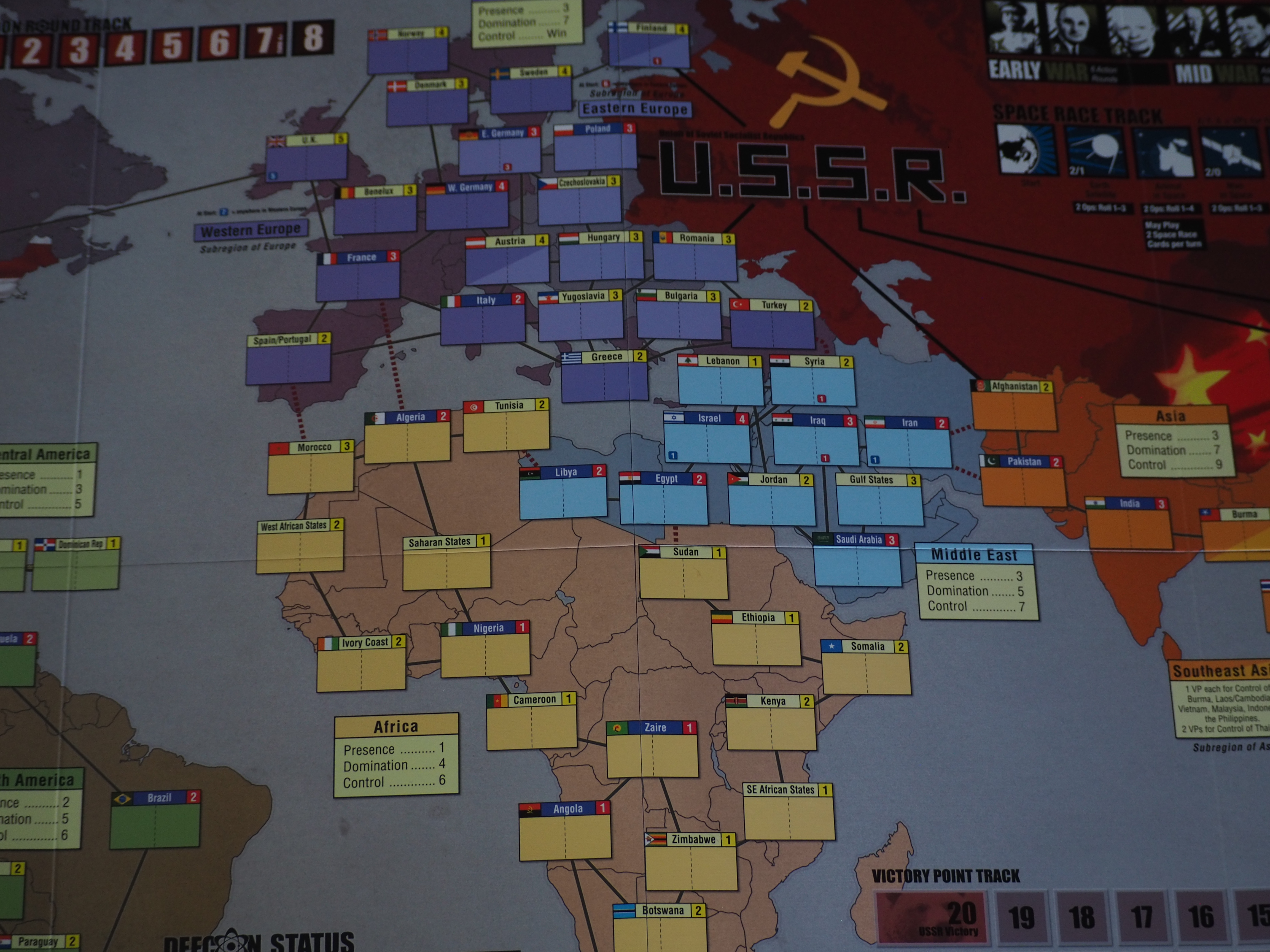
Topics: Cold War; Nuclear Weapons; Coup d'état; Domino Theory
Political science courses: International Relations; Peace and Conflict Studies
Other disciplines: History of the Modern World
Similar games: 1989: Dawn of Freedom; Imperial Struggle
Number of players: 2
Type of game: A two-player symmetrical strategy game
Learning goals:
- Students will be able to analyze how nuclear weapons affect state behavior.
- Students will be able to explain how the domino theory affected state behavior.
- Students will be able to identify how superpower policies affect third-party states.
- Students will be able to apply realist theory to the Cold War.
- Students will be able to explain how Cold War politics affected state stability and security.
Description from the publisher
On November 9th of 2009, the world marked the 20th Anniversary of the conclusion of the Cold War. That was the day that the Cold War's most tangible symbol -- the Berlin Wall -- was relegated to the ash heap of history. Unlike the 20th Century's other great conflict, the Cold War did not end in an explosion of neutrons, but rather, an explosion of human freedom and optimism. We had avoided what many thought inevitable -- the destruction of mankind through armed conflict between the Soviet Union and the United States. Overnight, the face of Europe had changed. Suddenly, all things were possible.
That was now 23 years ago. Sadly, we all learned that the end of the Cold War was not "the end of history." Mankind would find new ways to divide itself. While the threat of nuclear holocaust disappeared, newer and more sinister forms of conflict would take its place. Where once superpowers bestrode the globe, decentralized networks and even individuals now command the world's attention.
Teaching Twilight Struggle in Political Science
Twilight Struggle is a two-player game published by GMT Games which focuses on modelling the conflict between the United States and the Soviet Union during the Cold War. Players take the role of either the United States or the Soviets in the post World War II period up until the late 1980s. Based upon other card-driven games such as We the People and Hannibal: Rome vs Carthage, Twilight Struggle allows players to relive the Cold War by drafting and subsequently playing cards which describe historical events of the Cold War. As a tool to teach students the history and singular peculiarities of the Cold War, Twilight Struggle is an entertaining and fun activity to include in any international politics class.
Common to many games published by GMT, the real-world setting and detailed historical events make Twilight Struggle especially useful in ensconcing students in a historical period they may be less than familiar with. In each round, players have the option of playing a card from their deck to spend the points-value on the card, or they may choose to play the event described on the card. These event cards include a photograph and description of a historical event allowing players to play a historical event to affect the game. For example, event card 69 Latin American Death Squads features a photograph of Latin American guerrillas and when played, allows players to influence the likelihood of successful coup attempts in Central and South America. As an added bonus, the rulebook includes a detailed description of the historical importance of the event the card describes.
As a teaching tool, the event cards allow players to gain insight into how the conflict unfolded and which actors and events directly affected the conflict. The historical setting allows opportunity for students to learn not only about the United Stares’ role in the Cold War, but also how this conflict affected the politics and security of other countries around the world. In the game, other countries are simply seen as pawns, or collateral, in a game of ever-expanding influence. Need to reduce opposition influence in a region? Well, a bloody coup may be the best option. The way other states are simply seen as territories to expand influence in for the two superpowers, is an unmistakable take-away from a play-through of Twilight Struggle.
Twilight Struggle does a neat job of modelling the battle of ideas that played-out between 1945 and 1989. To win the game, players need to promote their own ideology across the globe. This can be achieved by playing the aforementioned event cards, or by assigning the point value of event cards to one of four Operations. Players could spend these resources to increase influence, reduce enemy influence, invest in the space-race, or attempt a coup event in a country. This mechanism models the Cold War rather well, as clearly direct conflict with the opposite superpower was likely unproductive due to the presence of nuclear weapons.
Speaking of nuclear weapons, Twilight Struggle also models the risk and undesirability of nuclear war in a compelling fashion. The Defcon status deliciously hangs over player actions, leaving players needing to engage in military activities but unable to risk all-out war with their rival. If the Defcon status should ever reach Defon 5, nuclear war occurs and the player who instigated the event automatically loses the game. This mechanism constrains players’ options, leaving them unable to play beneficial events or operations lest nuclear war triggers.
Sample Assessment
I incorporated Twilight Struggle to my introductory International Relations class, however, as this class is also a general educational option, I made it a low-stakes assignment making it only 10 percent of their final grade. The learning goals for this course are: Students will be able to analyze how nuclear weapons affect state behavior; Students will be able to explain how the domino theory affected state behavior; Students will be able to identify how superpower policies affect third-party states; Students will be able to apply realist theory to the Cold War; Students will be able to explain how Cold War politics affected state stability and security.
One of the potential disadvantages of incorporating Twilight Struggle into class, is its low player count. This is a two-player game only, so team play is likely the only option for an instructor save having your library purchase multiple copies. However, this leads to interesting cooperation opportunities for students when playing the game and likely models real-life decision making in Washington and Moscow during the Cold War. With that in mind, I decided to assign around five or six students to each side requiring two copies of Twilight Struggle for a class or around 20 students. I also had the students play an abridged version of the game of only three turns (one early, one mid, one late) also allowing us to complete the game over two fifty minute classes. To ramp-up the conflict within each team, I assigned each player a secret identity based upon different theories of international relations (liberalist, realist, Marxist (critical theory), constructivist, feminist).
Prompt: For this assessment, in teams of five to six you will be required to play a game of Twilight Struggle. We will play Twilight Struggle during two class periods (TBD) and attendance and participation is mandatory for both classes. Each student will be assigned one of five roles for the game (liberalist, realist, Marxist (critical theorist), constructivist, feminist) and you should re-familiarize yourself with your role before we play the game. As you play the game, try to balance the best move for your side with your worldview from your assigned role. Come to class having watched the How to Play video and read the Easy rules (see links below). After playing the game you also need to write a 500 word reflection paper detailing your experiences playing Twilight Struggle.
How to Play Twilight Struggle | Roll For Crit: https://www.youtube.com/watch?v=en-lhkX4HZE
Easy rules: http://howtoplaypodcast.com/wp-content/uploads/2012/03/htp%20teaching%20guide%2035%20twilight%20struggle.pdf
Prompt for the paper: Reflect upon your experience of playing Twilight Struggle. What role were you assigned and how did this affect how you played the game? How did the threat of nuclear war constrain how you approached the game? Do you think this modelled the nuclear threat in an accurate way? What have you learned about the Cold War that you did not know before you played?
How to Play/tips/complexity
Twilight Struggle is a moderately complex game, scoring a rather high 3.6/5 on the gaming website BoardGameGeek. Although clearly more difficult to learn than many introductory board games available today, once students begin to understand the rules around playing cards from their hands, undergraduates should be able to play a game of Twilight Struggle with little direction. Both players have the same options, rules, and win conditions, making learning possible simply by watching your opponent make their turns. To win the game, players need to accrue more victory points than their opponents. Points are logged on a shared score space making it clear which player is winning as the game proceeds, and a cursory glance at the board allows players to gauge which regions they are currently ‘winning’. This all means that in many ways, Twilight Struggle plays much like any traditional board game.
Although somewhat elementary, there are some difficulties in learning how to play event cards, the currency of Twilight Struggle. Players are dealt a hand of event cards each game turn, which they play until they typically have one card left in their hand. Each card can be played either as an Operation, with the player spending the point value of the card as currency on one of four options, or playing the event described on the card. Although not described terribly well in the rules and easy to miss on a first play-through, if the U.S. player tries to play a U.S.S.R. card as an operation (so, for the points) the event still triggers (and vice a versa, of course).
Playing cards as operations will also take a moment for new players to understand. Although not as cryptically worded as the games from the COIN series, GMT Games uber-complex asymmetric conflict games, operations in Twilight Struggle still require a couple of read-throughs to fully understand. For example, if players choose to undertake a coup attempt, the modified roll not only determines success or failure, but also the level of influence change in the country. While it would have added an extra dice-roll to the game, a second dice-roll to determine the level of influence change in a country may have been easier to understand.
Similarly, rules for where players can place influence markers (another option for Operations) are easy for new players to forget. Players cannot place influence markers just anywhere, they need to be in, or adjacent to, a friendly country. Cost also varies, with influence costing two points in countries controlled by the opposing player. In sum, although not terribly difficult to follow, there are enough qualifiers and finicky rules to make fluid gameplay unlikely on a first play-through.
To make the game run a little smoother, there are also a couple of rules an instructor could easily omit without sacrificing balance. Firstly, the rules around the China Card are difficult to follow and somewhat oblique. I would recommend removing this card and the corresponding action card #71 from the game entirely. While thematically the China Card does an interesting job of simulating China’s role in the Cold War, the game does not seem to suffer from omitting this card and its omission removes one added rule form the game. Secondly, a play-through of Twilight Struggle can drag on remorselessly for new players. Consider abridging the number of turns down from a full ten to say six turns (two early war, two mid war, and two late war). Alternatively, a spritely three turn game (one early, one mid, one late) leads to a breezy game.