Guerrilla Checkers
Topics: Asymmetrical Warfare;
Political science courses: International Relations; Peace and Conflict Studies
Other disciplines: Psychology of Decision Making
Similar games: Cubra Libre; Colonial Twilight; All Bridges Burning: Red Revolt and White Guard in Finland, 1917-18
Number of players: 2
Type of game: A two player asymmetric war-game
Learning goals:
- Students will be able to recognize asymmetrical warfare
- Students will be able to identify different strategies of asymmetrical warfare
- Students will be able to identify different forms of warfare.
Description from designer Brian Train
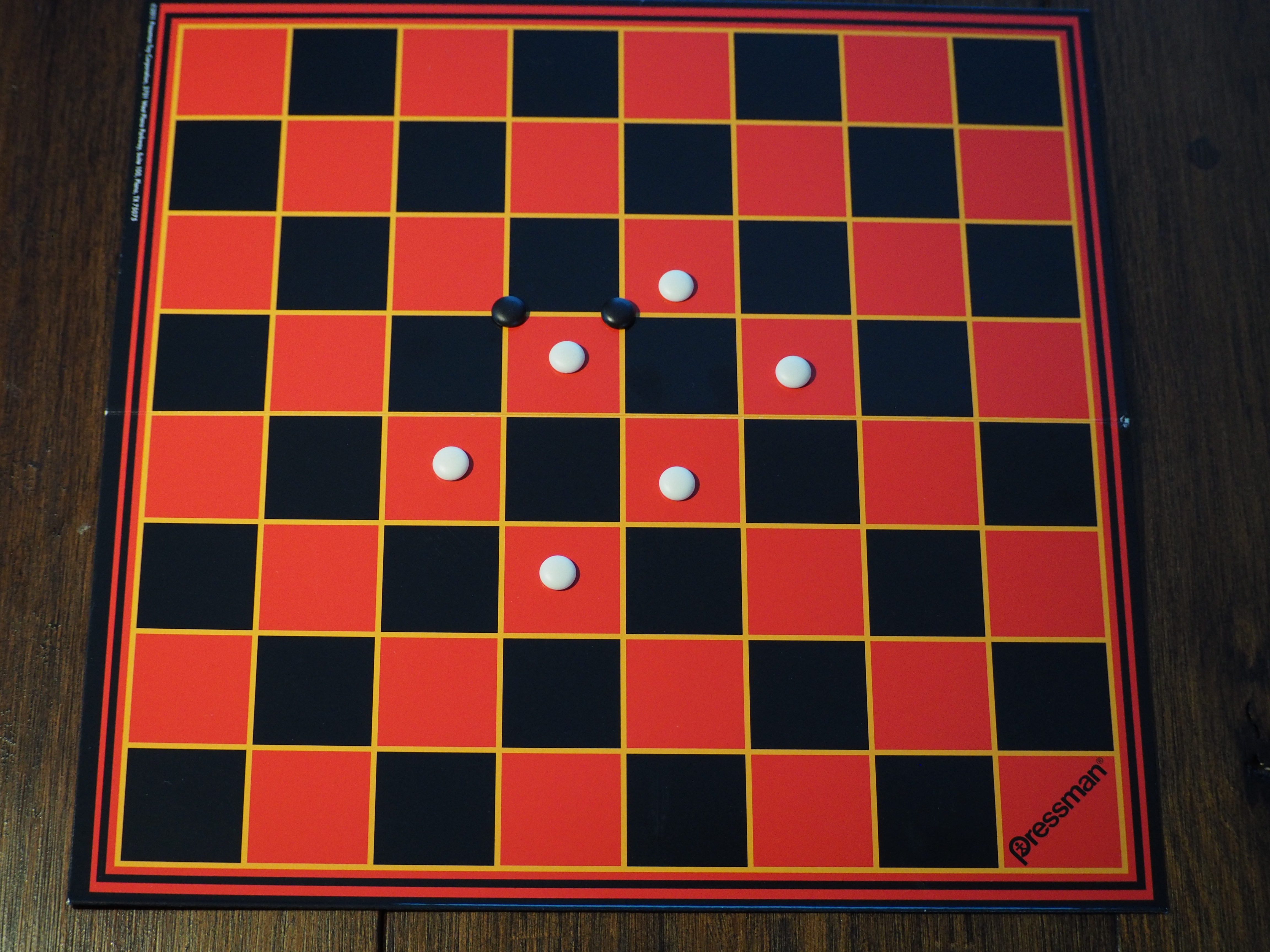
A hybrid of Checkers and Go, for two players. The "Guerrilla" player, using small Go stones, plays on the intersection points of the checkerboard squares to surround and capture the enemy pieces. Meanwhile, the "Counterinsurgent" player, using checkers, moves on the checkerboard squares to jump and capture the enemy.
Equipment required: checkerboard or 8x8 grid, six checkers or large pieces, and 66 small pieces distinct from the large pieces (buttons, glass beads, small Go stones, etc.)
Teaching Guerrilla Checkers in Political Science
Guerrilla Checkers is a two player asymmetric abstract game which models a simple conflict between the state and an insurgent force. One of the first things to say about this game, is that it is incredibly simple to acquire and get started playing. All you need to play is an 8x8 checker board, six pieces for the state, 66 pieces (which should be differentiated from the state) for the guerilla player, and a copy of the rules (see below). For my class, I simply purchases two inexpensive checker board games and a go board for the guerilla pieces. This gave me enough player pieces to run two games at once.
Guerilla checkers is also an ideal introductory, or warm-up, game for any class in which you intend to run a more complex asymmetric game such as Andean Abyss or Cuba Libre later on in the semester. The simple gameplay and the different rules and win conditions, mean that students can become accustomed to different rules for different factions and differing win conditions in more complex asymmetric games. As soon as students realize that different sides have different goals and ways to achieve these goals, topics which can be explored in-class after a play through of Guerrilla Checkers, this will make more advanced asymmetric games a little less daunting to learn and play for your students.
Sample Assessment
I incorporated Guerilla Checkers introductory International Relations class, making it a low-stakes assignment at only 5 percent of their final grade. On other occasions, I simply made the playing of Guerilla Checkers an ungraded in-class activity. The learning goals for this course are: Students will be able to recognize asymmetrical warfare; Students will be able to identify different strategies of asymmetrical warfare; Students will be able to identify different forms of warfare.
Prompt: For this assessment, you will be required to play a game of Guerilla Checkers with a peer in class. While you play this game, reflect on the following questions: Which side do you think the guerillas are and who might the other side represent? Which strategies were successful and which did not work? What types of conflicts might this little abstract game model?
How to Play/tips/complexity
Guerrilla checkers is a simple game which any student should be able to pick up in a matter of minutes. This is, of course, the beauty of this game, as it is an abstract game that simply models asymmetrical warfare. There are very few rules. Set-up the board with the six pieces representing the state already in play. The state only has these six pieces and when they are gone, they are gone for good. The guerilla has 66 pieces and places two pieces each turn orthogonally to each other. The state can eliminate guerilla pieces by jumping diagonally over as many pieces as it can, ala checkers. The guerilla eliminates a state piece by surrounding it on all four corners, with the caveat that pieces should be placed adjacent to other guerilla pieces. The only other rule is that the corners of the board act as if they already have guerilla pieces on them, meaning a state piece can be captured on the side of each board with only two guerilla pieces and if it is in the corner, just one piece can capture.
Games speed by quickly, making this the perfect low-stakes assessment or non-graded class activity for any introductory international politics class. In my experience with undergraduates, they quickly become accustomed to the rules and speed through a game in no time. If you possess multiple 8x8 boards, this allows for some best of three games during a class period. Win conditions differ for each side, with the state winning if the guerilla player runs out of pieces to place on the board and the guerilla winning by eliminating the six state pieces.
Link to the full rules https://nestorgames.com/rulebooks/GUERRILLACHECKERS_EN.pdf