Crescent Moon
Crescent Moon
Topics: Asymmetrical Warfare; Historical setting
Political science courses: International Relations; Peace and Conflict Studies
Other disciplines: Psychology of Decision Making
Similar games: Cubra Libre; Colonial Twilight; All Bridges Burning: Red Revolt and White Guard in Finland, 1917-18
Number of players: 4-5
Type of game: A four to five player asymmetric area-control game
Learning goals:
- Students will be able to identify different approaches to state security.
- Students will be able to explain the value of cooperation between groups.
- Students will be able to identify military and non-military factors that influence periods of war and peace.
- Students will be able to describe the ethical dilemmas of war.
Description from Publisher Osprey Games
As the sun rises over the deserts, rivers, and oases of the Caliphate, a delicate balance has been upset. As one of many rival powers in the region, you now have the opportunity to alter the course of history and seize power for yourself. The ambitious Sultan sits in a golden palace, presiding over great works of architecture. The secretive Murshid works to covertly undermine the central authorities through an expansive network of agents.
The wandering tribes of the Nomad aim to sow discord in order to secure employment for their experienced mercenary citizenry. The ravaging forces of the Warlord sweep across the land, chasing after promises of plunder. And, in the face of chaos and uncertainty, the Caliph aims to preserve order through military might. Will you successfully navigate this web of rivalries and rise to prominence, or will you squabble with your lesser adversaries and fade into obscurity?
Crescent Moon is played over three years (or four years in the long game). Each year, players will take four actions which might be to deploy new armies, enlist mercenaries, build fortifications and settlements, conquer new land, expand their influence, and much more. Each character has a unique pool of abilities and available actions, which will shape their game, whether its the Sultan, who cannot raise their own army and must depend on mercenaries, or the Murshid, who can use their political influence to interfere in other characters' battles. Players can purchase potent power cards, representing ploys, wise advisors, and specialist units from a market shared between all players. At the end of each year, players score points according to their own unique character objectives, and at the end of the game, the player with most points wins.
Crescent Moon is an area control game for four or five players. Take on the role of one of five radically asymmetric characters, each with their own objectives to fulfil, unique actions to utilize, and game-changing special powers to employ. Build symbiotic relationships with your allies, undermine your rivals, and choose your friends and enemies wisely in this cut-throat game of power and politics.
Teaching Crescent Moon in Political Science
Crescent Moon is a four to five player asymmetrical area-control board-game which models the competing powers of Arabia and the Near East. Players take the role of one of five factions: the Sultan, the Warlords, the more political Murshid, the Capiph, and the Nomads. Each of the five factions have distinct victory conditions and although many actions are shared across these factions, each faction also has unique powers.
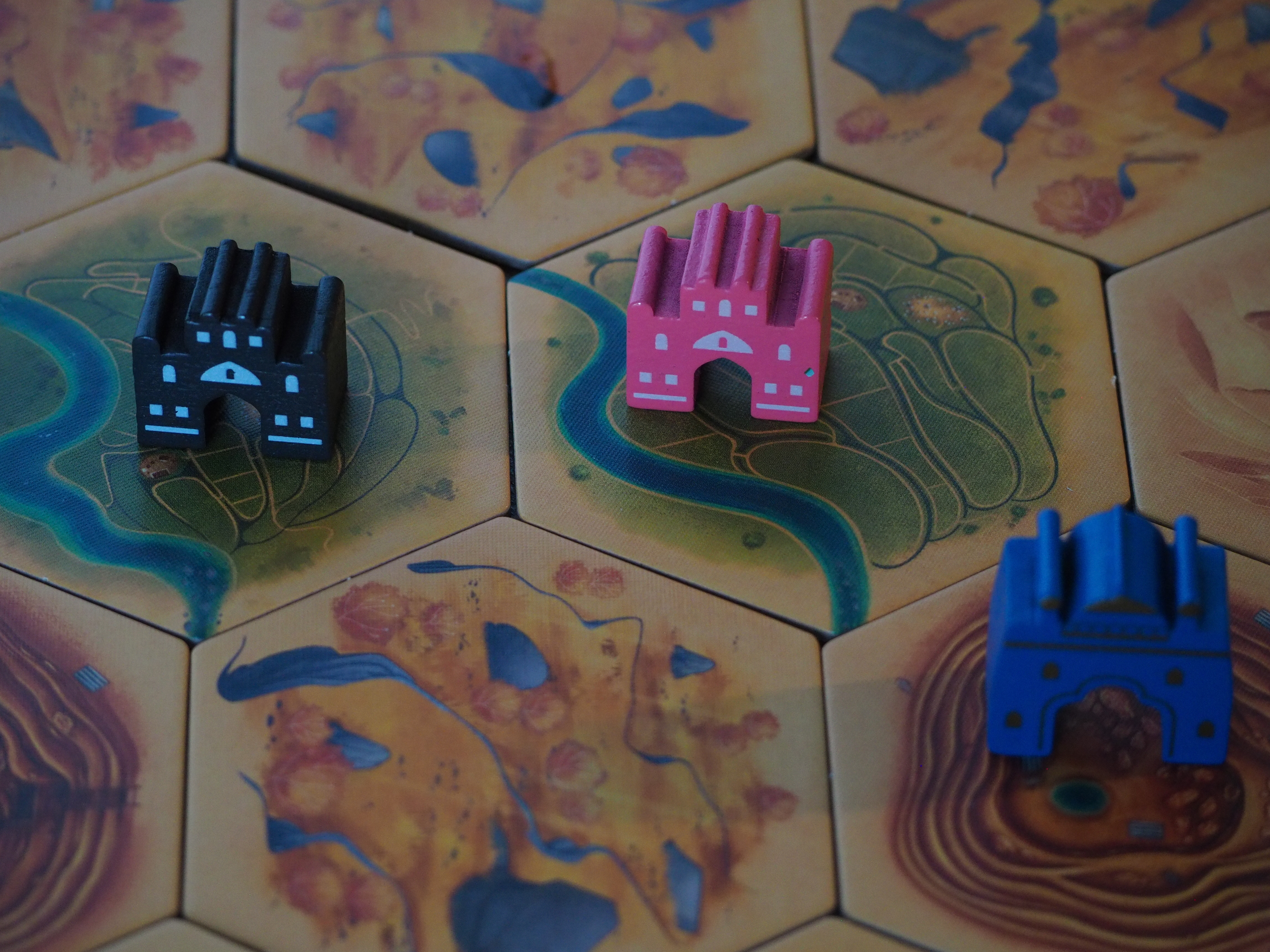
The first thing to say about Crescent Moon, is that the production design is outstanding. Before you even open the box, it is impossible not to notice the embossed cover art and colorful art and design. Production quality inside the box is equally impressive, with satisfyingly tactile units, towns, and castles, and a breezy and colorful rulebook. The production is so satisfying to play with, I think it certainly makes this a more enticing product to introduce students to.
The game itself is an interesting addition to asymmetrical area-control, and may best be described as containing elements of GMT Games’ COIN Series and the popular fantasy war-game Root. Crescent Moon is, however, unique being that it is set in the 10th century Near East. Although I may be showing my ignorance here, I think this is the first war-game to be set in this region and period of history. Crescent Moon simulates the competition between four to five rival groups in this region, providing historical context to an under-explored period and area of the world.
The factions are also worth highlighting as they are not only interesting, being that they are little studied in Western political science, but also have diverse goals. Of the four always in-play factions, it is only the Warlord which needs to engage in destructive play to accumulate victory points. The Murshid wins by spreading influence across the map, the Sultan by building cities, while the Caliph wins by controlling cities. These disparate victory conditions often lend themselves to more cooperative than zero-sum styles of play, with the rules keen to specify ways that players can cooperate during the game. For example, as Sultan you need to build, but not necessarily control settlements to win, while the Caliph wins by controlling cities, cities it cannot easily build. This is a refreshing and nuanced game design, which rewards cooperation between players rather than more realist approaches to achieving victory goals.
Sample Assessment
Crescent Moon could be easily incorporate into most international relations classes. The focus on achieving specific goals, often without resorting to violence, make it a good candidate to model the anarchic system of states and the different approaches actors can employ to navigate this system. I incorporated playing Crescent Moon into my introductory International Relations class as a medium-stakes assignment (it was worth 10 percent of the final grade for the class).
Prompt: For this assessment, you will be required to play a game of Crescent Moon with your peers. After playing the game, you also need to write and record a five-minute reflection of your play-through answering the prompt below. Finally, you will be expected to share your experiences of the game with your fellow students during our debrief class. The library has the game available for a twenty four hour loan.
Prompt for the paper: Reflect upon your experience of playing Crescent Moon. Which faction did you play and what were the goals of your faction? Which, if any, other factions did you sympathize with or work together with? Was there a faction which you were directly in opposition to? Did you engage in any actions which you found ethically troubling, but would have been advantageous to your faction? What have you learned about this time-period and region of the world?
How to Play/tips/complexity
While initially looking somewhat intimidating, Crescent Moon is not a difficult game to play. The unusual setting and occasional odd turn of phrase does, on occasion, make learning this game seem overwhelming. However, after you get over these initial hurdles and start to actually play Crescent Moon, you soon find there is a pleasant repetitiveness across the game’s ‘year’ which comprises four turns. The community on BoardGameGeek give Crescent Moon 3.55 out of 5 in complexity, but I do not think this is in anyway as obtuse as COIN favorite Cubre LIbre (3.79 out of 5) or has the same bewildering idiosyncratic player options in the aforementioned Root (3.77 out of 5). The benefit Crescent Moon holds over these two games is that most of the player actions are duplicated across each faction, meaning that by simply observing other players turns you will become more familiar with the game. Furthermore, the game includes a first ‘year’ goal for each player, which gives players something to aim for from their very first interaction with the game.
All of this mean that players can get started with Crescent Moon in a less painful manner than many other asymmetrical games. Of course, the best way to prepare to teach this game is for the instructor to play a game herself with all of the factions laid-out and played in-turn. This is not as traumatic an experience as in other asymmetric war-games due to most actions being common across each faction and
Finally, the rules in Crescent Moon suggest that the game can be played either four years (rounds) for a short game or five years (rounds) for a longer game. The flexibility of the game design means that instructors are not bound to these limits and instead can tailor the game to the time available in class. A four year game would take around an hour and an half, but if you have only an hour to play with, just play 3 years or cut the number of turns each round down to three from the usual four. Such changes do not seem to affect the balance of the game and as I am still no closer to developing winning strategy for any of the factions after numerous plays, means that this somewhat of a mute-point for most people.