Andean Abyss
Andean Abyss
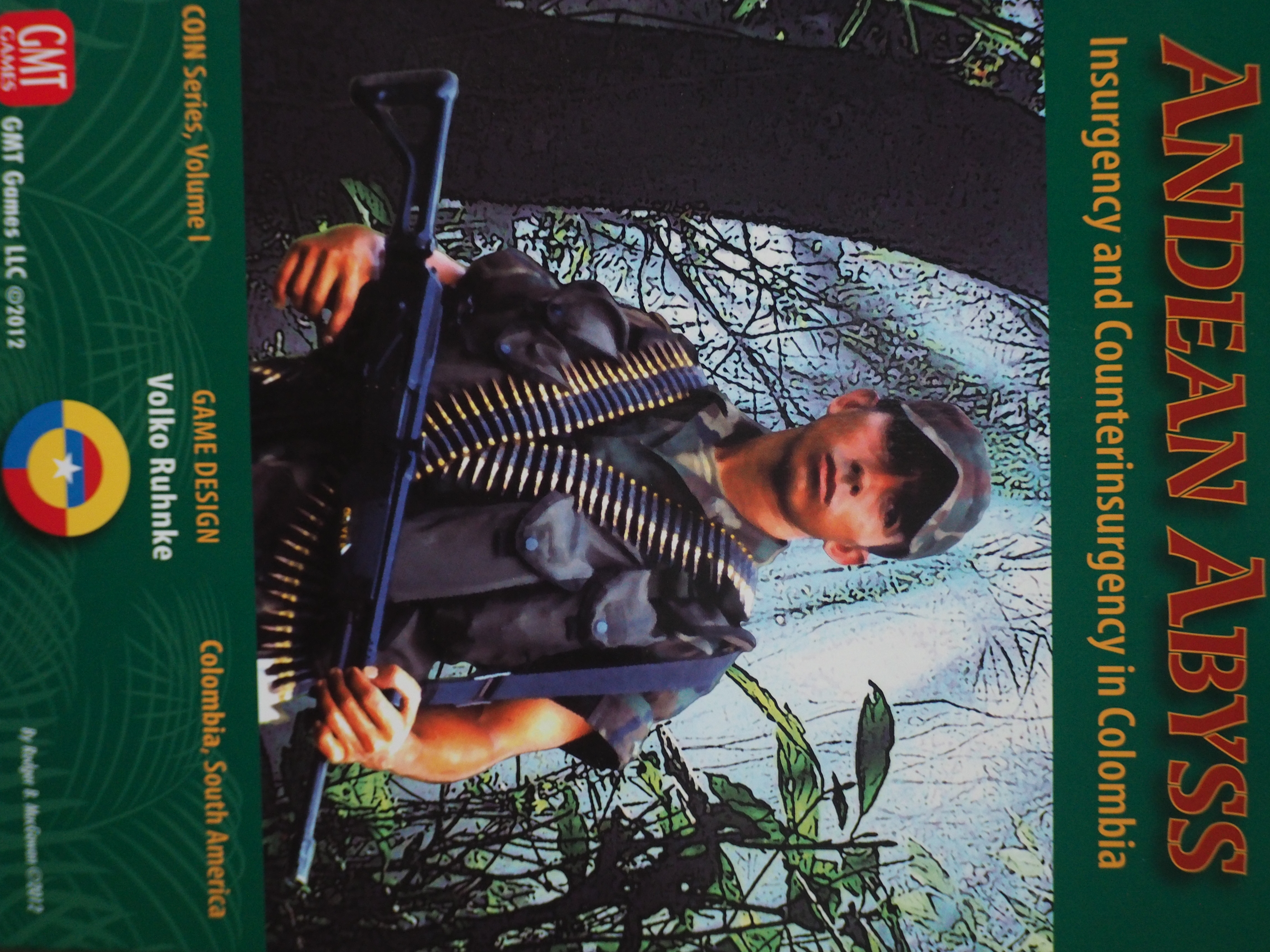
Topics: Asymmetrical Warfare; Latin America; Terrorism; Drug Trafficking
Political science courses: International Relations; Peace and Conflict Studies; Latin American Politics
Other disciplines: History of Latin America; Psychology of Decision Making
Similar games: Cubra Libre; Colonial Twilight; All Bridges Burning: Red Revolt and White Guard in Finland, 1917-18
Number of players: 1-4
Type of game: A 4-way asymmetric multiplayer game
Learning goals:
- Students will be able to identify different ideologies.
- Students will be able to explain how Cold War politics affects intrastate conflict.
- Students will be able to analyze motivations for contention.
- Students will be able to analyze the tension between human rights and state sovereignty.
- Students will be able to evaluate different approaches to state security.
- Students will be able to describe different forms of warfare.
- Students will be able to identify military and non-military factors that influence periods of war and peace.
- Students will be able to describe the ethical dilemmas of war.
Description From the Publisher
Colombia: Nation at the Edge of Abyss: Colombia in the 1990s hosted one of the world’s last Marxist guerrilla armies, brutal drug lords, and right-wing death squads and appeared close to failing as a state. A decade later, its Marxists had lost their top leaders and rural sanctuary, its big drug bosses were dead or in prison, and its paramilitaries were negotiating demobilization. The Government had extended its writ to most of the countryside, restored its popularity, and improved the economy and respect for human rights.
Teaching Andean Abyss in Political Science
Andean Abyss is a one to four player board game published by GMT Games that focuses on modelling insurgency and counterinsurgency in Colombia during the 1990s. Players take the role of one of four factions: the Colombian Government, the leftist FARC, the right-wing AUC, and the narco-trafficking Cartels. Each of the four factions have distinct victory conditions with decisions made by each player potentially affecting other players’ options.
Andean Abyss is the first in the COIN Series of games designed by Volko Ruhnke. Volko, who’s day job is teaching at an instructor at the CIA’s Sherman Kent School for Intelligence Analysis, is best known for this series of games (COIN is an abbreviation of counter-intelligence) which are based upon real-world intrastate conflicts. These games are somewhat unusual for war-games, as instead of focusing on interstate conflict, they attempt to model the more common intrastate conflicts. This makes this series of games particularly useful as teaching aids for many International Politics classes.
One of the most useful elements of the COIN series is the way that the historical background of the conflict is central to the game experience. Each round, players have the option of choosing one of two options on a deck of cards. Unlike traditional card-drafting games, players do not have a hand per-se, instead a player may choose the action on the card on the top of a deck of event cards. These cards include a photograph and description of the action and are based upon historical events. For example, event card 31 Betancourt is simply a photograph of Senator Ingrid Betancourt who was kidnapped by FARC in 2002, with the event providing an opportunity for FARC or the Government, depending upon who gets the opportunity to play this card. The player therefore has an opportunity to exploit this event for sympathy and support which will depend upon which faction the player is playing as. As an added bonus, the rulebook includes a detailed description of the historical importance of each event card and a brief history of each faction, which should be required reading for all students before they play the game.
As a teaching tool, this allows players to gain insight into how the conflict unfolded and which actors and events directly affected the conflict. The games historical setting allows opportunity for students to learn not only about this conflict, but also U.S.-Latin American politics, and more broadly on the politics in the region.
The four main factions in Andean Abyss are also far removed from usual actors in traditional war-games. Traditionally, war-games have focused on more well-known interstate conflicts such as the Great War or the Second World War, allowing players to play familiar protagonists such as the Axis and the Allies. With Andean Abyss simulated an internal conflict in a medium-size Latin American nation, the four main factions are likely to be less well-known to most undergraduates, allowing for greater exploration of less well-known conflicts and regions of the world. The four playable factions include the Columbian Government and their guerilla rival the FARC, in addition, the right-wing militia the AUC and the narco-traffickers the Cartels are also playable factions. Each faction has different goals and a number of different actions to complete these goals, which leads to opportunities for cooperation and betrayal across the game. This often leads to interesting strategies and gameplay as it is perfectly possible for say the narco-traffickers, to win without engaging in a single battle. The narco-traffickers can win by not taking over the country or the government, but instead by placing enough drug bases on the map to achieve their victory conditions. Similarly, the right-wing militia group the AOC wins by having more bases on the map than the FARC. These relative win conditions lead to interesting strategy decisions for players, for example, should the AOC focus on consolidation and supporting the Government, or should they take the FARC on directly?
Sample Assessment
I incorporated Andean Abyss into my upper-level undergraduate Peace and Conflict Studies class, making it a major assessment due towards the end of the semester. The learning goals for this course are: Students will be able to describe different forms of warfare; Students will be able to identify military and non-military factors that influence periods of war and peace; Students will be able to describe the ethical dilemmas of war. At the start of the semester I surveyed students to gain knowledge of their experience playing modern board-games and used that information to create balanced groups of two. During this semester, I had one group of students play Andean Abyss and another play Cubra Libre (a similar COIN game).
Prompt: For this assessment, you will be required to play a game of Andean Abyss. After playing the game you also need to write a 1000 word reflection paper. There is also an online Canvas quiz to take. Finally, you will be expected to share your experiences of the game with your fellow students during class. This will be a significant part of your participation grade. The library has the game available for a 24 hour loan.
Prompt for the paper: Reflect upon your experience of playing Andean Abyss/Cuba Libre. Which faction did you play and what were the real-life goals of your faction? Which, if any, other factions did you sympathize with or work together with? Was there a faction which you were directly in opposition to What type of a conflict was portrayed in this game? Which events portrayed in the card deck and/or the course of the game influenced your likelihood to engage in conflict with other players? Did you engage in any actions which you found ethically troubling, but would have been advantageous to your faction? What have you learned about this conflict?
How to Play/tips/complexity
There is both good and bad news when utilizing Andean Abyss in a class setting. Firstly, the bad. This is a complex game, scoring a somewhat generous 3.79 out of 5 in complexity on the gaming website BoardGameGeek (I would suggest this seems more of a 4/5). There is no getting around the fact that if your students are new to modern board-games, they will struggle without your help. The good news is that this series of games has elements common throughout, so when students master Andean Abyss, they will easily be able to play Cubra Libre or any other COIN game.
One of the biggest hurdles students will face when first playing Andean Abyss, is that their unfamiliarity with this conflict and the factions will likely lead to ‘analysis-paralysis’ as they will not fully understand what their tactics should be during their early turns. While it is fairly easy to understand the victory conditions, the number of different options open to players on any one turn can be bewildering. For instance, if you are the player to go first during a round, you have the option of taking one of two options from the event card on top of the deck, or taking one of four secondary options (called Operations) from your player action-menu (and it does look like a menu). That is not all. Players also may have the option of adding one of four Special Activities to their original choice. In short, deciding which actions to play each turn is, in itself, a difficult tactical judgement to make.
Compounding this issue is the obliqueness of the text throughout the game, with phrasing, conjunctions and qualifiers cryptically included on player menus of actions. The Rally action, for example, is a standard action (Operation) for three of the four factions, but understanding how to conduct the Rally action, is far from elementary.
To ameliorate this issue, this game needs to be played, or at the least begun, under the supervision of the instructor. My conflict class is a 1 hour 10 minute class, so consider having students start their games during class and finish in their own time. No amount of YouTube videos can prepare students for this experience as they are likely to have questions throughout, so I would highly recommend supervising these sessions.
To prepare to teach this game, the simplest way for an instructor to gain experience of this game is to play it yourself. There is a solo-mode, however, I would not recommend this as a way to gain experience of the game, instead, carve out three hours of your time and play against three other versions of playing as each faction. After this experience you will be emotionally and physically spent, but you will know how rounds are structured and the foibles of each factions’ action-menu.
Finally, to make the game more manageable from a time point of view, I would definitely recommend using only half of the cards in the deck. For a full game, students will need to set aside three to four hours for a full play through. To make the experience a little less daunting and to get the game in at under two-hours, have the students set the game up with only half of the event cards. To keep the balance of the game still include all three Propaganda cards, and spread them evenly throughout the deck.