
Geog 004 World Geography
Geog 004 World Geography
Purpose: to help other instructors teaching the same course
Common Course ID: 30649-2233. World Georgraphy GEOG 004
CSU Instructor Open Textbook Adoption Portrait
Abstract: The open textbook by Berglee is being utilized in Geog 4 (World Geography) for undergraduate students by C.K. Leung at California State University, Fresno. The open textbook provides a regional geographic perspective that is fundamental to the conduction of the course. The main motivation to adopt an open textbook was zero cost. Most students access the open textbook through the OER at University of Minnesota.
Course Title and Number: Geog 4 World Geography
Brief Description of course highlights: Survey of world-wide social, cultural, economic, and political forces; earth’s physical features; economic development; cultural and natural resources; man- land relationships; applicable concepts and methodologies. The approach is by continents or cultural realms or both. Fulfils the following requirements: General Education Area D Division 8 for catalogue years prior to 1999, and Area D3 for catalogue years since 1999. Major and minor in Geography. Prerequisite for the course: General Education Area A2. https://www.fresnostate.edu/catalog/courses-by-subject/index.html
Student population: Most students are liberal studies majors as the course is required by that department. The rest come from various disciplines including science, engineering, arts and humanities, and social sciences. The majority of the students are freshmen and sophomores.
Learning or student outcomes:
- To understand and analyze spatial relationship, and to explain and interpret: the distribution, processes and linkages between culture, economy, urbanization, agriculture, politics, and language; and the interrelationships between lithosphere, atmosphere, hydrosphere, and biosphere.
- To understand, analyze, and critique human-environment interactions, and to explain and critically evaluate: how human activities modify physical and biotic environments; and how the physical and biotic environments affect humans.
- To use basic geography tools and analytical techniques and apply them in a real-world setting, and to perform quantitative analysis and interpret the results; and read, interpret, and construct maps
Key challenges faced and how resolved: The cost of textbooks by publishers became excessive and was a burden to many students. With the availability of appropriate OER especially for lower-division courses, the course became a zero-cost course with the use of the free e-text.
Syllabus and/or Sample assignment from the course or the adoption [optional]: The course is a hybrid with ADA complaint pre-recorded lecture videos delivered through Canvas and in-person map activity classes on campus. The course further has bonus quizzes delivered through Canvas for boosting student success. Below is one of the in-person map activities to be completed on campus: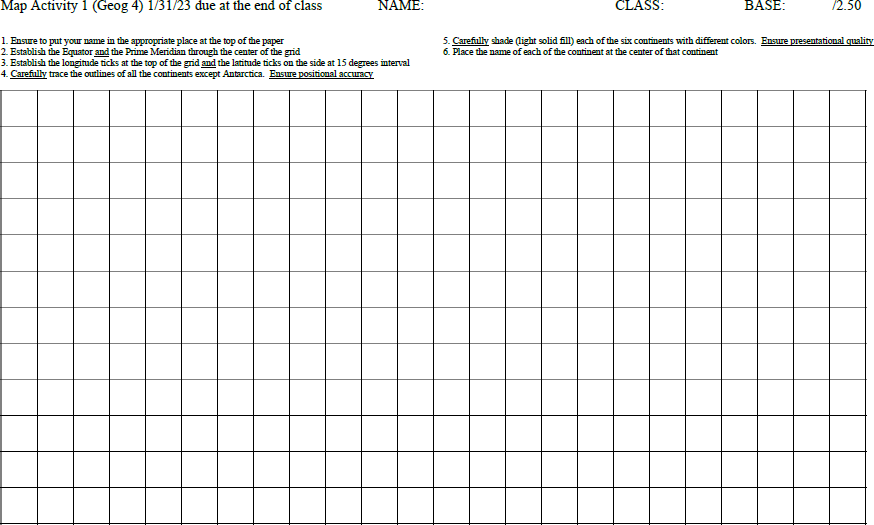
Textbook or OER/Low cost Title: World Georgraphy
Brief Description: The textbook introduces the world with a regional approach. The regional approach is the standard in organizing and presenting information for this course. The text has a discussion and study questions as well as activities at the end of each chapter; it is substantial with a total 1,023 pages.
Berglee, R. (2016) World Regional Geography: People, Places and Globalization. University of Minnesota Publishing Edition.
Please provide a link to the resource https://open.lib.umn.edu/worldgeography/
Authors: Bergless, R.
Student access: Through the link above, with digital and printable pdf versions.
Provide the cost savings from that of a traditional textbook. $134.95 from the previously required textbook (Nijman, J. et. al (2020) The World Today: Concepts and Regions in Geography, 8th Edition, Wiley). Price from Wiley.
License: The e-text is under Creative Commons (Attribution, NonCommerical, and ShareAlike)
OER/Low Cost Adoption Process
Provide an explanation or what motivated you to use this textbook or OER/Low Cost option. The previously required textbook was expensive. Efforts were made with the publisher to reduce the cost to less than $100 by utilizing a simplified version of the textbook. Nevertheless, the cost of that simplified version gradually increased to over $100. The greater availability of OER especially for lower-division general education course in recent years called for the adoption of OER material for this course.
How did you find and select the open textbook for this course? Searched online of my own accord.
Sharing Best Practices: The development of OER is part of the Open Sources movement. The use of OER depends on availability, which is greater for lower-division general education courses. OER should be used when the content of a textbook does not need to be adhered to closely.
Describe any challenges you experienced, and lessons learned. The most important constraint is time. A lot of time is needed to develop ADA complaint lecture videos and supplementary teaching material. Lecture videos are important as they help to better organize course material and focus on the information and knowledge that are deemed central.
Instructor Name: C.K. Leung Ph.D.
Professor, Department of Geography and City and Regional Planning, California State University, Fresno.
Please provide a link to your university page. https://socialsciences.fresnostate.edu/geography/faculty/leung.html
Please describe the courses you teach. World Geography is a lower-division general education course; it describes the physical and human environments of the world from a regional perspective. The course uses tall mountains and large deserts as physical divides to highlight the importance of geography in the historical formation and contemporary existence of the major world regions.
People and Places is an upper-division general education course; it describes the human environments of the world from a topical perspective. Ethnicity, language, religion, culture, polity, and economy form the core dimensions of the human environments on which the course operates. This course is also a zero-cost course with the use of an OER material.
Spatial statistics is a lower-division course for Geography and City and Regional Planning majors. The course entails basic descriptive and inferential statistics, both non-spatial (conventional) and spatial.
Describe your teaching philosophy and any research interests related to your discipline or teaching. Engage and encourage students as much as possible. Use of contemporary technologies to stimulate and inspire learning.
Courses taught include World Geography, People and Places, and Spatial Statistics.