Nazi Murder Victims
Nazi Murder Victims
WWll spanned the years of 1939 through 1945. During this time, the Nazi’s killed millions of civilians in what they called a Final Solution. They carried this out through an intricate system of concentration camps. This is a concept that has been covered extensively. However, unbeknownst to most people, the Nazi also communicate on the spot mass murders. These murders of local populations have been relatively uncovered by mainstream history and is sometimes referred to as the Holocaust by Bullets. These murders usually consisted of distribute disinformation by the local government to gather a group of people to a specified location. The victims would be processed and taken to a remote location and murdered.
However, what’s the difference between a “murder” and a death in a concentration camp? Throughout the years of WWll, Nazis and their collaborators killed millions. The majority of these killings were conducted in a semi-organized system of camps that littered Europe. This system constated of railroads, ghettos, and of course the concentration camps that held the prisoners. These camps would become death camps and millions would die in them; it was a planned mass extermination. Whereas the murders that took place throughout Europe were much more spontaneous and usually consisted of using the local government and its resources. Additionally, they didn’t use any of the concentration camps systems of railroads and they usually took place within the local environment. In some cases, the civilians would also participate in these actions. Furthermore, sometimes the killings were just a van that drove from town to town gassing the passengers. It is difficult to distinguish between one method of killing or the other and decide which counts as “murder”. But concentrations camps where an method of complete mass extermination that would confuse, torture, and use it victims until they were useless, and then incinerate them. The other method was much smaller and would be much quicker and didn’t torture its victims or long periods of time, it would just kill and dispose.
Consequently, the number of victims that were killed in these murders is not an exact amount. In fact, no number about the holocaust is exact but rather estimates by reviewing documents left over from the Nazis, census reports, and other methods to determine populations (United States Holocaust Memorial Museum, Washington, DC). The murders are no exception. I did a very general estimate that there were over 1.5 million murders that were conducted this way. This number is very estimated as many murder sites were covered up afterwards so many may not have been found. Additionally, it is difficult to estimate how many people died at any particle mass murder.
Furthermore, it wasn’t always Jews who were the victims. Though the Jews were a primary target of the Nazis, the Nazis did murders thousands of other groups too. Sometimes they did this with mass executions like Babi Yar, more stealthy gassing with vans, and sometimes cleanup crew of such events would be killed as well. Earlier, I talked about how the Nazi had gassing vans that drove town to town and would use their exhaust fumes to suffocate the passengers (Mann). Many times, the victims in these cases were the mentally disabled or a-socials. It was much easier to kill these people as they were already removed from society making it particle easy. Additionally, during the events of Babi Yar where 34,000 Jews were murdered during September 29-30 and over the next few years another 30,000 would be murdered at the same location (Naimark 1). This is where the Nazis exploited other victims of their execution system. Because of the Red Army quickly advanced towards Babi Yar and the Germans on retreat, the Nazis had to hide their war crimes. What they did was use prisoners from a neighboring concentration camp called Syrets that held predominantly Soviet POWS and a small portion of remaining Jews (Naimark). These prisoners had to exhume the corpses of the dead in Babi Yar and build huge pyres to burn them. After all the thousands of corpses had been incinerated, they built more pyres. These pyres, however, were not for the dead but for the prisoners who had to clean up the mass murder. The prisoners tried to escape but only 18 of the 327 survived this endeavor (Naimark).
How did the Nazis convince thousands of civilians to willingly sign up for their deaths? The Naizs were masters of manipulating words. They were able to get these large masses of people in once place by using the local government to distribute disinformation. The disinformation may have incomplete information or inform the target group that they are just going to a location. Many people wonder why thousands of these victims would obey these orders. Unlike information today, people didn’t have access to instant ready information. News took much longer to travel between towns or cities and people were much more trusting. When the victims of the Nazis saw the notices or orders to go to a location, they mostly believed that they were going to be deported considering that the notices told the victims that they should bring all their valuables and warm clothes. However, these notices also had horrible consequences that usually ended in death if the person didn’t show.
Once people began reaching the assembly points, they would be processed. This processing meant that all the valuables that the people had brought, any extra clothing, and food would be forcedly confiscated by the Germans and then sorted (Pronicheva). The Jews at this time would also be forcibly pushed forward towards a larger group. The Germans handled the sorting and confiscation of the stolen property while usually the auxiliary police of the local government would keep order among the increasingly panicked Jews (Pronicheva). Throughout all this the Jews were beaten at will and forcibly pushed forward unable to stop or regroup. The Naizs used a sort of organized chaos when processing Jews and other victims inside and outside of the concentration camp system. This chaos was purposely created to keep the victims disorganized and confused as to what was really happening to them. Finally, as a final act of dehumanization, they Jews would be forced to give up any documents and strip naked (Pronicheva). It would be at this point that groups would be taken away periodically by Germans for execution.
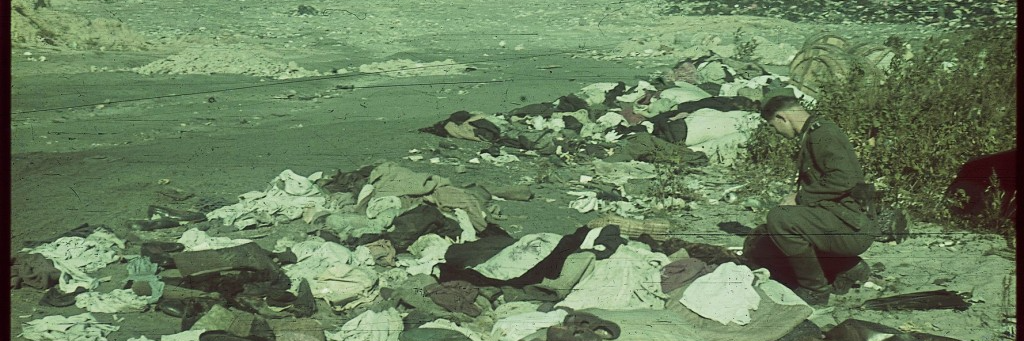
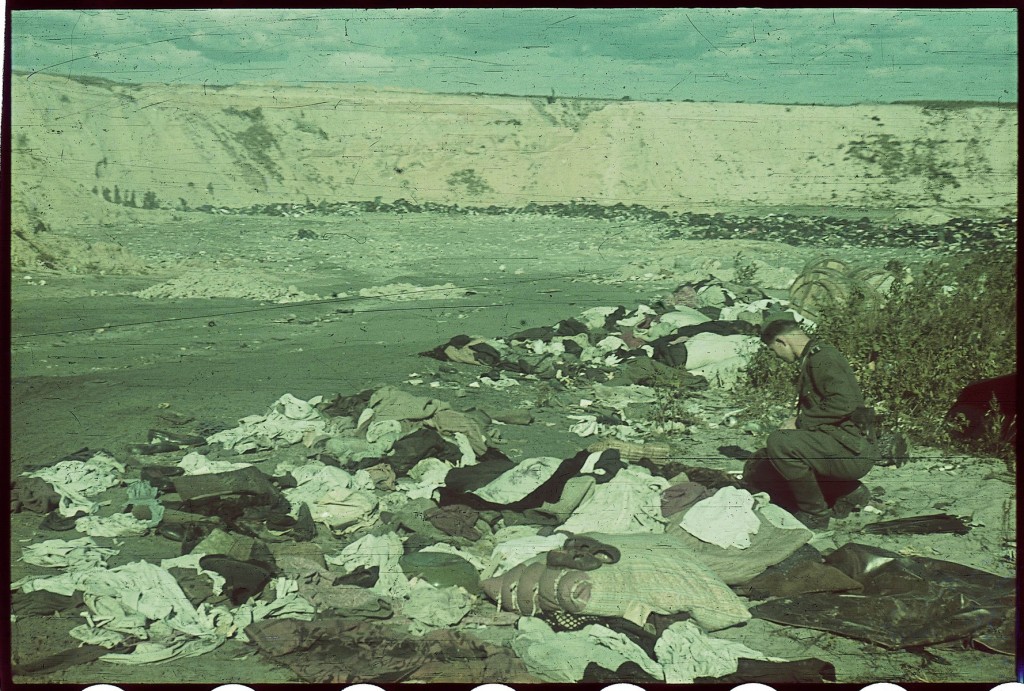 An SS guard examines piles of clothing belonging to the more than 33,000 Jews murdered at the nearby Babyn Yar killing site. The SS forced the victims to undress and leave their belongings behind. The Jews were then marched or driven to the shooting site. Kyiv (Kiev), German-occupied Soviet Union, after September 30, 1941. (unknown, https://encyclopedia.ushmm.org/content/en/photo/an-ss-guard-examines-clothing-of-victims-of-the-babyn-yar-mass-shootings)
Sometimes thought this wasn’t always the process. In some cases, the Germans didn’t have a large ravine or other location to hide the bodies, like Baby Yar. In these situations, the victims would be the ones to dig their own graves. This is what happed to the victims of the Tuchola Forest massacre in Poland. The victims were forced to dig their own graves guarded by SS prior to their execution. (United States Holocaust Memorial Meseum). In other cases, the Germans would use the “sardine packing”. Sardine packing was when the victims were forced to lie down in their own graves. Next, they would be shot to the back of the neck or head with one bullet (Museum). Dirt would then be spread thinly over the corpses and the next row of victims we be forced to lie down on top of them. In these situations, victims often had to watch there loved ones die before them. (Museum). However, similar to Babi Yar in which case the Germans had some sort of natural pit they would shoot them execution style. The victims would stand on the edge of the ravine and have to wait to be shot in which they would tumble into the hole.
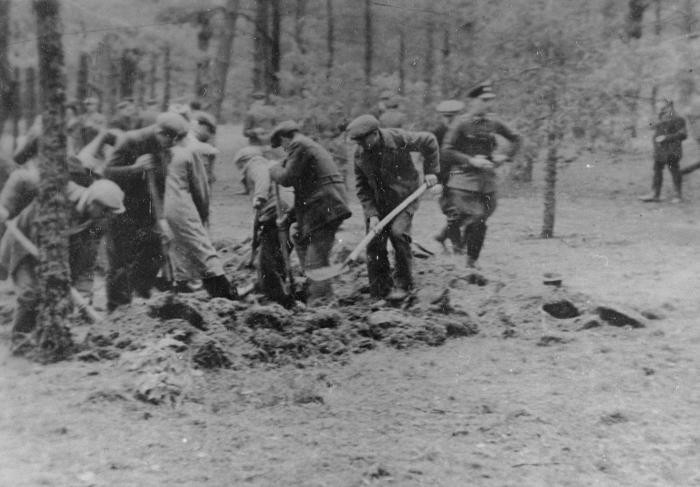 Polish civilians under SS and Selbstschutz (ethnic German self-defense organization) guard are forced to dig a mass grave prior to their execution in the forest near Tuchola. Tuchola Forest, Bydgoszcz, Poland, October 27, 1939. (United States Holocaust Memorial Meseum)
The holocaust was not only committed by one group, the Nazis. Instead, it was committed by a number of different peoples who all had deep antisemitism routed into them. Antisemitism was a problem that had been festering in Europe for hundreds of years. Some of it was based off of different religious ideologies while some of it was based off of false information. One such case is people thinking that Jews would kidnap and kill no-Jewish children for the Passover. False information such as this is what helped in the holocaust being only one group by many. However, no one would open go after and kill the Jews, that was until the invading Germans gave them the opportunity to do such a thing.
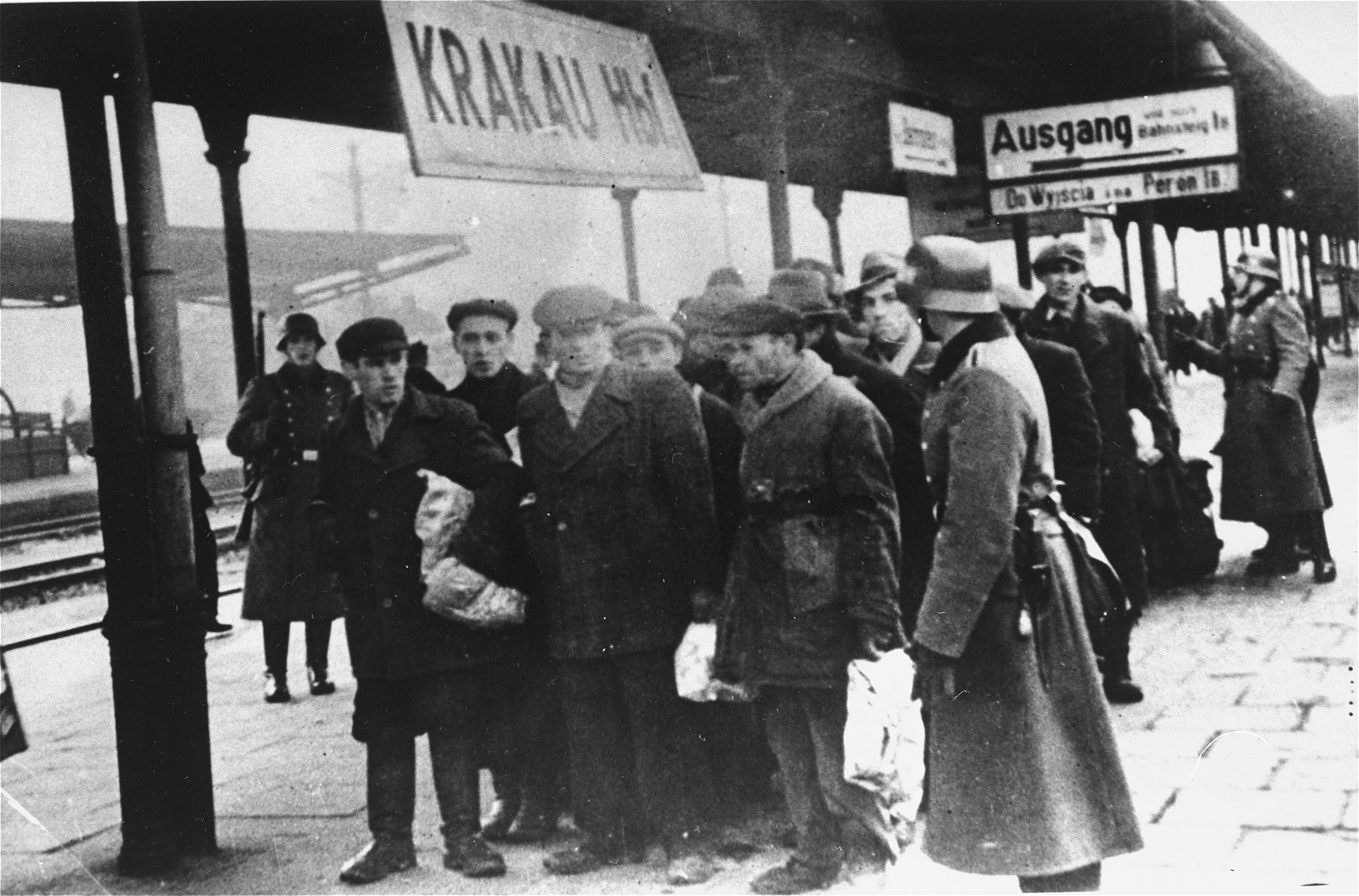
Jews assembled for deportation wait on the platform in the railway station for further transport.
(c. o. United States Holocaust Memorial Museum)Wherever the Nazi occupied, they implemented a divide-and-conquer ideology. They used the local resources as well as the locals to do the work for them. The Nazis would seize control of the local governments and their resources. In event where the Nazi would use the local government to issue orders to get groups of interest to specified assembly points. From there they also use the local police force combined with the auxiliary police to maintain order. This happened almost anywhere a massacre took place. Additionally, civilians would take part in this. The Jews would leave their homes or sometimes would be chased out by force by the police or by the civilians themselves who wanted the Jews stuff. In Latvia, the Latvians killed 10,000 Jews before the Germans even order them to (Mann). They loot their land, home, and belongs and would sometimes kill for them. This was a notorious subject after the war as displaced Jews would try to return to their home and find that new residents had stolen and confiscate everything. Sometimes, they would beat and kill the Jews that had returned as well.
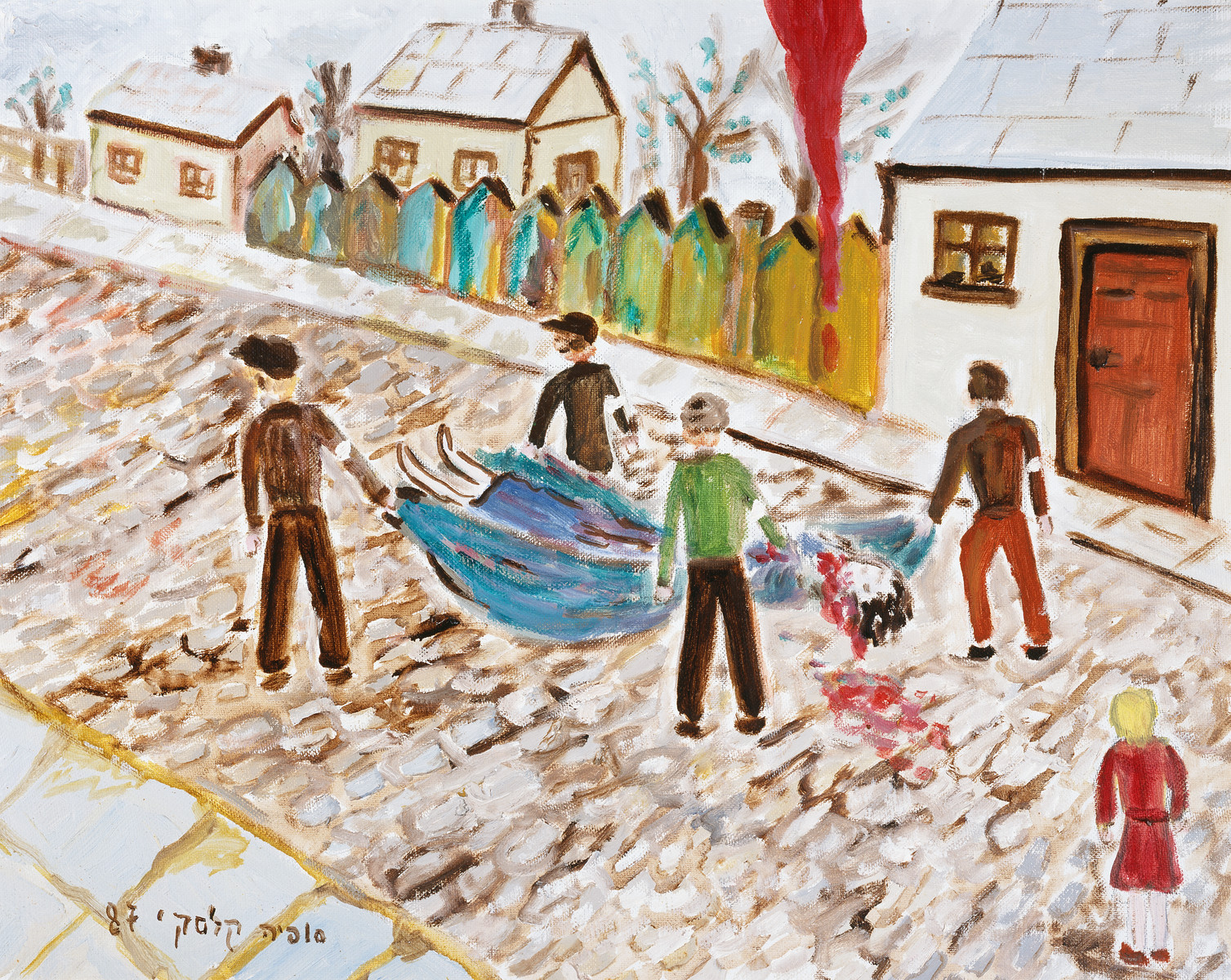 A painting by artist Sophia Kalski entitled "Murder in the Street."
The artist writes about the image, "In Trembowla ghetto, in the spring of 1943. A woman walked in the ghetto and all of a sudden, a German murdered her for no reason. Hearing the screaming, I walked out and I saw four policeman removing her wrapped in a blanket and drops of blood falling on the road."(c. o. United States Holocaust Memorial Museum)
However, the Nazis themselves were a major player in the holocaust. One murder squad, called the Arajs Kommando that was located in Nazi-occupied Lativa was a notorious (Mann). This squad had 300 members who were led by Victor Arajs, from which the squad gets its name. This squad used blue gassing vans that they stocked with vodka and cigarettes and would drive to town to town killing entire villages (Mann).furthermore, this group participated in the Rumbula forest massacre located outside of Riga. Thousands of Jews from the local ghetto were forced into the forest and massacred with the sardine system. All 300 members of the Kommanda participated with the dozen Germans command by by Heinrich Himmler himself who was unhappy with the pace of the killing in Latvia (Mann).
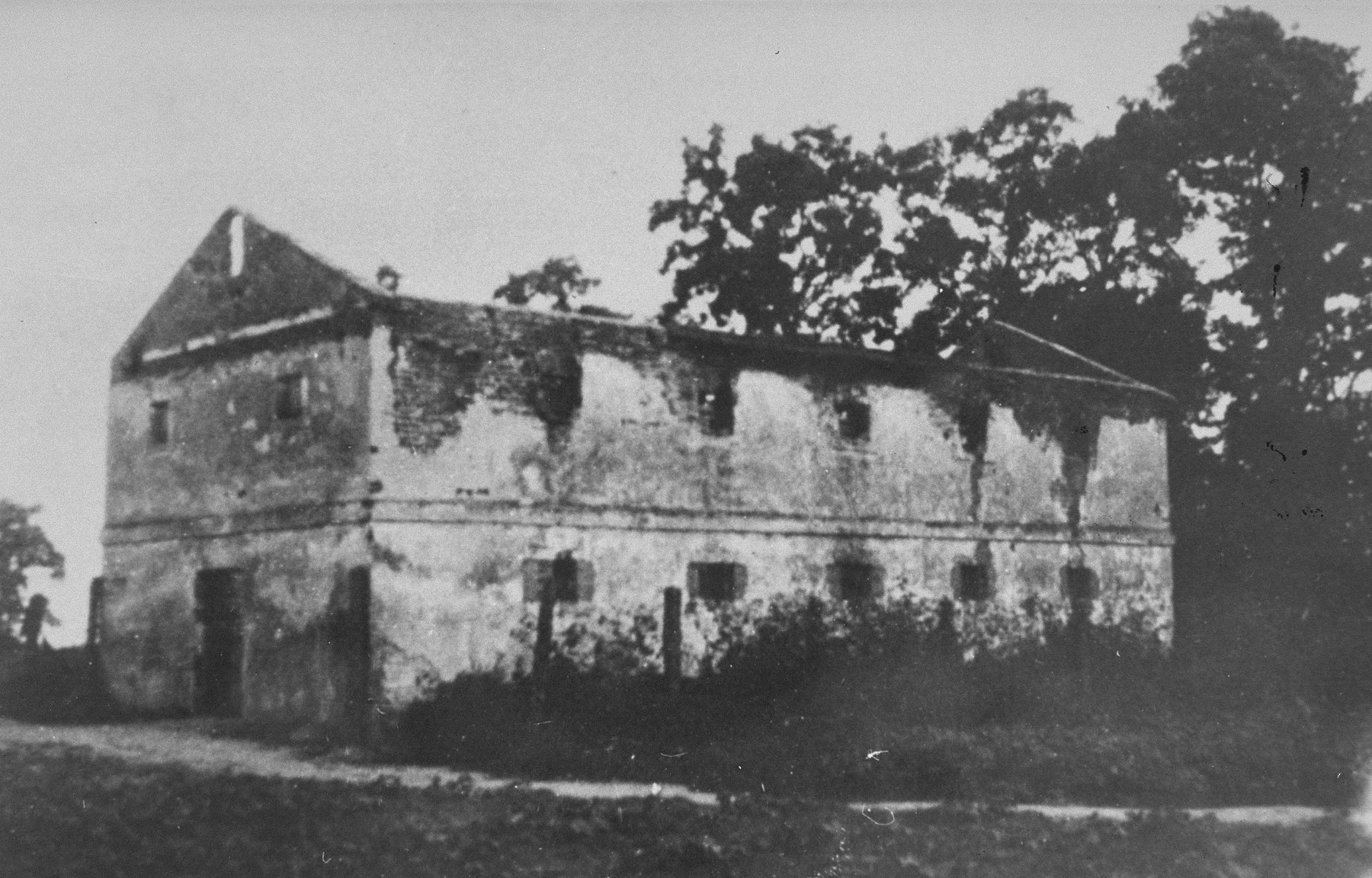 The grain elevator, where Jews were kept before they were loaded into gassing vans, killed, and then taken to the forest for cremation. This is also the site where 45 of the last 48 prisoners held at Chelmno were shot and burned before the advance of the Red Army. (United States Holocaust Memorial Museum)