Murder Sites
Murder Sites
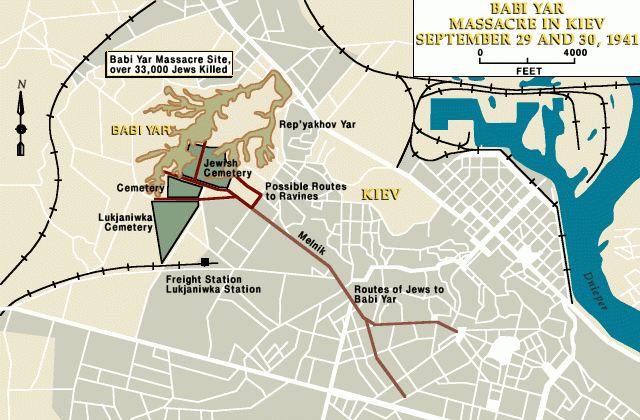
Jews were ordered on Sept 28 to report the next day at 8am near Lukianivka freight station. This Freight station was located right next to a ravine called Babi Yar. On September 29 and 30 thousands of Jews carrying there belonging marched toward the assembly point. The majority of these people were elderly, children, and women. The men were mostly gone as they had joined the Red Army and/or were moved with the factories when the USSR retreated inland.
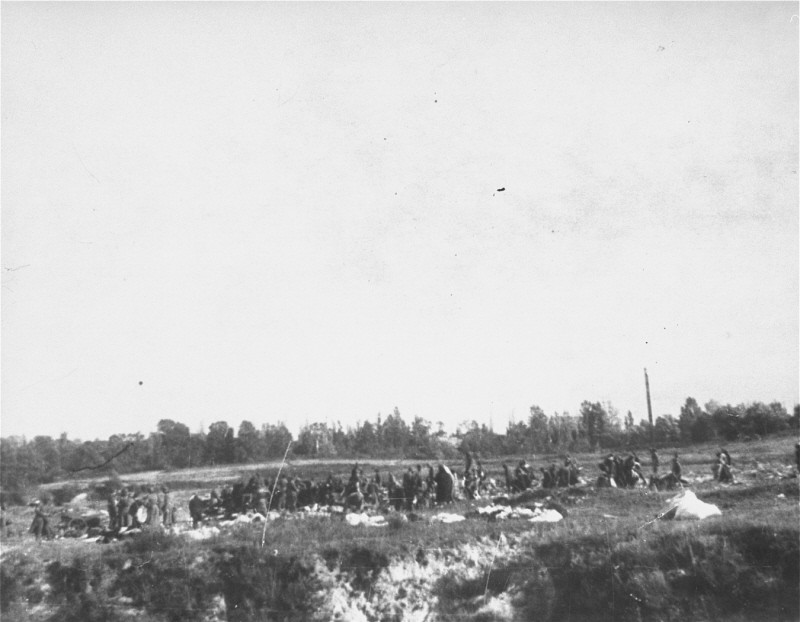
The Jews when they reached their checkpoint were beaten by the German policemen while being forced to hand over possessions and disrobe. While the Germans were busy sorting through the Jews possess, the Ukrainian policed kept order amount the Jews. Additionally, while this was happening, the Jews would be taken in groups marched by the Germans towards Babi yar. Once the group of Jews reached the ravine, they would stand at the edge and get shot. Their bodies would then fall into the ravine and the next group which would have already been marching towards the ravine would also line up and be murdered. This continued until 34,000 jews were murdered.
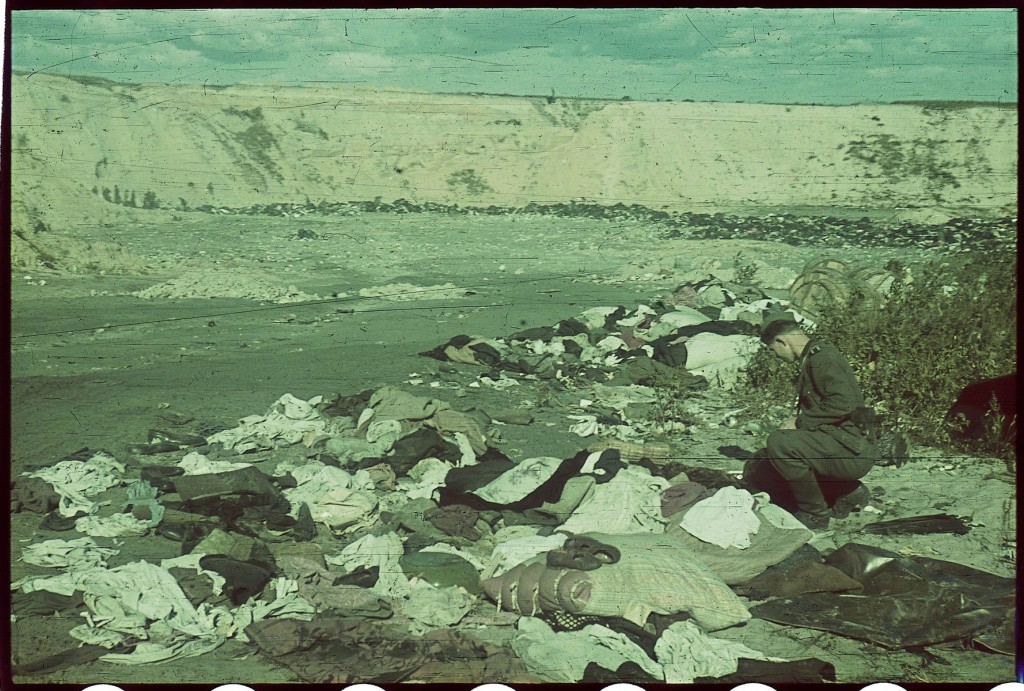
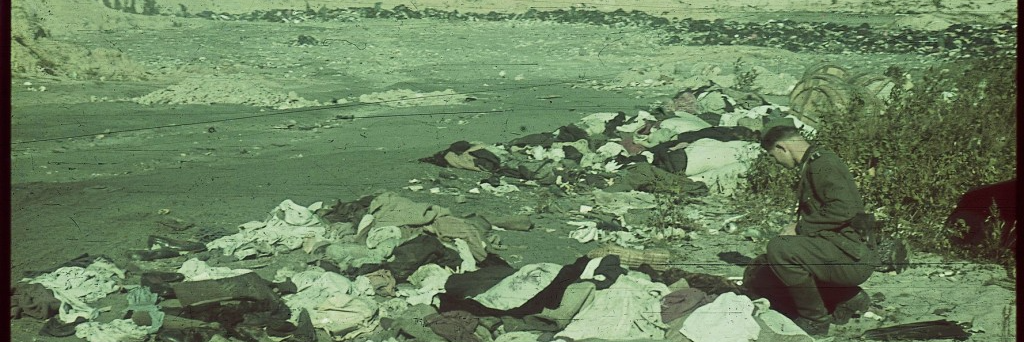
This is an image taken after the events of Babi Yar. During the massacre of Babi Yar, thousands of Jews were forced to give up their meager belongings and strip naked. The person in uniform examining the piles of clothes is an SS guard. The culprits that committed this crime was not only limited to the Germans as the local population participated. Ukrainian policemen were involved in keeping the large groups of Jew calm and contained.
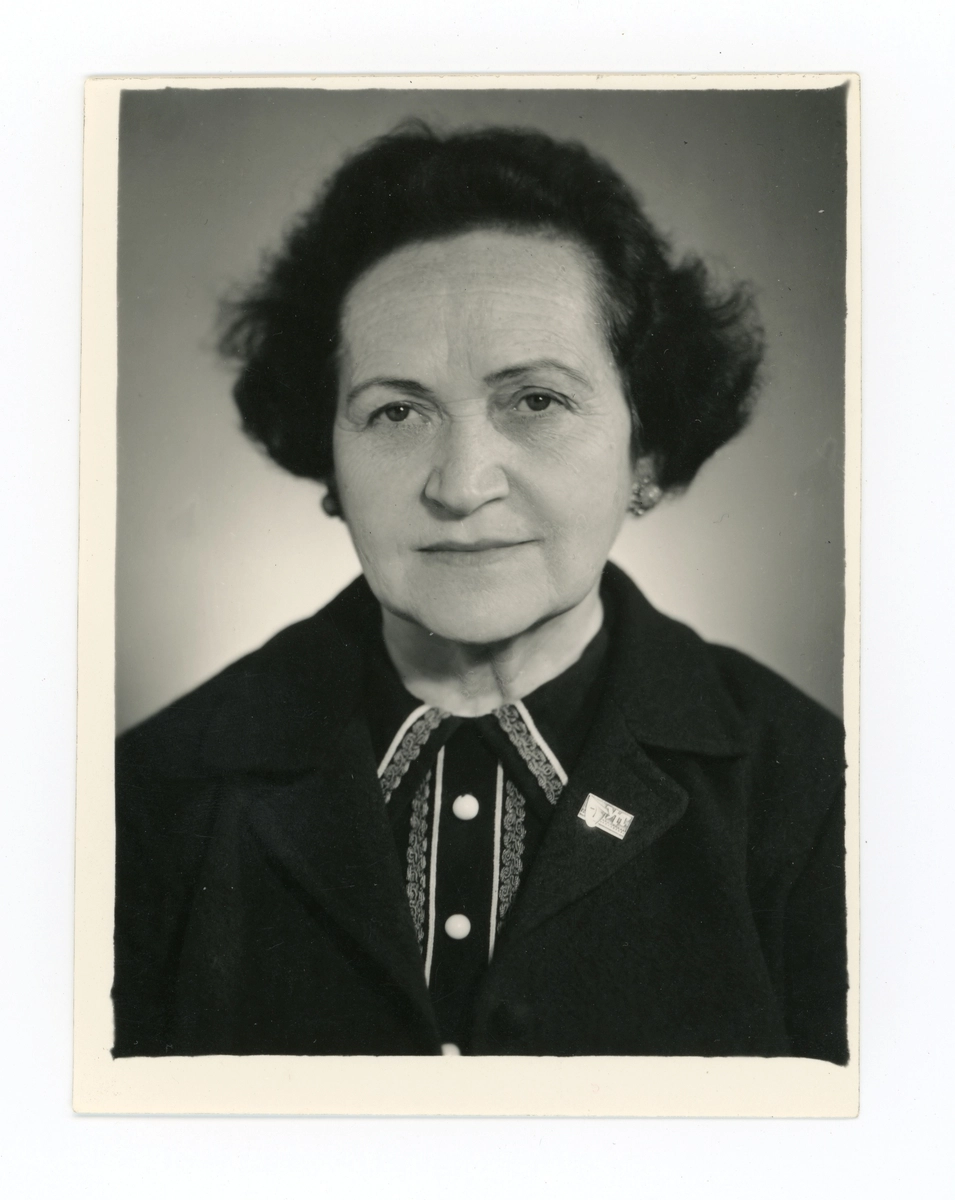 Dina Mironovna Pronicheva was born on January 7, 1911.
When the Germans entered Kyiv on September 19, 1941 they immediately set to work on the Jews. There were rumors that the Germans were setting fires to Jews that had remained in the city when the USSR retreated. September 28 an order appeared thought the city instructing any remaining Jews to report to the location Detiarev Street. Included in the order where instructions to bring any valuables that you had and warm clothing. Anyone who disobey would be executed.
Her family thought that they would be deported as they were being instructed to bring warm clothing. “It was impossible to get through the streets: carts, cars and two-wheeled carts were transporting belongings. There was a terrible rumble. Very many people were walking: old men, mothers with infants in arms, old women.”
The place they arrived was a Jewish cemetery that had been repurposed with anti-tank barricades and barbed wire. “I thought that a train was waiting there, but I saw that Germans were immediately taking away furs, taking away food and putting it to the side, clothing to another side, and people were going straight.”
Dina would then be forced to walk through a gauntlet of Germans armed with truncheons and leashed dogs. It was at this entrance to the gauntlet that Dina stopped and watched as the German beat everyone that passed between them. Anyone that feel or didn’t continue would have a dog set upon them. It was also here that Dina’s mother told her to go back as she didn’t appear to be a Jew. In order to get out, Dina had to also pass thought the gauntlet. “I had to pass through the corridor under blows from German staves, but I walked without stooping. I walked upright and endured everything.”
Once through she went straight toa Ukrainian policeman for the commandant to tell him that she wasn’t a Jew. “. I said that I was a Ukrainian, not a Jew. I had come to accompany my co-workers and had ended up here by accident.” Naturally, the policeman was suspicions, so Dina showed him her work papers that didn’t have nationally indicated. It was because of tis that the policeman believed her and told her to wait at a mound away from everything with another group of displaced persons.
Here Dina waited until evening with the others until a car rolled up and a German officer stepped out and said that everybody should be shot as they were all witness. Unlike all the rest of the Jews, Dina and her group were not forced to undress but were taken straight to the murder site as the Germans were tired. Dina and her group lined up at the edge of the ravine and waited to be shot. “I shut my eyes, squeezed my fists and threw myself down before a shot came. Of course, it seemed to me that I was flying a whole eternity because I was very high.” It was here that saved her life by letting herself be partially buried alive until all the Germans left. Once clear she was able to escape to the edge of the forest.
¾ of the 21K Lativan jews would be murdered by the Arajs Kommando between the years 1941 and 1944. Rumbula is a forest located outside of the capital of Latvia, Riga. During November and December of 1941, thousands of Jews were forced to march to this forest from the city’s ghetto and murdered. The killers used the “sardine method” to kill the Jews. This method is where the prisoners would be forced to dig their own graves and then made to lie down inside of it face down. Once a layer of Jews was complete, they would all be shot in the back of the head with a single pistol shot. After that, a thin layer of dirt would be thrown over the bodies and it would be repeated until every Jew in the gathering was dead. This murder was directly ordered by Himmler who was unhappy with the pace of the killings in Latvia. So Himmler ordered a dozen Germans to do the killing with the help of the entirety of the Arajs Kommando to complete the killings.
Arajs Kommando was a murder squad during WWII that was led by Victor Arajs. The squad contained 300 members that worked closely with the SS. Additionally, the Kommando would also lead ski-borne assaults of 30-40 men on Latvian villages. The Kommando would also drive a blue bus that would be stocked with cigarettes and vodka and would drive to villages systematically wiping them out. The Latvians were worse than the Germans as the Latvians had already killed 10,000 Jews before they were ordered by the Germans.