CLAS 3-Introduction to Chicano Studies
CLAS 3-Introduction to Chicano Studies
Purpose: to help other instructors teaching the same course
Common Course ID: CLAS 3-Introduction to Chicano Studies
CSU Instructor Open Textbook Adoption Portrait
Abstract: This open textbook is being utilized in a Chicano and Latin American Studies course for undergraduate or graduate students by Dr. Vivi Marquez at California State University, Fresno. The open textbook provides students with the tools necessary to meet the course objectives. The main motivation to adopt an open textbook was to create a more equitable learning environment for students by giving students access to free course materials. Most students access the open textbook in CANVAS via links provided and/or downloads of free .pdf files.
Course Title and Number:
CLAS 3-Introduction to Chicano Studies
Brief Description of course highlights: The course is an introduction to the historical and contemporary experiences of Chicanxs and other Latinxs in United States society. The areas of discussion cover from the census data, folk culture, language, literature, art, politics to history. It will also involve discussing the contributions of Chicanxs /Latinxs to the United States and their current economic, political, and social status.
Student population: This is an undergraduate course with students majoring in various disciplines, such as Chicano Studies, Criminology, and Education. The student population is very diverse, with the majority of students being Hispanic.
Learning or student outcomes:
- Analyze and articulate concepts of ethnic studies, including but not limited to race and ethnicity, racialization, equity, ethno-centrism, eurocentrism, white supremacy, self-determination, liberation, decolonization and anti-racism.
- Apply theory to describe critical events in the histories, cultures, and intellectual traditions, with special focus on the lived-experiences and social struggles of one or more of the four historically defined racialized core groups, specifically Latina/o Americans, and emphasizing agency and group-affirmation.
- Critically discuss the intersection of race and ethnicity with other forms of difference affected by hierarchy and oppression, such as class, gender, sexuality, religion, spirituality, national origin, immigration status, ability, and/or age.
- Describe how struggle, resistance, social justice, solidarity, and liberation as experienced by communities of color are relevant to current issues.
- Demonstrate active engagement with anti-racist issues, practices and movements to build a diverse, just, and equitable society beyond the classroom.
Key challenges faced and how resolved: There is an overall gap in anything that has to do with Chicano courses. I plan to create a curriculum plan that can be modified that will follow the sequence I currently use in my class. It will have weekly activities, assessments, links to open resources, etc. I plan to make this available to all my students for free. I would like to somehow create this for other Chicano Studies instructors for free on creative commons. I was able to create a curriculum plan and pacing guide for my course that sequenced how students would meet the objectives set by my department.
Syllabus and/or Sample assignment from the course or the adoption
Syllabus I have created my own assessments that measure understanding of the assigned reading material. They contain questions from the reading and are multiple choice, True or False, and/or essay questions.
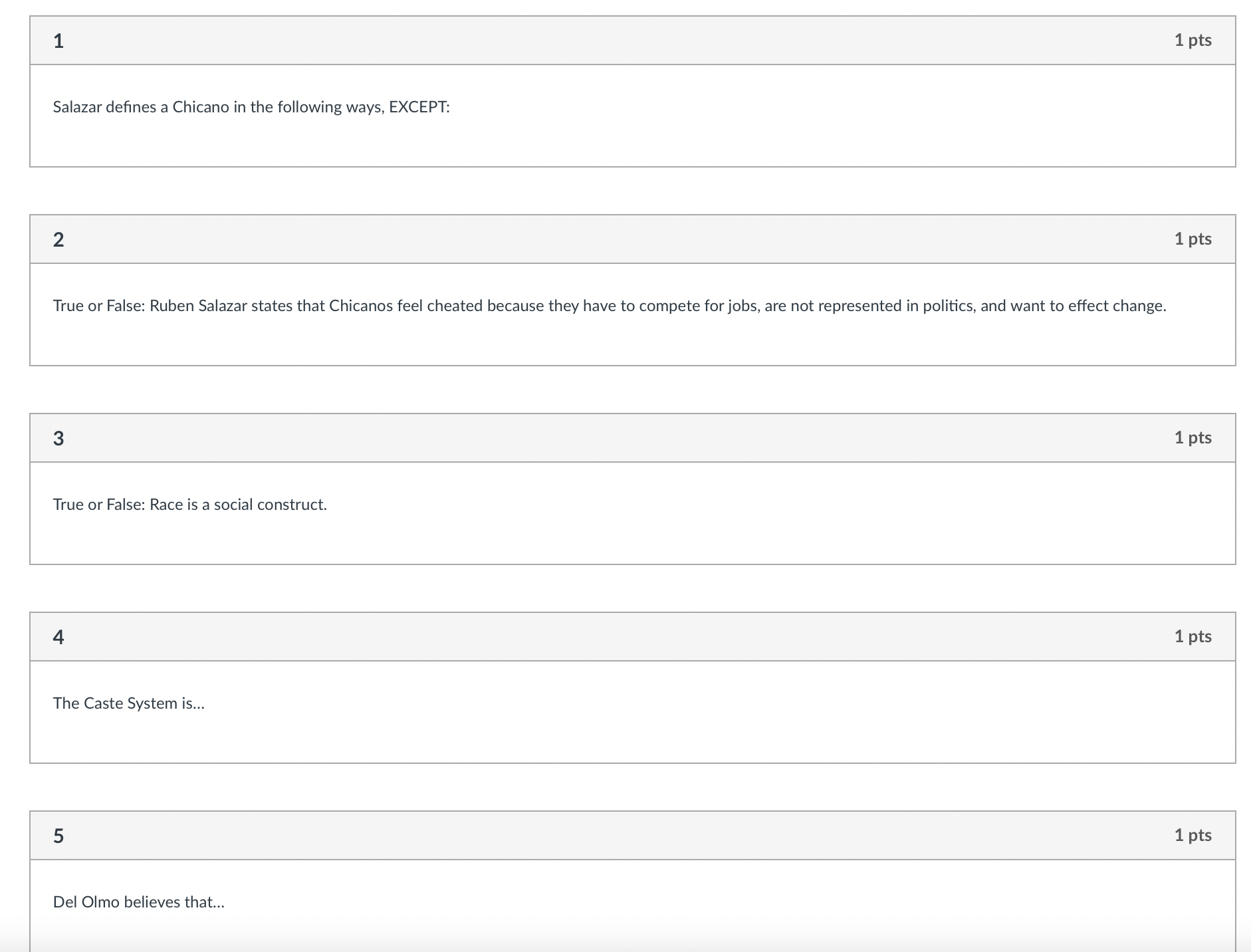
Textbook or OER/Low cost Title: I created a resource and use several different free resources rather than a textbook. Here is a sample of what I created:
Brief Description: Here is the link to the resource (Research Outline) I am choosing to share with Canvas Commons. I have licensed it as CC-NC and it is open to anyone on Canvas. I have tagged it “Chicano Studies” so that I may target the correct audience for this specific resource. I chose this specific resource because I have found it to be helpful to my students that they have prompts to choose from for their major assignment (an essay) as well as an outline that has guiding questions to help them frame their research and thinking. My students complete one section of their essay each week for eight weeks using this outline. Then, on week nine, they turn in their essay for a grade. I have found that students like this “chunking” method for writing their essay as well as having a choice on what to write. Lastly, the resources for their research (some they do on their own) can be found on Canvas as well.
Please provide a link to the resource https://lor.instructure.com/resources/96349965dc3f4fb5abe1d09e26b96324?shared
Authors: Vivi Marquez
Student access: Canvas
Provide the cost savings from that of a traditional textbook. Students save about $100-250 in course materials by enrolling in my courses.
License: I have licensed it as CC-NC and it is open to anyone on Canvas
OER/Low Cost Adoption Process
Provide an explanation or what motivated you to use this textbook or OER/Low Cost option. I wanted to save students money and create an equitable learning environment.
How did you find and select the open textbook for this course? I went to Creative Commons and learned about free resources in the workshops provided by the university’s professional development.
Sharing Best Practices: I think it is important to be collaborative and share any resources you can with your colleagues. In the end, students benefit from us sharing our resources with each other.
Describe any challenges you experienced, and lessons learned. In my discipline, there are not very many resources available that are college level, or any level for that matter. So, I had to create my own resources from scratch. That can be very time consuming.
Instructor Name: Dr. Vivi Marquez
I am a Chicano and latin American Studies professor at California State University, Fresno.
I teach CLAS 3, CLAS 30, CLAS 120, CLAS 128 and CLAS 160
Please provide a link to your university page. Fresno State Chicano and Latin American Studies Department Page
Please describe the courses you teach.
CLAS 3: Introduction to Chicano/Latino Studies- Introduction to the historical and contemporary experiences of Chicanos and other Latinos in American society. Their contributions to the United States and their current economic, political, and social status are discussed.
CLAS 30: Critical Thinking in Chicano and Latin American Studies-Distinguishes belief vs. knowledge and fact vs. opinion; examines relationship between language/logic in structuring around arguments; uses deductive/inductive reasoning; distinguishes and evaluates unsupported beliefs. Critical thinking skills are applied to topics concerning questions of race, ethnicity, gender, culture and class with a focus on Chicanos and Latin America.
CLAS 120: Latina/o Cultural Changes-The course examines the diversity of the Latina/o population in the U.S. It analyzes cultural, political, social, and economic complexities facing Latinas/os
CLAS 128:Contemporary Political Issues-Political philosophies, goals, and strategies of Chicanos and Latinos as reflected in their attempts to gain political power.
CLAS 160: Sex, Race, and Class in American Society-From an interdisciplinary perspective, focuses on ethnic identity and gender and their interrelationship with socioeconomic class structure in American society. Special attention is given to analyzing how inequities in race, gender, and class structures influence and shape social, economic, and political relations in society.
Describe your teaching philosophy and any research interests related to your discipline or teaching. I believe that best practices in education should be grounded in theory and proven methods for success. I know that all students learn in different ways and it is our job as educators to know our students, learn about their learning style, and adapt to fit their needs. This will ensure that they are successful in our class. As a professor, I strive to build a community of learning and partnership with my students. I build upon what they already know so that I may better support them. Therefore, my teaching philosophy is grounded in the constructionist theory. This theory posits that learning is student-centered, based on inquiry of contemporary issues, and builds upon the prior knowledge students possess. Learning is active, relies on students’ interests and needs, and is differentiated. These elements in and out of the classroom will ensure all students become involved in their education, will solve real-world problems, and will develop a passion for learning. In my classroom you will hear in-depth discourse about the content being taught, see meaningful application of concepts learned both in and out of the classroom, and feel a sense of community and belonging.