Math 110 - Critical Thinking
Math 110 - Critical Thinking
Purpose: to help other instructors teaching the same course
Common Course ID: MATH 110 – Critical Thinking
CSU Instructor Open Textbook Adoption Portrait
Abstract: Open course materials are being utilized in a math course for first-time freshman math majors by Dr. Hanson Smith at CSU San Marcos. The open course material provides a variety of different sources and opinions to compare and build upon at no cost to the students. The main motivation to adopt open course material was student budgets. Most students access the open materials as PDFs via the library website or CougarCourses (Canvas).
Course Title and Number: MATH 110 - Critical Thinking
Brief Description of course highlights: In addition to achieving the A3 General Education requirement, students will gain a deeper perspective into what mathematics is and help build a foundation of mathematical thinking and logic that will serve them in their future careers. As a class we will deconstruct stereotypes about who is "good" at math. Math is difficult, but also beautiful, and we will work together to overcome difficulties and share the beauty. We will think critically about the positive and negative ways that mathematics is used the world around us, and we will work to build the skills to employ mathematics in an uplifting way.
Course Description in Catalog: https://catalog.csusm.edu/search_advanced.php?cur_cat_oid=8&search_database=Search&search_db=Search&cpage=1&ecpage=1&ppage=1&spage=1&tpage=1&location=33&filter%5Bkeyword%5D=math+110
Student population: First-time freshman math majors. Students are typically Category I or II.
Learning or student outcomes: A3 Critical Thinking Learning Outcomes:
• A3.1: Distinguish matters of fact from issues of judgment or opinion and derive factual or judgmental inferences from unambiguous statements of knowledge or belief.
• A3.2: Judge the reliability and credibility of sources.
• A3.3: Effectively argue a point of view by clarifying the issues, focusing on the pertinent issues, and staying relevant to the topic.
• A3.4: Understand the nature of inductive and deductive reasoning, identify formal and informal fallacies of reasoning, and employ various methods for testing the strength, soundness, and validity of different argument forms.
• A3.5: Understand the basic concepts of meaning (sense, reference, connotation, etc.) and identify different methods of word definition.
• A3.6: Understand logic and its relationship to language by identifying the basic components of reasoning, including the propositional content of statements, the functions of premises and conclusions in the makeup of arguments, the linkage between evidence and inference, and the rules of inference and logical equivalence.
Also see the course highlights section above.
Key challenges faced and how resolved: One of the key challenges I have faced is bridging the level of the materials I am using with the math background my students have. I am still working to ensure that this course is challenging but not discouraging, but I’ve found that writing my own additional materials to help scaffold our texts is very helpful.
Syllabus and/or Sample assignment from the course or the adoption [optional]:
Weapons of Math Destruction by Cathy O'Neil
Algorithms of Oppression by Safiya Umoja Noble
A Friendly Introduction to Number Theory by Joseph H. Silverman (First six chapters available free from the author’s website)
Elements by Euclid, Translation by Richard Fitzpatrick (From the translator’s website)
Meno by Plato
The Allegory of the Cave from Republic by Plato
Discourse on Method by Descartes
The Declaration of Independence
* One assignment, that I would like to highlight, was using sidewalk chalk and string “compasses” to follow some of Euclid’s classical constructions outside on the CSUSM sidewalks.
OER/Low Cost Adoption Process
Provide an explanation or what motivated you to use this textbook or OER/Low Cost option. I did not want the cost of course materials to be a barrier for my students. My primary motivation was to make my classroom inclusive and reduce monetary impediments to student success. I found that using a diverse array of open source material allowed me to customize my course more and make bigger connections across mathematics.
How did you find and select the open textbook for this course? Talking with other mathematicians and educators was a really great resource for preparing my syllabus, and the folks at the library were amazing with helping me get access to resources for my students and making sure I was not violating copyright laws.
Sharing Best Practices: I really wish I had consulted with the library earlier. They have a lot of great resources and can really save you from having to reinvent the wheel
Describe any challenges you experienced, and lessons learned. I think one of the biggest challenges is incomplete open-source materials. However, this is an opportunity to get creative and find ways to bridge the existing materials.
Instructor Name: Hanson Smith
Assistant Professor of Mathematics at Californa State University, San Marcos. 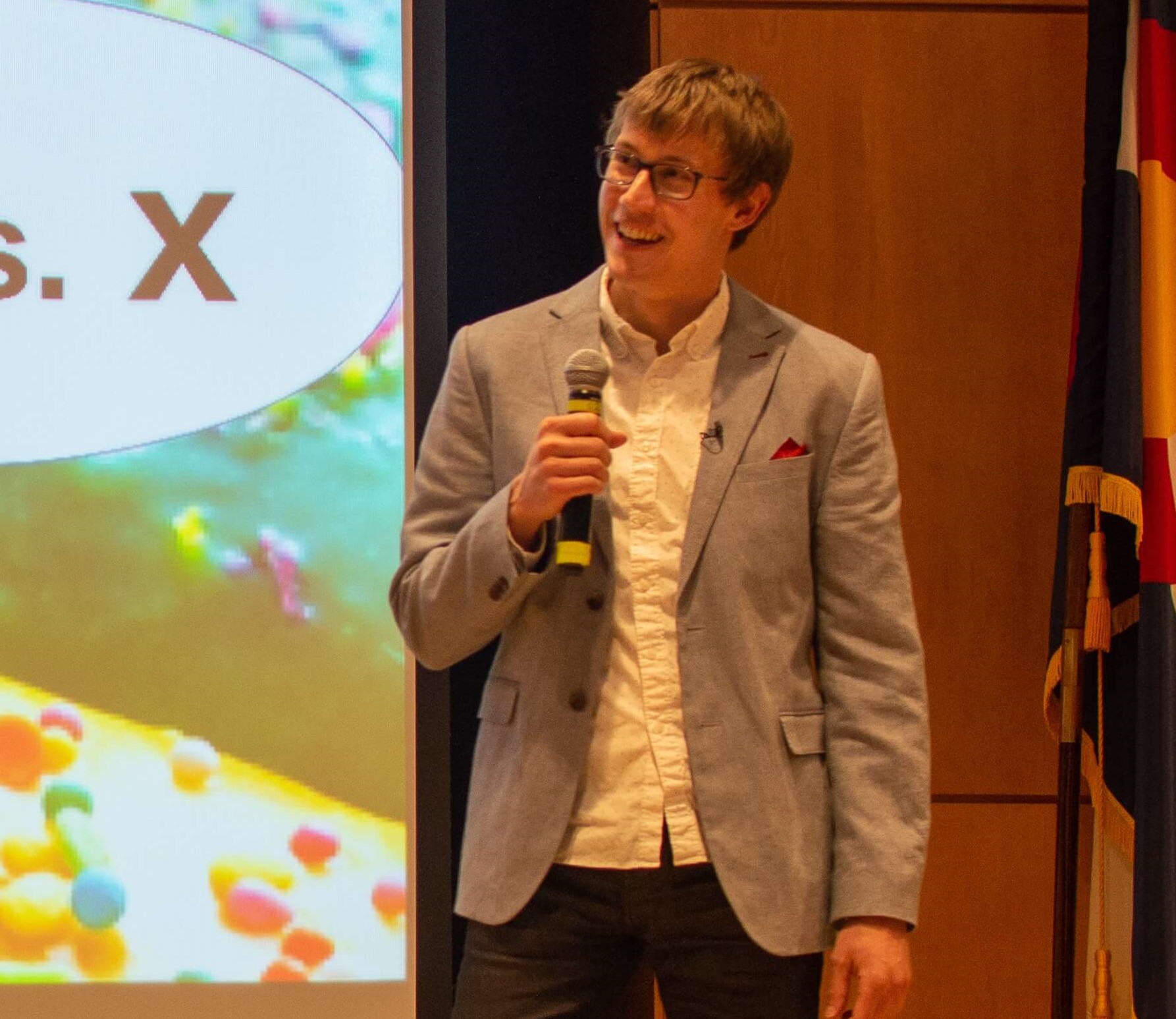 Please provide a link to your university page. https://www.hansonsmath.info/
Please describe the courses you teach. I teach a number of courses including Math 110: Critical Thinking, Math 378: Number Systems, and Math 470: Abstract Algebra.
Describe your teaching philosophy and any research interests related to your discipline or teaching. Teaching is an integral part of how I define myself as a mathematician. Justifying, explaining, and contextualizing mathematics is extremely important to me. Teaching allows me to better understand how different people learn. This in turn informs how I write, speak about, and present research mathematics. Teaching gives me the chance to be an ambassador for mathematics, to pique students' interest in math, and to help rectify some of the negative assumptions people make about mathematics. More broadly, my work in the classroom is one of the most direct ways in which I can fight against inequity and exclusion.
My most immediate goal is to effectively enable my students to mature mathematically in the context of the course that I am teaching. In addition to computing a determinant, say, my definition of mathematical maturity encompasses things like communicating mathematically with one's peers, abstracting concrete situations into mathematics, and thinking critically about the world. I also devote more class time to mathematical motivation. When and where was this developed? Why would someone want to do it in this way? What problems/questions/issues might these concepts be addressing? I can see that this approach motivates students.
Each semester I love the opportunity to make changes and try to do even better. I consciously view the practice of teaching with the same growth mindset I impress upon my students: There is no finished product or perfect instructor. Mistakes are opportunities to improve and learn. The important things are the process and the joy found in being a part of a student's intellectual growth.
My research is in algebraic number theory and arithmetic geometry. This is a fancy way of saying that I study the integers using techniques from algebra and algebraic geometry. My research and teaching don’t directly inform each other, but they are both important parts of my holistic view of mathematics.
Textbook or OER/Low cost Title: Course readings and resources (listed above)
Brief Description: Outcomes A3.4, A3.5, and A3.6 are confronted extensively in the first four weeks of the course from the standpoint of mathematics. A Friendly Introduction to Number Theory often engages with mathematical thinking by contrast with “conventional” (often inductive and anecdotal) reasoning. Thus, outcomes A3.1-A3.3 are addressed in a secondary manner in the first four weeks of the course. Week five is focused on writing an essay addressing the following prompt: “Compare and contrast mathematical argument and ‘conventional argument.’” This sharpens student’s understanding of logic, reasoning, and meaning (A3.4-6) while simultaneously asking them to define critical thinking in contrast to more passive, everyday “thinking.”
With weeks six and seven, the course pivots to looking at various critiques, condemnations, and celebrations of current corporate manifestations of mathematical thinking, specifically Weapons of Math Destruction by Cathy O'Neil and Algorithms of Oppression by Safiya Umoja Noble. With their understanding of mathematical thinking well-developed from the first five weeks of the course, students engage with these sources to separate matters of fact from opinion (A3.1), evaluate the reliability of the evidence presented (A3.2), and argue their own thesis (A2.2) answering, “How has mathematics been used on you and how can you respond to it?” Students are prepared for this task not only by reading the material, but by in-class discussions with their peers.
Weeks eight through ten are devoted a deeper introduction to number theory. This more traditional mathematical material builds towards outcomes A3.4-A3.6 while also giving students skills that will help them in future STEM courses. Students demonstrate these skills with an in-class midterm.
After the midterm, we shift to Euclid’s Elements. This text is one of the pillars on which modern mathematics is built; however, it is also over 2,000 years old and does not always meet the standards of modern mathematical reasoning. We read and discuss this text critically in class to simultaneously understand the mathematical ideas and tools Euclid is building while also being skeptical of the work. This critical discussion of a fundamental historical math text naturally builds toward all six learning outcomes (A3.1-A3.6) with a special emphasis toward the first three outcomes (A3.1-A3.3). It is a daunting, but immensely rewarding task to use one’s budding mathematical skills to critique an ancient text that is one of the pillars of Western thought. After three weeks of Euclid, we spend weeks 14 and 15 analyzing how Elements has impacted Western thought by reading Plato, Descartes, and the Declaration of Independence. These two weeks help students develop the ideas to write the final essay of the course where they answer how the axiomatic approach of Euclid has affected our world today. As objectives, the discussions of these final two weeks blend skills that are requisite for all six learning outcomes (A3.1-A3.6) for the course. Moreover, students aim to produce a final essay that shows a high level of mastery of and significant progress toward all six learning outcomes. This essay simultaneously allows students to create an authentic definition of ‘critical thinking’ in comparison with Western thought. Thus, there is an important aspect of meta-learning whereby students must think critically in their own context to deconstruct the westernized notion of what constitutes “critical thinking.”
Student access: Students access the online resources through the learning management system, Canvas.
Supplemental resources: The primary external resources used are Canvas and Gradescope.
Provide the cost savings from that of a traditional textbook. Average savings of $110
License: Readings are either freely available through author websites, in public domain, or accessed as library ebooks.