Living Myths of War & Peace (RS 300)
Living Myths of War & Peace (RS 300)
Purpose: to help other instructors teaching the same course
Common Course ID: Religous Studies 300
CSU Instructor Open Textbook Adoption Portrait
Abstract: This open textbook is being utilized in a Religious Studies] course for graduate students by Sara Hart at Cal Poly Humboldt. The open textbook provides [brief description of highlights and any instructor supplements]. The main motivation to adopt an open textbook was [supply reason]. Most student access the material through the campus LMS, Canvas. The nature of the material itself, though, is driving the development of a more robust, public-facing platform for delivery.
Course Title and Number: Religious Studies 300
Brief Description of course highlights: RS 300: Living Myths of War & Peace. UD Area C GE. No prerequisites. Course Description: Examines how the nation’s “sacred stories” have developed in the context of war mobilization and anti-war movements, with special attention to the experience of diverse, often marginalized and embattled, populations. Organized according to America’s war eras, beginning with early colonialism and extending to the present. Foundational mythic themes - such as American exceptionalism, self-evident truths, and moral communities (e.g., “We the People"), manifest destiny, and the frontier - are traced into modern experience, highlighting the development of the nation’s mythos through changing historical times.
Student population: The course is regularly scheduled as an UD GE course, which also fulfills Humboldt’s Diversity & Common Ground campus requirement, and students therefore enroll from across the University. A wide array of majors is represented. The course has no prerequisites, though Freshmen rarely enroll. Humboldt’s campus hosts a vibrant senior enrollment program, and participants in that program regularly enroll, bringing a diversity of age, and direct experience with mid- and late-century events under review. Other diversity metrics follow campus trends.
Learning or student outcomes:
Students will identify and define fundamental historical facts (significant figures, events, texts, etc.) and concepts from the United States of America’s martial history. I.e., students will demonstrate historical literacy around American militarization.
Students will recognize and critically consider mythic assertions developed through the nation’s martial history, such as “American Exceptionalism,” “Liberty and Justice for All,” “Manifest Destiny,” and “Redemptive Violence,” and will identify where those assertions are reflected and/or challenged in historical and contemporary experience.
Students will demonstrate clear understanding that a plurality of perspectives exist in relation to each national martial engagement, and will apply a situational awareness of power and privilege to that plurality of perspectives.
Students will develop the capacity to engage in civic discourse on politically divisive topics, using the tools of Religious Studies (esp. Phenomenological distance).
Key challenges faced and how resolved: Due to the curricular changes initiated with my adoption of OER, I have collaborated with more people on campus, and more people in the community, than I could have imagined. I use a far broader range of materials, in terms of both perspective and medium. And I have collaborated at some length with our on-campus videographers, in order to create brief lecture videos used to frame the wide array of course materials.
Syllabus and/or Sample assignment from the course or the adoption [optional]: Through the help and guidance of the CTL, I have developed an online, or “liquid” syllabus for this course, which provides students with a more accessible format (especially on devices other than computers). While the syllabus does not include links to the resources, it does include a calendar listing them, as well as descriptions for every assignment. It is updated each time the course is taught (Falls, and often Summers), and is in a perpetual process of improvement. It can be accessed in its most current version through this link.
Textbook or OER/Low cost Title: A single title was not used. Site links were included in the course LMS to each individual assigned resource,. I am working towards developing a web-based collection, formatted as a multimedia timeline.
Here are links to resources used in the first half of the class:
RTD&A, Murrow, October 1958
Weinstein, Rediscovering ivil Religion in America
USCIS Civics Practice Test
NPR, Fresh Air, On Ben Franklin's 'Liberty, Safety' Quote
Mytheos Holt, On Ben Franklin's 'Liberty, Safety' Quote
Henry, Speech to the 2nd Virginia Convention, 1775
Declaration of Independence
Paine, The Crisis, 1776
Horowitz, On Thomas Jefferson and the Blood of Tyrants
Key, The Star-Spangled Banner
Claugue, On Star-Spangled Banner Critics
Parker, On The Star-Spangled Banner
Whitney Houston Sings the Star-Spangled Banner
Lady Gaga Sings the Star-Spangled Banner
Tecumseh, Sleep Not Longer, 1811
PBS Voices, On Native American Military Service
O'Sullivan, On Manifest Destiny, 1845
M. Escontria's Press, Federation or Death, 1847
State Press in the Palace, Prayer (Satire), 1847
Corrido de Joaquin Murrieta
Sollitto, Ballad of Joaquin Murrieta
The Mexican Standoff, Muro
Hughes, Let America Be America Again
Frost, The Gift Outright
Lincoln, First Inaugural
Lincoln, Gettysburg Address
Lincoln, Second Inaugural
Jones as Stevens, from Spielberg's Lincoln
Limbong, on The Battle Hymn of the Republic
Houston, Battle Hymn of the Republic
Mormon Tabernacle Choir, Battle Hymn of the Republic
Qureshi, on Dixie
Presley, American Trilogy
Ford, Dixie (Union)
Formerly Enslaved Americans Talk about Slavery
Lepore, The Invention of the Police
Hill, Black Rage
Angelou, Still I Rise
Student access: Currently, students access all material through the campus LMS, Canvas. The nature of the material itself, though, is driving the development of a more robust, public-facing platform for delivery.
Provide the cost savings from that of a traditional textbook. Since I began teaching this class, I have used a collection of no-cost materials, cobbled together. The class is taught to approximately 90 students each Fall semester (in addition to occasional other sections, such as summer school and self-support), and I have taught the class for about 5 years. If a textbook could be found at the cost of $20/book (which would be cheap), then that book would have cost students approximately $9,000 so far. This is a conservative estimate, in terms of both likely cost and students enrolled. It’s definitely saving students .
License: All material presented is under fair use laws, for education.
OER/Low Cost Adoption Process
Provide an explanation or what motivated you to use this textbook or OER/Low Cost option. 1. There is no textbook on the relationship between American war and American myth: the subject itself requires a curated set of primary source documents drawn from centuries of material, and from as wide an array as possible of cultural perspectives. It was the need for a customized set of materials that motivated me to adopt no-cost materials for this course, and it is the hope for a coherent, framed set of such materials that has motivated me to work toward the development of a public-facing, timeline-based, multimedia collection of sources, which would also serve as a “textbook” for the class. At the same time, I am equally motivated by the desire to frame this material in a way that is accessible to the public, in order to fill an informational gap and meet a stark civic need. (While America has been at war for 92% of its national history, a 2018 Rasmussen poll showed that, at that time, 42% of Americans did not know that their nation was at war in Afghanistan, its longest-running martial engagement ever. The gap between national practice and national awareness is staggering, and it is filled with exhortations to “support the troops” and symbolic exhibitions of national fervor.)
How did you find and select the open textbook for this course? Finding the materials for this project has been easy: there is an embarrassment of riches in America’s belief-based wartime proclamations (of both support and dissent). The challenge has been, primarily, in figuring out how to present the material in a public-facing, cleanly designed way. Cal Poly Humboldt is currently working toward a more robust Digital Humanities presence, and that institutional infrastructure of digital platforms will be indispensable to getting the materials out of an LMS list, and into an attractive and meaningful format.
Cal Poly Humboldt has provided many, many introductions to the possibilities for OER, and to the practices that support its use, especially through the Library and the Center for Teaching and Learning. The campus’s Sustainability Librarian, Morgan Barker, has worked tirelessly since her time on campus as an instructional designer, to familiarize faculty with OER, and to ease its adoption. I found and selected OER with a great deal of help and support.
Sharing Best Practices: I have tried and failed at a number of things, on my journey toward OER. Not everything works. But I also haven’t found any firmly closed doors: technology is flexible, and I’m learning that there are many, many ways to accomplish any task. I would encourage people who are just getting started to keep the dream in mind, and keep working towards it. Also, keep an ongoing list of possible resources to include somewhere in the cloud.
My own progress has been in such fits and starts, that I have yet to feel like I have a finished product. I know what I want that finished product to look like, and I’m just not there yet. But I have shared methods, and experiments, and failed attempts, at professional development events hosted by Humboldt’s Library and CTL, and I will continue to do that. Those presentations always lead to discussions with other faculty, staff, and students who have hot tips.
Describe any challenges you experienced, and lessons learned. The greatest challenge has been the construction and dissemination of course materials through a multi-media, public-facing online timeline of resources. Such a framing would render the material in more apparently a developmental way, while highlighting the contemporaneity of diverse and often conflicting texts, events, and figures. This challenge has not been fully resolved, though a collaborative team on campus is working toward grant funding for the site’s construction, as well as toward a more robust, public-facing online platform housing a campus-wide range of online research and creative projects, developed by faculty as well as students. So we have hope.
Sara Hart, PhD
Religious Studies
Cal Poly, Humboldt 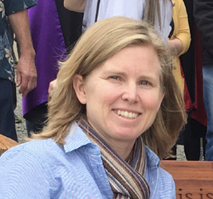
Situated within the interdisciplinary field of Religious Studies, I explore how a shared sense of meaning, value, and purpose organize the lives of contemporary Americans, in both religious and secular contexts. I’m focused on the relationship between America’s wars and the American myth, and dedicated to providing students (and ultimately the public) with a curated set of multimedia resources tracing the development of America’s national narrative through the wars that fill over 92% of its history and continue to sit at the center of its ritual engagements. In addition to Living Myths, I teach classes on Religion in America and World Religions and am currently developing a Peace & Justice Studies curriculum.
Please describe the courses you teach. RS 300, Living Myths of War & Peace, is an upper-division GE course, and it also fulfills Humboldt’s Diversity & Common Ground requirement. Most students are therefore GE students, often majoring in the sciences or professional studies. There are no prerequisites; the class is commonly a mixed population, though it is rare that Freshmen enroll. Every student brings to the class what they learned about America’s wars in K12 History and Social Studies classes, and through popular presentations of national faith (such as national holidays, the Pledge of Allegiance, military involvement at sporting events, etc.). A common refrain is, “Why didn’t I learn this in High School?”