Chapter 3: Biological sex and intersexuality
In this chapter we will be exploring the typical manner in which one’s biological sex is determined as well as common exceptions to this process.
For most individuals, biological sex is determined by what combination of sex chromosomes are inherited from their biological parents. Human DNA contains 23 pairs of chromosomes. The first 22 pairs are autosomes and contain all the genetic information for the developing fetus except for biological sex. The last pair, the sex chromosomes, contain the genetic information for biological sex. Typically, a fetus with XX chromosomes will develop into a female; a fetus with XY chromosomes will develop into a male.
There are five stages involved in biological sex development, beginning with conception and ending with puberty. As discussed by Kaplan (1980), these five stages of development include genetic, gonadal, hormonal, internal genitalia, and external genitalia. The genetic stage involves the inheritance of either XX or XY chromosomes from the biologic parents. The gonadal stage refers to the beginning of the differentiation of the gonads into either testes or ovaries. The hormonal stage involves the maturation of internal genitalia due to the influence of the release of sex hormones, making them functional. Internal genitalia refers to testes for males and ovaries for females. External genitalia refers to a penis and scrotum for males and clitoris, labia, and vaginal opening for females. External genitalia are the physical structures generally used upon observation at birth to determine the sex of the child (in addition to an ultrasound which can also be used to determine the sex of a fetus during the gestational period).
A later component of biological sex development is puberty. This stage is characterized by the onset of secondary sexual characteristics and the ability to reproduce. Hormonal changes during puberty trigger the development of adult sexual characteristics and the maturation of the reproductive system. Puberty is the stage of human development in which a child's body transforms into that of an adult, capable of sexual reproduction. During puberty, the body undergoes several physical, hormonal, and emotional changes that are characteristic of adolescence. These changes are primarily driven by increased production of hormones such as testosterone in males and estrogen in females.
In males, puberty is marked by the growth of facial and body hair, a deepening of the voice, and an increase in muscle mass. In females, puberty is characterized by the onset of menstrual periods, the growth of breasts, and the development of wider hips. Both males and females typically experience an increase in height and a growth spurt during puberty.
Puberty typically begins between the ages of 8 and 13 for girls and 9 and 14 for boys, but can start earlier or later depending on a variety of genetic and environmental factors. The duration of puberty can vary as well, but most individuals complete it by their mid-teens to early twenties.
At the beginning stage, conception takes place when the sperm of a male enters the egg of the female, and this combination of either XX or XY is established. To state that the biological sex of the child is thus determined at conception, however, is inaccurate. This is because the eventual biological sex of the child is determined during the gestational period, or the roughly nine-month period from conception to birth during which the fetus grows from a one-celled organism into a (mostly) fully-formed individual. For roughly six weeks after conception, regardless of chromosomal make-up, a fetus is capable of developing into either a male or female. Thus, other factors must be considered in determining the biological sex of an individual.

"Baby Lying on White Cushion Beside Brown Bear Plush Toy" by The Craft Wonder is in the Public Domain, CC0
Progressing through the first sex weeks of fetal development, the fetus develops two systems which determine eventual biological sex: Wolffian and Müllerian. As explained by Yu and Wang (2022), the Wolffian ducts, or mesonephric ducts, which appear around 25-30 days after gestation, “are paired embryonic structures that serve as progenitors of the male internal genitalia.” These ducts are responsible for the development of the epididymis, vas deferens, ejaculatory duct, and seminal vesicle. Conversely, the Müllerian duct, present around 40-48 days after conception, provide the physical structures for the development of the female internal genitalia, which include oviduct, uterus, cervix and upper vagina. Which duct system becomes activated depends on the levels of sex hormones in the womb.
The endocrine system is responsible for secreting these sex hormones throughout the body to various receptor sites which influence the development of the fetus during the gestational period. Two relevant components of this system are the hypothalamus, which is essentially the coordinating center of the brain, and the pituitary, the master hormonal regulatory gland. Working in tandem, these structures are responsible for transmitting information to other parts of the body to determine whether the fetus will develop into either a male or female in terms of what proportions of sex hormones are produced.
The hypothalamus and the pituitary gland play a key role in determining biological sex by regulating the production and release of hormones that control sexual development. The hypothalamus produces gonadotropin-releasing hormone (GnRH) which stimulates the pituitary gland to release follicle-stimulating hormone (FSH) and luteinizing hormone (LH).
In males, LH stimulates the testes to produce testosterone, which is responsible for the development of male secondary sexual characteristics, such as the growth of facial and body hair, deepening of the voice, and the development of the penis and testes. In females, FSH stimulates the ovaries to produce estrogen, which is responsible for the development of female secondary sexual characteristics, such as the growth of breasts, the onset of menstruation, and the regulation of the menstrual cycle.
There are two major types of sex hormones. Androgens, the most common of which is testosterone, are commonly associated with males and control the development and maintenance of masculine characteristics. Estrogens, the most common of which is estradiol, are commonly associated with females and control the development and maintenance of feminine characteristics. However, to describe these as ‘male’ versus ‘female’ hormones would be inaccurate as both males and females produce both types of hormones, just to varying proportions. Men typically produce more testosterone than estrogen; women typically produce more estrogen than testosterone. A third type of hormones, progestins, the most common of which is progesterone, play an important role in maintaining the menstrual cycle as well as maintenance of the uterus during pregnancy (Cable & Grider, 2022).
Associated with the biological sex development of a fetus are physical structures known as the gonads, or internal reproductive organs, which are responsible for producing gametes, or reproductive cells. For biological males, these gonads will develop into testes. For biological females, these gonads will develop into ovaries. However, all fetuses will first develop undifferentiated gonads, which means that these organs will have the capacity to develop into either testes or ovaries.
Located on the Y chromosome is a gene known as the SRY gene. According to Medline Plus (2021), “The SRY gene provides instructions for making a protein called the sex-determining region Y protein. This protein is involved in male-typical sex development, which usually follows a certain pattern based on an individual's chromosomes.” For fetuses with this SRY gene, around six weeks into typical fetal development, the hypothalamus instructs the pituitary gland to release a surge of testosterone. This surge of testosterone triggers the activation of the Wolffian system, which triggers the undifferentiated gonads to masculinize into testes. This occurrence furthermore activates the release of a Müllerian inhibiting substance (MIS) which causes the Müllerian ducts to be reabsorbed by the fetus. The fetus will develop into the typical male form as a result.
For fetuses without this SRY gene, there is no corresponding surge of testosterone around the sixth week of development. As a result, the Müllerian ducts provoke the undifferentiated gonads to develop into ovaries, and the Wolffian system begins to be reabsorbed by the fetus. The fetus will develop into the typical female form as a result. In both cases, this process is completed by around the twelfth week of development. This entire process thus straddles the three main stages of fetal development in general: the germinal stage (conception to four weeks) in which the fertilized egg, i.e., the zygote, moves along the top of the female fallopian tube toward the uterus and releases sex hormones indicating to the female that she is pregnant (such as by stopping her menstrual cycle); the embryonic stage (weeks five to nine), during which the brain and central nervous system are developed, internal organs are formed, and one’s biological sex is starting to be determined; and the fetal stage (weeks ten to birth), during which the biological sex is finally determined, the physical structures of the fetus progress towards being able to exist outside the womb, and cerebral functioning is strengthened.
Depending on what criteria are considered in determining one’s biological sex, it is estimated that the above process holds true for roughly 149 out of 150 live births in the U.S. This means, of course, that for roughly 1 out of 150 live births, determination of one’s biological sex takes a different approach. Although this seems a fairly small percentage (just 0.0067%), it corresponds to the lived experiences of roughly 2.2 million Americans. Other estimates place its occurrence as high as 1.7% of the population (Fausto-Sterling, 2000). In this next section we will focus on situations involving atypical biological sex development, also referred to as disorders of sexual development (DSDs).

"Ancient Architecture Doric" by Oksana Titova is in the Public Domain, CC0
Hermaphroditism
According to ancient Greek myth, the messenger god Hermes and the fertility god Aphrodite consummated their relationship and bore an offspring, a son named Hermaphroditus. Being quite vain, Hermaphroditus continually brushed off the romantic gestures of the water nymph Salmacis, who was unhappy to have her love for Hermaphroditus unrequited. Frustratedly, Salmacis begged the queen goddess Hera to allow them to be together. Always one to be duplicitous, Hera told Salmacis that if Hermaphroditus ever entered into her waters, they would be joined as one. When Hermaphroditus eventually did so, their two bodies fused together into a new being named Hermaphrodite, who was fully both male and female, conceivably capable of self-impregnation. Although this is not a biological possibility for humans, the term hermaphroditism was originally used to describe an individual who did not develop into either the typical male or female pattern. Since the beginning of the 20th century, given our advances in scientific and medical knowledge, we know use the term intersex as an umbrella category to refer so someone who is not, strictly speaking, an XX female or XY male.
However, there does remain a specific type of intersex condition still referred to as hermaphroditism, which refers to an individual who possesses both ovarian and testicular tissue, also referred to as ovo-testes. According to Britannica, “In ovotesticular disorder (sometimes also called true hermaphroditism), an individual has both ovarian and testicular tissue. The ovarian and testicular tissue may be separate, or the two may be combined in what is called an ovotestis. Affected individuals have sex chromosomes showing male-female mosaicism (where one individual possesses both the male XY and female XX chromosome pairs). Most often, but not always, the chromosome complement is 46,XX, and in every such individual there also exists evidence of Y chromosomal material on one of the autosomes (any of the 22 pairs of chromosomes other than the sex chromosomes).” Considered extremely sporadic and rare, not much is known about this condition other than the testicular tissue is prone to developing cancer and can be life-threatening if not surgically removed.
Whereas for most people the process described in the first half of this chapter progresses without issue, there are instances in which a zygote, a fertilized egg, will possess a differing number of chromosomes than is typical. These can occur due to genetic abnormalities or simply random error in the cell division process. Below are some examples of intersex conditions due to chromosomal abnormalities.
Klinefelter’s syndrome, which affects only males, results from random error that occurs during cell division such that a person has an extra X chromosome in all or only some of their cells (known as XXY mosaic). Individuals with an extra X chromosome in all of their cells experience more severe symptoms than do those who are XXY mosaic. Epidemiological studies indicate that this occurs in about 1 in 500 men, making it one of the more common intersex conditions (Abramsky & Chapple, 1997), although it is often underdiagnosed. As a result, males with Klinefelter’s syndrome have a greater incidence of gender dysphoria than the general population (Cai & Yap, 2022).
Although there is no cure for Klinefelter’s syndrome, there are treatments which can help with some of the symptoms, which include gynecomastia (enlarged male breasts), delayed puberty, and lowered sperm production. Other symptoms include enlarged hips, less facial and body hair, and potential cognitive deficits. Although some males with Klinefelter’s syndrome are sterile, others may benefit from fertility treatments such that they could father a child. Also, whereas it is possible to diagnose this condition after birth with medical testing, it typically does not become apparent until puberty.
Typical biological sex development results in a fetus with either XX or XY chromosomes. Every viable fetus must possess an X chromosome; a fetus without an X chromosome lacks genes which are necessary for the sustaining of life (Jegalian & Lahn, 2001). It is possible for a fetus to have just one X chromosome and either a missing or non-functioning second sex chromosome (either X or Y). Given this second sex chromosome’s non-functional status, individuals with this condition, known as Turner’s syndrome, are designated with an XO chromosomal pattern.
Discovered in 1938 by Dr. Henry Turner, Turner’s syndrome, which affects only females, is estimated to occur in 1 out of every 1,000 live births. The specific cause of this syndrome is currently unknown. According to the National Human Genome Research Institute (2013), “Girls who have Turner syndrome are shorter than average. They often have normal height for the first three years of life, but then have a slow growth rate.” Individuals with Turner’s syndrome seem to share three common characteristics: lymphedema, a swelling of the hands and feet; short stature (compared to typical females), and dysmorphia, some form of abnormal difference in body structure.
Whereas most girls will start to produce more estrogen and progesterone at the start of puberty, those with Turner syndrome, due to non-functioning ovaries, do not. This means that they also do not experience the usual growth spurt during puberty, develop breasts, or experience menarche, the start of menstruation. Under the care of a specialist endocrinologist, some girls may benefit from hormone replacement therapy to address these issues. Women with Turner’s syndrome have intact vaginas and wombs but are often infertile. However, it is possible for individuals with Turner’s syndrome to undergo IVF (in vitro fertilization), become pregnant, and deliver a child via cesarian section.
As further discussed by the Turner Syndrome Foundation (2022), “Turner Syndrome is a spectrum disorder, consisting of major symptoms and signs, all of which may or may not be present. Health concerns include but are not limited to cardiovascular disease, issues with the kidneys and thyroid, diabetes and hearing deficiencies. Early intervention has been proven to produce long-term positive outcomes.”
Normally, females have just two X chromosomes in all cells (XX). However, for every 1 out of 1,000 live births, females can have a third X chromosome (XXX). This results in a condition known as Trisomy X syndrome. First described in 1959 by Dr. Patricia Jacobs and colleagues, Trisomy X syndrome is believed to be caused by random error in cell division. However, unlike many other syndromes, girls with Trisomy X may not experience any physical or cognitive impairments due to the presence of an extra chromosome and may not even be aware of this condition. Fertility is not affected, and unless other health issues warrant it, this syndrome is likely to remain undiagnosed.
Common attributes of girls with Trisomy X syndrome include accelerated growth rate until puberty and longer legs as adults (Otter, Schrander-Stumpel, & Curfs, 2010). Some females with Trisomy X syndrome may experience motor-coordination problems and lower IQ scores compared to those unaffected by this syndrome. Some may “struggle with low self-esteem and need psychological, behavioural and educational support.”
Super male syndrome, which affects only males, is thought to occur due to random error in cell division in the sperm which results in males having an extra Y chromosome (XYY). Given the variation in which cell division error occurs, males may have some cells with XY and other with XXY. The prevalence rate is estimated to be 1 out of every 1,000 live births. Similar to Trisomy X syndrome, it is likely to remain undiagnosed since it may or may not cause any issues related to fertility, physical growth or other areas of development. One study estimated that only 15-20% of cases are ever diagnosed (Davis, 2012).
For those with greater severity, symptoms may include delayed motor skill development, speech or attention difficulties, learning difficulties, and taller-than-average height. Some males (around 5%) may also experience fertility issues which may or may not be related to this syndrome. Furthermore, according to Milunksy (2010), the presence of an additional Y chromosome is not associated with any discriminating physical or behavioral features and does not affect pubertal development.
Testosterone is well-established to be associated with aggression (Book, Starzyk, & Quinsey, 2001). As such, researchers earlier believed that the presence of an extra Y chromosome should cause these males to be more aggressive in nature. In the 1960s, it was demonstrated that males with XYY were over-represented in the prison population. However, their incarceration was due largely to non-violent offenses, thus negating this hypothesis (Richardson, 2013). Later research verified that males with an extra Y chromosome do not have higher testosterone levels compared to those without (Davis, Bloy, Roberts, Kowal, Alston, Tahsin, et al., 2020).
In addition to intersex conditions caused by chromosomal abnormalities, there are also intersex conditions caused by hormonal abnormalities. With chromosomal abnormalities, there generally is no disconnect between an individual’s genetic make-up and the presentation of their biological sex. A female born with an extra X chromosome would still be assigned a female at birth, just as a male born with an extra Y chromosome would still be assigned a male. When intersexuality involves variations on typical hormonal influences on fetal development, however, there is much greater disconnect. Children can be born with ambiguous genitalia, in which the biological sex of the child is not clear based on external observation. In extreme cases, a child could even be erroneously assigned a sex at birth which does not match up with their biological sex. Below are some examples of intersex conditions due to hormonal abnormalities.
As previously discussed, the SRY gene on the Y chromosome will prompt a surge of testosterone causing a fetus with XY chromosomes to activate the Wolffian system, leading to the development of a biological male child. This is due to the fetus possessing androgen receptors. Androgen receptors are proteins which recognize androgens (such as testosterone) and allow it to develop male characteristics, i.e., male internal and external genitalia. For some fetuses with XY chromosomes, a mutation in these androgen receptors interferes with the body’s ability to recognize or sense the presence of additional androgens. Although the SRY gene does produce additional testosterone around the sixth week of development, the body is insensitive to its presence. As a result, instead of the Wolffian system activating, the Müllerian system becomes dominant and will start the process of developing the fetus into a female. Androgen insensitivity syndrome occurs when an XY fetus develops the external sex characteristics of a female.
There are three main types of androgen insensitivity syndrome: complete androgen insensitivity syndrome (CAS), partial androgen insensitivity syndrome (PAS), and mild androgen insensitivity syndrome (MIS). All occur quite rarely among live births. For example, it is estimated that 1 out of 99,000 infants are born with partial androgen insensitivity syndrome and 2 to 5 out of 100,000 infants are born with complete androgen insensitivity syndrome (Singh & Illyayeva, 2022). The most common symptom of any form of AIS is infertility.
Individuals born with complete androgen insensitivity syndrome have a narrow or shallow vagina but no uterus. Incomplete gonad development typically results in undescended testes which can become cancerous if not surgically removed (Hughes, Werner, Bunch, & Hiort, 2012). Infants are usually reared as girls and experience normal development until puberty. At puberty, adolescents do not experience menarche and do not have monthly periods. There is generally little to no pubic or arm hair. These symptoms only start to appear at puberty and it is at this time that most diagnoses are made, if at all. As adults, individuals with CAS are typically taller than their non-AIS counterparts (due to the influence of the Y chromosome) and are infertile. Individuals with CAS may be treated with estrogen therapy to help maintain a more feminine appearance, and may also benefit from psychological counseling.
According to MedlinePlus (2016), “The partial and mild forms of androgen insensitivity syndrome result when the body's tissues are partially sensitive to the effects of androgens. People with partial androgen insensitivity (also called Reifenstein syndrome) can have genitalia that look typically female, genitalia that have both male and female characteristics, or genitalia that look typically male. They may be raised as males or as females and may have a male or a female gender identity. People with mild androgen insensitivity are born with male sex characteristics, but they are often infertile and tend to experience breast enlargement at puberty.” Individuals with PAS may need corrective surgery to help match their gender identity and, if reared as a male, may be treated with testosterone therapy to help maintain a more masculine appearance. Psychological counseling is again encouraged.
Given the possibility that the gender identity of individuals with AIS may not match up with their biological sex, careful consideration should be given to ensure healthy psychological and social development. “Management of androgen insensitivity syndrome involves a holistic approach toward the psychological, physiological, and social well-being of the individual suffering from this disorder. It is imperative to address the challenges foreseen to the family of the infant who is born with AIS to optimize well-being of the infant into adulthood (Singh & Illyayeva, 2022).
Whereas androgen insensitivity syndrome affects XY fetuses, congenital adrenal hyperplasia (CAH, also known as adrenogenital syndrome) affects XX fetuses. Adrenal glands, located on top of each kidney, produce steroid hormones such as cortisol, adrenaline, and aldosterone. In individuals with CAH, a gene disorder results in the body not producing enough of one or more of these hormones (usually cortisol), thereby prompting the adrenal glands to produce more androgens. More than 90% of CAH cases are a result of a specific enzyme deficiency called 21-hydroxylase deficiency (New, Yau, Lekarev, et al., 2017). The resulting increase in androgens has a virilizing effect on the fetus, meaning that it masculinizes its development. This condition occurs between 1:13,000 to 1:15,000 live births (Yau, Gujral, & New, 2019).
The severity of CAH depends on how much additional androgens are released by the developing fetus. On the extreme end of the Prader scale (which is used to measure genital conformity), individuals with CAH, although they have two X chromosomes, may appear outwardly as male with an enlarged clitoris mistaken for a penis. There is a salt-losing form of this disorder that can be fatal if not treated. As a result of this possibility, all children born in the United States are tested for this disorder.
Previously we discussed AIS in which an XY fetus’s body (who would typically develop into a male) is insensitive to the presence of the increase of testosterone around the sixth week of fetal development and as a result develops according to the typical pattern of a female. The child would therefore be ‘born’ and raised as a female. Imagine, however, if at puberty, during which a very similar type of testosterone is produced to induce the masculinization of external genitalia, that same XY individual’s body now suddenly responds to the increase of testosterone and starts developing into the typical male pattern. This would result in an intersex condition known as 5-alpha reductase deficiency disorder (5-ART).
5-ART is a rare genetic condition in which the body lacks an enzyme called 5-alpha-reductase, which is necessary for the normal metabolism of testosterone. As a result, affected XY individuals have underdeveloped male secondary sexual characteristics, such as a small penis and testes, or even ambiguous genitalia enough to resemble female genitalia, and may also have increased levels of estrogen. Essentially, the child is born and raised as a female until puberty hits, at which time the ‘female’ child starts maturing according to the male pattern.
This particular intersex condition can lead to a variety of physical and hormonal differences as well as some cognitive and behavioral difficulties. Due to its rarity, the exact prevalence of 5-alpha reductase deficiency is not well established, although the disorder appears to be more common in certain populations such as certain ethnic groups in the Dominican Republic and in parts of Africa where genetic diversity may be scarce. Early diagnosis and treatment can help improve outcomes, such as promoting normal growth and development, and preventing gender identity confusion and related psychological problems.
An example of an individual with this condition is the Olympic medalist runner Caster Semenya from South Africa. Semenya was born with male chromosomes (XY) but with typical female external genitalia and was diagnosed at puberty when she began to experience rapid improvements in her athletic abilities. She faced controversy and discrimination in the athletic world due to her high testosterone levels and was subjected to gender testing. Despite this, Semenya continues to compete and has won several medals, including gold medals in the 800m at the 2009 World Championships and the 2012 and 2016 Olympic Games. Her story highlights the complex and diverse experiences of intersex individuals and the importance of respecting and supporting their gender identity.
Several organizations have devoted themselves to better understanding the lived experiences of intersex individuals. For example, the Intersex Society of North America (ISNA) was a non-profit organization that aimed to improve the lives of intersex people. Founded in 1993, it was the first advocacy organization in the United States focused on intersex issues.
ISNA was dedicated to ending shame, secrecy, and unwanted genital surgeries for people born with anatomy that is not considered traditionally male or female. It aimed to promote public education, medical and legal advocacy, and support for individuals and families affected by intersex conditions.
The organization worked towards promoting a more informed and compassionate understanding of intersex conditions and provided resources and support for individuals, families, and healthcare providers. Unfortunately, the Intersex Society of North America closed in 2008, but the legacy of its advocacy continues to shape the conversation around intersex issues and drive progress towards greater understanding and inclusion for intersex individuals. You can learn more by visiting their website at www.isna.org.
Today, there are several other organizations that focus on intersex conditions and advocate for the rights and well-being of intersex people. Some examples include:
- Organisation Intersex International (OII) - an international network of intersex organizations and individuals working to end stigma, discrimination, and human rights violations against intersex people.
- InterACT Advocates for Intersex Youth - a US-based advocacy organization focused on protecting the rights and improving the lives of children and youth with intersex traits.
- Androgen Insensitivity Syndrome Support Group (AISSG) - a UK-based support group that provides information and support to individuals and families affected by Androgen Insensitivity Syndrome (AIS).
- Turner Syndrome Society of the United States (TSSUS) - a non-profit organization that provides support, education, and advocacy for individuals with Turner Syndrome and their families.
- Intersex Trust Aotearoa New Zealand (ITANZ) - a New Zealand-based advocacy organization that works to advance the rights and well-being of intersex people in New Zealand.
These organizations offer a range of resources including support groups, educational materials, advocacy and legal resources and play an important role in advancing the rights and well-being of intersex individuals.
Studying intersex conditions is important for several reasons. One reason is that it can lead to improved understanding and treatment of intersex conditions. Studying intersex conditions can help increase understanding of their causes and lead to the development of better treatments and management strategies. Research can help improve the quality of life for individuals with intersex conditions by providing early diagnosis and proper medical, psychological, and social support.
Further research on intersex conditions can also lead to new insights and discoveries in the medical and biological sciences, which can have broader implications for human health and wellbeing. By increasing visibility and understanding of intersex conditions we can work towards a more inclusive and equal society where all individuals, regardless of their biology, are treated with dignity and respect. Overall, studying intersex conditions is important for improving the lives of affected individuals and for advancing our understanding of human biology and diversity.

"Turtle floating under blue sea water" by Daniel Torobekov is in the Public Domain, CC0
Humans (as are many animals) are sexually dimorphic, meaning that, for procreative purposes, we typically develop into either males or females. Our sexual dimorphism is largely dependent on our sex chromosomal makeup. Other species who are sexually dimorphic, however, are not dependent on sex chromosomes to determine their biological sex. Most sea turtles, for example, develop into either males or females via temperature-dependent sex determination (TSD), in which the ambient temperature during the gestational period determines their biological sex. According to the National Oceanic and Atmospheric Administration (NOAA; 2022), “Research shows that if a turtle's eggs incubate below 27.7° Celsius (81.86° Fahrenheit), the turtle hatchlings will be male. If the eggs incubate above 31° Celsius (88.8° Fahrenheit), however, the hatchlings will be female. Temperatures that fluctuate between the two extremes will produce a mix of male and female baby turtles.” Similar temperature-dependent sex determination is also true for other types of reptiles, such as alligators. No such temperature-dependent sex determination has been found in any species of birds, by contrast.
As of this writing, a heat wave in Florida and much of the American southeast is causing most, if not all, female sea turtles in the wild to be born female (Newsy, 2022), which obviously will have repercussions for future population growth. It’s interesting (if not frightening) to note how external circumstances such as climate change can be just as influential in biological sex development in other species as are internal factors for humans.
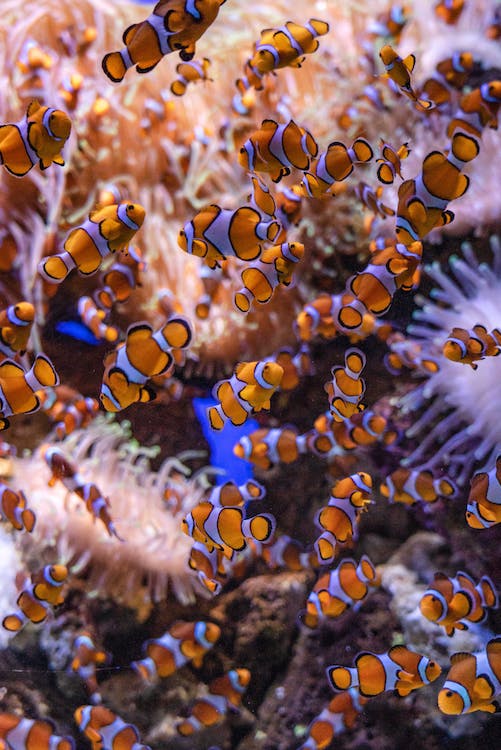
"A Bunch of Clownfish Swimming in a Tank" by Oleksandr Pidvalnyi is in the Public Domain, CC0
Furthermore, fans of the animated movie Finding Nemo may be curious to discover the peculiar trait of clown fish existing as sequential hermaphrodites, meaning that all juvenile fish are born and can behave as male, but have the ability to turn into females if the dominant female of the hierarchy dies and then procreates with other males of the species. Once becoming a female, however, the female clownfish cannot revert back to being male. This is because juvenile fish have both male and female reproductive organs, but after transitioning to a female, the male reproductive organs degrade (Casas, Saborido-Rey, Ryu, Michell, Ravasi, & Irgoien, 2016).
Abramsky L., & Chapple, J. (1997). 47, XXY (Klinefelter syndrome) and 47, XYY: Estimated rates of an indication for postnatal diagnosis with implications for prenatal counselling. Prenatal Diagnostics, 17, 363–368.
Book, A. S., Starzyk, K. B., & Quinsey, V. L. (2001). The relationship between testosterone and aggression: A meta-analysis. Aggression and Violent Behavior, 6, 579-599.
Britannica, T. Editors of Encyclopaedia (2021, July 15). Hermaphroditism. Encyclopedia Britannica. https://www.britannica.com/science/hermaphroditism.
Cable J. K., & Grider, M. H. Physiology, Progesterone. [Updated 2022 May 8]. In: StatPearls [Internet]. Treasure Island (FL): StatPearls Publishing; 2022 Jan-. Available from: https://www.ncbi.nlm.nih.gov/books/NBK558960/.
Cai, V., & Yap, T. (2022). Gender identity and questioning in Klinefelter’s syndrome. BJPsych Open, 8(S1), S44-45. doi: 10.1192/bjo.2022.176.
Casas, L., Saborido-Rey, F., Ryu, T., Michell, C., Ravasi, T. & Irigoien, X. (2016). Sex change in clownfish: Molecular insights from transcriptome analysis. Scientific Reports, 6(1), 1-19.
Davis, A. S. (2012). Psychopathology of childhood and adolescence: A neuropsychological approach. Springer Publishing Company.
Davis, S. M., Bloy, L., Roberts, T. P. L., Kowal, K., Alston, A., Tahsin, A., Truxon, A., & Ross, J. L. (2020). Testicular function in boys with 47,XYY and relationship to phenotype. American Journal of Medical Genetics, 184(2), 371-385.
Fausto-Sterling, A. (2000). Sexing the body: Gender politics and the construction of sexuality. New York: Basic Books.
Hughes, I. A., Werner, R., Bunch, T., & Hiort, O. (2012). Androgen insensitivity syndrome. Seminars in Reproductive Medicine, 30 (05), 432-442.
Jegalian, K., & Lahn, B. T. (2001). Why the Y is so weird. Scientific American, 284(2), 56.
Kaplan, R. H. (1980). The implications of ovum size variability for offspring fitness and clutch size within several populations of salamanders (Ambystoma). Evolution, 34, 51–64.
MedlinePlus [Internet]. Bethesda (MD): National Library of Medicine (US); [updated 2021 August 13]. SRY gene; Available from: https://medlineplus.gov/genetics/gene/sry/.
MedlinePlus [Internet]. Bethesda (MD): National Library of Medicine (US); [updated 2016 Nov 1]. Androgen insensitivity syndrome; Available from: https://medlineplus.gov/genetics/condition/androgen-insensitivity-syndrome/.
Milunsky, J. M. (2010). Prenatal diagnosis of sex chromosome abnormalities. In A. Milunsky & J.M. Milunsky (Eds.), Genetic disorders and the fetus: Diagnosis, prevention and treatment (6th ed.; pp. 273-312). Oxford: Wiley-Blackwell
National Human Genome Research Institute. About Turner’s syndrome. Updated 2013 September 24. Available from https://www.genome.gov/Genetic-Disorders/Turner-Syndrome.
New M, Yau M, Lekarev O, et al. Congenital Adrenal Hyperplasia. [Updated 2017 Mar 15]. In: Feingold KR, Anawalt B, Boyce A, et al., editors. Endotext [Internet]. South Dartmouth (MA): MDText.com, Inc.; 2000-. Available from: https://www.ncbi.nlm.nih.gov/books/NBK278953/
Newsy. Climate change is impacting the gender outcome of sea turtles. Retrieved 08/13/2022 from https://www.newsy.com/stories/climate-change-impacting-sea-turtle-gender/.
NOAA. What causes a sea turtle to be born male or female? National Ocean Service website. [updated 06/15/2022). https://oceanservice.noaa.gov/facts/temperature-dependent.html.
Otter, M., Schrander-Stumpel, C. T. R. M., & Curfs, L. M. G. (2010). Triple X syndrome: A review of the literature. European Journal of Human Genetics, 18(3), 265-271.
Richardson, S. S. (2013). Sex itself: The search for male and female in the human genome. University of Chicago Press.
Singh S, Ilyayeva S. Androgen Insensitivity Syndrome. [Updated 2022 Jun 5]. In: StatPearls [Internet]. Treasure Island (FL): StatPearls Publishing; 2022 Jan-. Available from: https://www.ncbi.nlm.nih.gov/books/NBK542206/
Turner Syndrome Foundation. What is Turner syndrome? Retrieved 08/14/2022 from https://turnersyndromefoundation.org/what_is_turner_syndrome/.
Yau M, Gujral J, New MI. Congenital Adrenal Hyperplasia: Diagnosis and Emergency Treatment. [Updated 2019 Apr 16]. In: Feingold KR, Anawalt B, Boyce A, et al., editors. Endotext [Internet]. South Dartmouth (MA): MDText.com, Inc.; 2000-. Available from: https://www.ncbi.nlm.nih.gov/books/NBK279085/
Yu M., & Wang S. M. Embryology, Wolffian Ducts. [Updated 2022 Apr 19]. In: StatPearls [Internet]. Treasure Island (FL): StatPearls Publishing; 2022 Jan-. Available from: https://www.ncbi.nlm.nih.gov/books/NBK557818/.