Chemistry 210 Laboratory
Chemistry 210 Laboratory
Purpose: to help other instructors teaching the same course
Common Course ID: General Chemistry 210L (Lab)
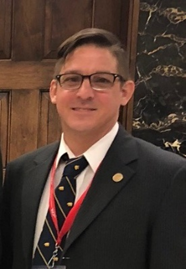
CSU Instructor Open Textbook Adoption Portrait
Abstract: This open textbook is being utilized in a general chemistry laboratory course for undergraduate students by Steven Runyon at the California State University - Maritime Academy. The open laboratory manual provides access to high-quality learning materials, maintaining high standards of academic rigor at no cost to students. The main motivation to adopt an open textbook was to provide a laboratory curriculum tailored to oceanography students at Cal Maritime, and to increase student access and decrease the cost of education. Most student access the open textbook in pdf format accessed via the Learning Management System.
Course Title and Number
Brief Description of course highlights: General Chemistry 2 Laboratory (CHE 210L) is a 2nd semester general chemistry laboratory course for students majoring in Oceanography who have completed General Chemistry 1.
Student population: The majority of students are freshman and sophomore students, and this course is a perquisite for a number of upper division Oceanography courses.
Learning or student outcomes: The specific educational objectives expected of students upon successful completion of General Chemistry 2 are as follows:
The specific educational objectives expected of students upon successful completion of General Chemistry Laboratory are as follows:
Scientific Method:
• Propose hypotheses based on experimental results.
• Propose potential experiments to test a hypothesis.
• Evaluate results of experiment in terms of consistency with hypotheses or theories.
• Document all experimental procedures and results in a laboratory notebook using standardized protocols.
Scientific Measurement and Uncertainty:
• Record measured values with appropriate significant figures and units
• Evaluate potential sources of error in an experiment and estimate how this error will affect experimental results.
• Solve problems using dimensional analysis, measured quantities, units of measure, and significant figures.
Key challenges faced and how resolved: Writing a lab manual from scratch is not for the faint of heart. I utilized published work to guide the design of the experiments to best correlate to the content covered in the lecture curriculum. Extensive testing and optimization required an enormous amount of time. I continue to optimize the experiments. To make matters worse, the first time that this course was offered in the spring of 2021, the laboratory was taught entirely online. During this time each of the experiments was conducted by filming myself doing each experiment and posting videos and images online. (zero out of ten stars – do not recommend!)
Textbook or OER/Low cost Title:
Brief Description: Chemistry 210L Laboratory Manual is designed to meet the requirements of a second semester general chemistry course for students majoring in oceanography, though it adheres to the scope and sequence of experiments of most second semester general chemistry courses. All experiments were designed and authored by the instructor with the intent of providing an experiential complement to the material presented in the lecture course and to introduce students to a research-focused mindset. Experiments in the laboratory manual include thin-layer chromatography, visible spectroscopy, kinetics, equilibrium, solubility, weak acid equilibria, buffers, thermodynamics, and electrochemistry.
Authors: Steven T. Runyun
Student access: Students access individual experiments and related resources via the LMS (currently D2L/Brightspace). Experiments are located in a dedicated Lab Manual folder and links to each chapter are posted in the calendar for easy access to current experiments and assignments.
Cost Savings: CHE210L: Free laboratory manual; compare to Slowinsky et al - $100 hard copy/$40 e-book. Cost savings spring 2022: 12 students x $100 ($40) = $1200 ($480); (enrollment is expected to be higher in spring 2023)
License: Pending
OER/Low Cost Adoption Process
Provide an explanation or what motivated you to use this textbook or OER/Low Cost option. The cost of education and has increased dramatically over the years, and I want to reduce the cost for my students in any way that I can. I have also been dissatisfied for laboratory manuals provided by publishers. I therefore decided to author my own laboratory manual.
How did you find and select the open textbook for this course? This is a self-authored laboratory manual that I created while on sabbatical in 2020.
Sharing Best Practices: This project took a great deal of effort to develop and was only possible because it was a main goal of my sabbatical. Our institution is very small (we have only 2 full time chemistry faculty and no support staff). This work would certainly have benefitted from more hands being involved to facilitate optimization.
Steven T. Runyun
California State University, Maritime
Associate Professor - Science and Mathematics
https://www.csum.edu/sciences-and-mathematics/faculty/steven-runyon.html
Dr. Runyon has a background in biophysical chemistry & structural biology and has been teaching at Cal Maritime since 2010. Cal Maritime is the smallest of the 23 CSU campuses and offers only 7 maritime-related majors. Chemistry courses offered at Cal Maritime include: introductory chemistry + lab, general chemistry 1 & 2 + lab, chemistry of industrial plant processes, and introductory organic chemistry & biochemistry.