Academic Literacy Development in Public Relations through Gamification
Academic Literacy Development in Public Relations through Gamification
This is an interdisciplinary project comprising CAT, Academic Development Centre support staff and Strategic Communication Academics at the University of Johannesburg. Funded since 2020, we are developing a blended course for first-year students to learn academic literacy in the context of public relations. This is to help students who are at risk of dropping out being unprepared for university demands, struggling with English as a second language and being first-generation university students (Motsabi, Diale and van Zyl, 2020; Van Zyl et al., 2020). To be inclusive of different learning styles and varying capacities for learning (Gargiulo and Metcalf, 2022), a relatable multi-media story of a public relations intern is told in a problem-based, online game-like design. Studies confirm that gamification stimulate socially motivated learning and is an effective engagement approach (Whitton and Langan, 2019; Hunsinger, 2021). Using scaffolded micro-learning episodes alongside game-based learning incentives, a virtual study-buddy also adds an element of fun. Following the advice of past studies, the blended course meaningfully embeds academic literacy skills in the discipline of public relations instead a loose-standing intervention (Gunn, Hearne and Sibthorpe, 2011; Boughey and McKenna, 2016).
Embedding academic literacy in the discipline tend to be more meaningful compared academic literacy classes offered separately. To this end, students complained that loose-standing academic literacy classes were boring and resembled yet another English grammar lesson.
Key elements of the development include:
Using Self-directed Learning

The resource intensiveness of academic literacy interventions universities has to undertake to assist and support first year students to cope with academic demands when transitioning to university by using artificial intelligence to teach academic literacy skills. The application will be designed to support self-directed learning, assisted by a multilingual virtual study buddy with assessments that are self-, or peer marked with limited instructor intervention.
Scaffolded Micro-Learning Episodes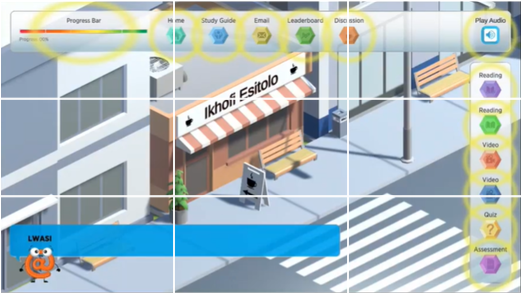
For first year students, attending academic literacy interventions are experienced as being boring and a repetition of English grammar classes learnt in school. To make learning academic literacy skills attractive and fun through storytelling and gamification of the scaffolded micro-learning episodes.
References:
Boughey, C. and McKenna, S. (2016) ‘Academic literacy and the decontextualised learner’, Critical Studies in Teaching and Learning, 4(2), pp. 1–9. Available at: https://doaj.org/article/ba8b3ac40b204bdc8f3fbdec4a172414 (Accessed: 20 June 2022)
Gargiulo, R. M. and Metcalf, D. (2022) Teaching in today’s inclusive classrooms: A universal design for learning approach. Cengage Learning. Available at: extension://bfdogplmndidlpjfhoijckpakkdjkkil/pdf/viewer.html?file=https%3A%2F%2Fpdfuni.com%2Fsample%2FPoliticsSociology%2FPS701-800%2FPS793%2Fsample%25EF%25BC%258DTeaching%2520in%2520Today%27s%2520Inclusive%2520Classrooms%25203rd%25203E.pdf
Gunn, C., Hearne, S. and Sibthorpe, J. (2011) ‘Right from the start : a rationale for embedding academic literacy skills in university courses’, Journal of University Teaching & Learning Practice, 8(1), pp. 6–18. Available at: http://ro.uow.edu.au/jutlp/vol8/iss1/6/?utm_source=twitterfeed&utm_medium=twitter.
Hunsinger, J. (2021) ‘Toward a critical theory of playful research in the internet age exploring playful research in Second Life, Minecraft, and Hackerspaces/Makerspaces’, The Journal of Play in Adulthood, 3(1). doi: 10.5920/jpa.868.
Motsabi, S., Diale, B. and van Zyl, A. (2020) ‘The Academic Persistence of First Year First Generation African Students (FYFGAS): A Framework for Higher Education in South Africa’, Journal of Student Affairs in Africa, 8(2), p. 2307‑6267. doi: 10.24085/jsaa.v8i2.4449.
Whitton, N. and Langan, M. (2019) ‘Fun and games in higher education: an analysis of UK student perspectives’, Teaching in Higher Education, 24(8), pp. 1000–1013. doi: 10.1080/13562517.2018.1541885.
Van Zyl, A. et al. (2020) ‘Effective institutional intervention where it makes the biggest difference to student success: The University of Johannesburg (UJ) Integrated Student Success Initiative (ISSI)’, Journal of Student Affairs in Africa, 8(2), p. 2307‑6267. doi: 10.24085/jsaa.v8i2.4448.
Teaching Academic Literacy in Public Relations

Academic literacy is usually taught as loose-standing modules. Teaching academic literacy out of context of a discipline students do not see the relevance of what they are learning. By teaching academic literacy skills within the discipline of Public Relations by telling the story of the tasks that a public relations intern needs to complete, knowledge is authentically applied in a relatable manner.
Supported by a virtual study buddy

Lwazi is the virtual study buddy that narrates what a user needs to do and consider. It tells the story of Lerato. Currently AI generated voice overs are used. In further developed a human voice will be recorded in different languages.