Home
Repository for Organic Chemistry Active-Learning Materials
Laurie Starkey
California State University, Polytechnic Pomona
Course Name: Organic Chemistry, CHM 314
Project Abstract: I will create a repository of active-learning materials (LOCAL) that can be used by any Organic Chemistry instructor. Each activity will directly map to one or more SLO of the course, and the collection will be organized according to the relevant topic/textbook chapter. Each week, the instructor can select suitable activities from the repository to be implemented during a face-to-face lecture period. By working on problems in class, the instructor can model problem-solving approaches and the students will gain valuable hands-on learning. With embedded and supplemental growth mindset and study strategies lessons, students will not only be learning organic chemistry, but they will be learning how to learn.
Keywords/Tags: active learning, problem-based learning, PBL, POGIL, case studies, group work, exam wrapper
Instructional Delivery: Face-to-face
Pedagogical Approaches: Clickers, group work
Class Size: 48
About the Course Redesign |
Background on the Redesign
Purpose for Course Redesign
Course Characteristics
Student success in CHM 314 is critical because it builds a solid foundation for the remainder of the yearlong sequence. Organic Chemistry traditionally has a high D/F/W rate as well as a relatively high "fear factor" for students.
The Learning Problem
Not all instructors include hands-on problem solving during class. Such activities are essential to learning Organic Chemistry, and when they take place in a classroom setting, instructors can model problem-solving techniques and peer-to-peer instruction can take place.
Course History/Background
CHM 314 is the first quarter of the yearlong, three-quarter sequence of Organic Chemistry. A full year of Organic Chemistry is a core component of the Chemistry major, and is a required class for many other majors as well. Because of the high demand and high repeat rate, CHM 314 is a bottleneck course.
High Demand/Low Success Issues
Organic Chemistry is a challenging course because:
a) it is all new to the students and like nothing they are likely to have seen before - there is little to no prior knowledge of the subject;
b) has a significant volume of information with concepts that are cumulative throughout the entire year;
c) has a fast pace requiring a high level of student motivation, effort and time commitment;
d) demands a high level of independent work on the part of the student - working with the textbook and solutions manual, and on assigned homework sets; and
e) students often have a negative perception of the course and students may fear it as a "weed-out" class.
- Many students are unable to commit the required time needed for success and they may have had a significant lapse in time since the General Chemistry pre-requisite course.
- Also, negative preconceptions and pessimistic emotions do not set the stage for a constructive learning environment, and expectations of failure can often be self-fulfilling prophecies.
Syllabus (Pre-Redesign)
This is an example of my traditional course syllabus, before the course redesign.
About the Students and Instructor Stage 2 |
Student Characteristics
Organic Chemistry is largely a service course so the students come from a wide variety of majors.

Advice I Gave My Students to be Successful (see also "How to Earn an A" link below)
Tools for Success: Organic Chemistry is a challenging course which requires a lot of time and effort on behalf of the student. The following suggestions will give you your best chance to succeed:
• Come to class and be involved! I hope the iClicker Response System will help engage you and offer real-time self-assessment. If you miss class, get the notes from someone in your study group.
• Read and work through the textbook. Take notes, try problems, be an active participant.
• Work on the textbook problems (answers at the back of the book or in the Study Guide). A minimum of 10% of each exam will be derived directly from the textbook problems.
• Start studying now. If you wait until a few days before each exam, it'll be too late. Try flashcards!
• Review your notes often, ideally before each class. Work through your notes, ask questions.
• Come to office hours. Ask questions about the lecture, your notes, the book, your exam...
How to Earn an A in Organic Chemistry Handout
The handout provides the student with specific steps they should take to maximize their performance and improve their grades. Explicit guidelines are easy to follow and encourages excellent study habits.
Impact of Student Learning Outcomes/Objectives (SLOs) on Course Redesign
On successful completion of this course, students will be able to:
- Predict type(s) of bonding and draw Lewis structures.
- Draw resonance structures and understand the effect of electron delocalization on stability and reactivity.
- Understand the fundamental principles of molecular structure and geometry, and demonstrate their relationship to physical properties (e.g., relative boiling point, solubility).
- Provide a reaction mechanism and predict the products for a given acid-base (proton-transfer) reaction. Predict the relative strength of organic acids (or bases), and be able to provide a detailed explanation to support your choice. Predict and explain the favored direction of an acid-base equilibrium.
- Apply the rules of organic nomenclature to interconvert between structures and names.
- Draw various conformations of alkanes and cycloalkanes, and predict and explain their relative energies.
- Understand the fundamental principles of stereochemistry, including chirality, nomenclature, optical activity, identifying stereoisomers, and identifying the relationship between given structures.
- Provide mechanisms for the formation of reactive intermediates (e.g. radicals, carbocations), predict their relative stabilities, and provide mechanisms for carbocation rearrangements. Draw an Energy vs. Progress of Reaction (Reaction Coordinate) Diagram, and provide transition state structure(s) for a given reaction.
- Understand factors that affect nucleophilicity, electrophilicity and leaving group ability.
- Predict the product(s) and provide a reaction mechanism for reactions of various functional groups, including alkanes, haloalkanes, alkenes, alkynes and alcohols. Explain observed outcomes of various organic reactions (e.g., product ratios, reaction rates, stereochemistry, regiochemistry). Propose a reasonable synthesis for a given target molecule.
Alignment of SLOs With Course Redesign
Improving the student success rate can only be achieved by addressing all of the content-related Student Learning Outcomes above (SLOs 1-10). All active-learning resources in the repository will be directly mapped to these SLOs.
Assessments Used to Assess Students' Achievement of SLOs
Midterm exam, final exam, surveys, American Chemical Society (ACS) standardized exam in terminal course, CHM 316.
Accessibility, Affordability, and Diversity Considerations
Accessibility
Course supplements will benefit all students in our diverse student body, including those with disabilities. Any new videos will be captioned.
Affordability
Sapling online homework system is relatively inexpensive ($30 per quarter) but to make it even more affordable they have bundled the online access with an older edition of the textbook and solutions manual for a low-cost option. The online homework is optional to accommodate students with extreme financial hardships.
Clickers are also inexpensive. They can be used throughout a student's entire academic career at Cal Poly Pomona and then they can be sold back to the bookstore. iClicker has instituted a user fee for registering used clickers to another student, so I have removed that requirement Instead, I have students submit their clicker numbers to me so I can give a small amount of participation credit.
Diversity
Incorporation of metacognitive exercises and promotion of a growth mindset will help all students, but can be especially useful in closing the "minority gap" that is typically observed in STEM classes. Implementation of active learning methods and explicit teaching of good study strategies are also beneficial to the diverse learners at Cal Poly Pomona.

About the Instructor, Laurie S. Starkey
I earned my B.S. in Chemistry from the University of Connecticut in 1991 and my Ph.D. in Organic Chemistry from UCLA in 1996, and I have been teaching organic chemistry and organic synthesis at Cal Poly Pomona since 1996. As a faculty member, I have been immersed in Scholarship of Teaching and Learning (SoTL) research around the use of teaching with technology, including creating and assessing online pre-lab tutorials and quizzes, developing multiple-choice questions for classroom “clickers,” providing lectures for Educator.com, creating and implementing assignments for Calibrated Peer Review (CPR) and serving on the editorial board for MERLOT. In 2012, I published a textbook for senior-level undergraduate students, “Introduction to Strategies for Organic Synthesis” (Wiley) and since 2008 I have served on the GRE-Chemistry Committee of Examiners. My community involvement includes serving on the PTA and providing a variety of hands-on science demos at my children’s elementary school every year since 2009 (see videos on my YouTube channel, ChemistryConnected!).
Curriculum Vitae
My C.V. with the details of my background and interests.
Laurie Starkey's Homepage
Dr. Starkey's homepage at Cal Poly Pomona has links to course materials, etc.
O-Chem lectures on Educator.com
The entire yearlong Organic Chemistry lecture sequence is covered by Dr. Starkey at this commercial website.
Introduction to Strategies for Organic Synthesis
The stepping-stone text for students with a preliminary knowledge of organic chemistry looking to move into organic synthesis research and graduate-level coursework.
YouTube Channel: Hands-on Science Demos
Demonstrations of science experiments developed for elementary-level students, along with videos to support teaching and learning of Organic Chemistry.
Calibrated Peer Review (CPR)
Online tool that administers peer-reviewed writing assignments.
Online O-Chem Lab Tutorials
A variety of Organic Chemistry Laboratory techniques are covered, including Recrystallization, Melting Point, Extraction, Distillation and Thin-Layer Chromatography (TLC). Each fully narrated lesson presents an introduction to theory and videos of laboratory demonstrations.
Course Redesign Planning |
Implementing the Redesigned Course
Aspects of My Redesigned Course
- The primary goal of this project is to create an online repository and those efforts are underway. To this point, I have created a database of 218 clicker questions (created by me and some taken from Chemistry GRE practice book), and provided links to clicker resources. I am currently creating worksheets for active-learning problems, so they have not yet been posted to the website.
- Organic Learning Communities (OLC) I have encouraged the formation of study groups by offering extra credit. Each student in a study group is required to submit a weekly report describing the work done by the group (via Blackboard journal), as well as a final reflection at the end of the quarter.
- Redesigned syllabus I created a learning-centered syllabus to reduce anxiety and to make the course more inviting and interesting.
- Online homework I continue to use an online homework system (Sapling Learning and also WileyPLUS). Because there is an extra cost to the students, I have made it optional. Every chapter we cover has an online problem set to supplement the textbook problems. As an incentive to utilize the online homework, I offer extra credit to be added to each midterm exam (0.5-1 points per problem set, with a maximum of 2 points total extra credit). By capping the extra credit at 2%, students who opted out of the online homework are not at a significant disadvantage.
- Exam wrapper a reflective survey was offered after the first midterm is graded and returned. In this metacognitive exercise, students examine their midterm results while describing how they prepared for the exam, what kinds of mistakes they made, and what they will do differently in the future if they hope to improve their grade. I offered 2 extra credit points for the survey and an additional 2 points for making corrections on their exam. In addition, I covered the name and photocopied each survey so I could work with the data at a later date. I am interested in looking for trends in various student populations (e.g., study habits for those who are repeating the course).
Adopted Technologies
- Webpage Dreamweaver is used to create the LOCAL website. Clicker questions were created in ChemDraw and saved as gif files, or screenshots are taken to create gif or jpeg files. This format enables the user to preview the clicker questions while browsing through the topics. Users can click on the image to save it, or can download a zip file containing all of the clicker questions.
- I used Adobe Connect to conduct Virtual Office Hours the night before each exam (see screen shot below). The sessions were well attended and very busy with questions, especially regarding topics that were on previous exams. These review sessions were recorded so all students had access to the material once the office hours were over.
- I used a Blackboard journal to record student involvement in their Organic Learning Community (OLC) study groups.
- I used Microsoft OneDrive to administer surveys (Forms) and to provide a shared document (Word) to keep track of the OLC rosters. These tools are similar to Google Docs, but they are integrated with Cal Poly Pomona's Blackboard LMS so the survey data automatically included the students' identification information when it was downloaded to Excel.
- Classroom Response Systems (i.e., "clickers") have been used in this class since 2008. Every class meeting begins with a clicker question (review from previous class) and additional multiple-choice questions are incorporated into each lecture, for a typical total of 4-6 clicker questions per week. Students vote, I write the distribution of responses on the board, and then we discuss why the right answer is right and the wrong answers are wrong. This formative assessment is valuable to keep students engaged and on-track and provides an excellent platform to explore common mistakes.
- Online homework system (Sapling Learning or WileyPLUS).
- Kahoot! was used to do a syllabus "quiz" on the second day of class. I distributed the lengthy, learning-centered syllabus on the first day and asked students to read it in preparation for the quiz. At the end of the second class period, I had students pair up and participate in a fun and engaging gameshow-style Kahoot! activity (in team mode) to review the important components of the class.
- Lightboard videos Thanks to the CSU CRT Summer Institute, I learned about lightboard technologies and encouraged Cal Poly Pomona to purchase and implement one. I was excited to be able to beta test it in Fall 2017. I created a video that was used in my class when I was out of town. The resource is also being shared with the chemical community.
Professional Development Activities Participation During Course Redesign
- I have made use of every opportunity available through the Course Redesign program: weeklong summer institute, Professional Learning Community (PLC) teleconferences every two weeks (mostly via recording because my schedule isn't good for the live version this year), daylong mid-year meeting in Long Beach. All of these have been very useful and have given me many great active-learning strategies to work with.
- In addition, I always make every effort to participate in programs on campus sponsored by the CPP Faculty Center for Professional Development. It was a learning community organized by our FCPD that got me interested in promoting active-learning by using clickers, another PLC taught be about metacognition, and various speakers/workshops have explored how to address the affective domain in teaching and learning and how to get students to participate in class.
- Non-CSU Professional Development Activities
- I have presented at two Wiley EdTech forums (Winter 2018)
- I gave a talk at Cal Poly Pomona as a "Wall of COOL" honoree (in March 2018, for effectively using technology in my teaching) on "Technology-Infused Teaching for Better Engagement & Student Success"
- I presented at the upcoming National American Chemical Society meeting (March 2018), and I attended various Chemical Education sessions. My presentations are on how to create videos, which is something I've learned about through the CSU-CRT.
- I participated in an active learning workshop with a variety of speakers including iClicker developer Mats Selen (April 2018).
Additional Resources for the Redesign
- I have used the CSU dashboard and consulted with institutional research to determine the D/F/W rates for organic chemistry in the past so I can supplement my own historical data with department-wide statistics.
- I have worked with Wiley and Sapling Learning to learn about the software, and to implement the online learning system in my course. I secured FREE access to WileyPLUS for my students in order to explore and test the software.
- The Cal Poly Pomona Faculty Center for Professional Development has been helpful as described above.
Redesigned CHM 314 Syllabus
This Organic Chemistry syllabus has been revised to be learning-centered.
Wall of COOL talk
I gave a talk "Technology-Infused Teaching for Better Engagement & Student Success" March 1, 2018.
Lightboard video
After being inspired by a lighboard presentation at a CSU-CRT summer institute, I inquired about getting one set up at Cal Poly Pomona and I was excited to be able to beta test it this year!
LOCAL Clicker Questions
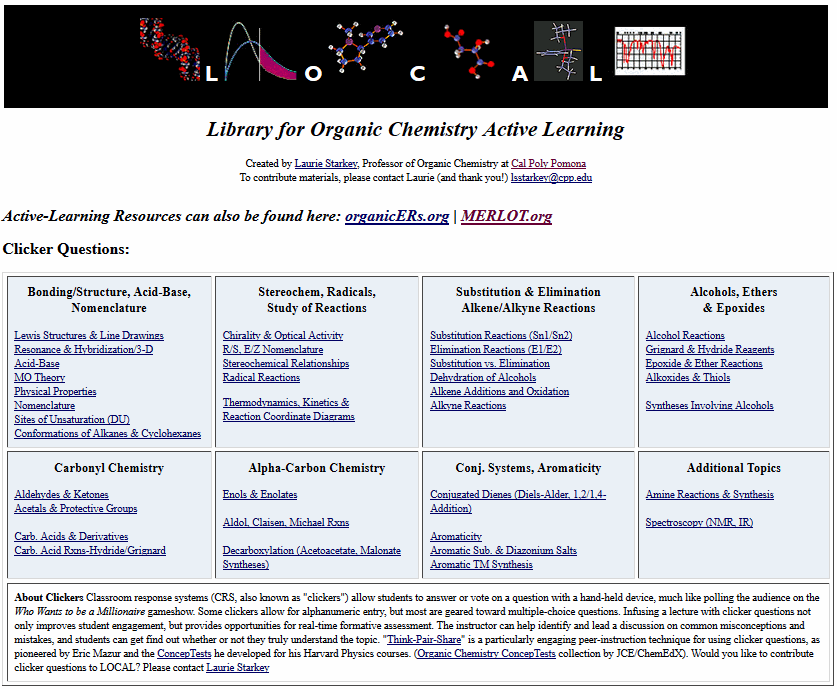
Repository of clicker questions for Organic Chemistry has been added to LOCAL website.
CHM 314 homepage (mid-quarter)
Course homepage halfway through quarter.
CHM 314 homepage (end of quarter)
Course homepage at the conclusion of the term.
Exam Wrapper
A metacognitive post-exam reflection.
"How to Earn an A" Study Strategies
Explicit instructions are given for effectively and efficiently using your time (how to make "studying" result in "learning"!).
OLC Rosters
As students formed their study groups, they recorded the names of the group members on a shared Word document (MS OneDrive).
Redesign Results |
Course Redesign Results
The LOCAL website has been established and its development will be ongoing.
- Organic Chemistry faculty have been invited to contribute materials.
- LOCAL will be used by CPP faculty to support the built-in weekly 50 minutes of recitation time for CHM 3140 in beginning Fall 2018 (course will be 4 WTU).
LOCAL website
Library for Organic Chemistry Active Learning (LOCAL) website includes clicker questions, CRS resources, worksheets, and links to active learning resources.
Course Redesign Impact on Teaching and Learning
- Although this redesign project was not a traditional one, the redesign strategies from my previous CRT course redesigns were implemented as described above.
- The current section of CHM 314 is off-sequence, so the student population can be significantly different from the students who take CHM 314 in the Fall (Fall CHM 314 students are typically on track and are less likely to have repeated any chemistry courses). Therefore, the comparison below is focused only on past CHM 314 sections that were also off-sequence, being taught in either Winter or Spring quarters.
Assessment Findings
- I taught three sections of CHM 314 in Winter 2018, with several redesigned elements including OLC study groups, a redesigned learning-centered syllabus, and online homework (both Sapling and WileyPLUS were available).
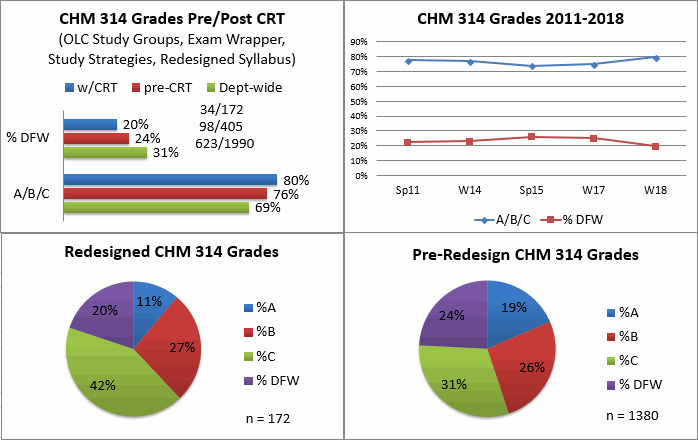
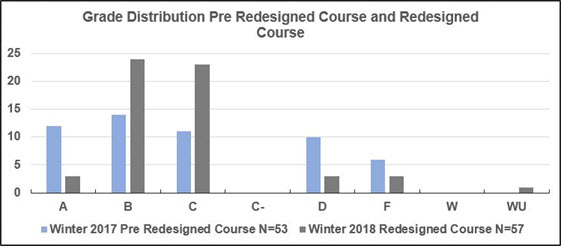
- Students in the redesigned course performed slightly better than in previous quarters. While there was a smaller than usual percentage of students earning an A grade, the 20% D/F/W rate was very good, and significantly better than the Chemistry Department's overall rate of 31% (over all sections taught 2009-2014)
CHM 314 Raw Data
Data tables and graphs for grade distributions in pre/post-redesign CHM 314 courses.
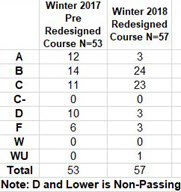
The table and graph below show the actual count of grade distribution for one section of the course before and after the redesign. The other data shows the combination of all sections for the course before and after the redesign.
Future Work: Helping Students Develop Better Study Habits
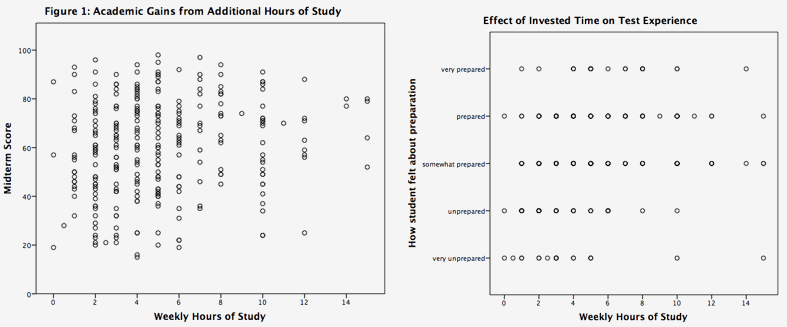
While researching mindset/metacognition principles for the course redesign, I started to delve into literature on better studying practices. As a result, I developed a handout, "How to Earn an A (or B) in Organic Chemistry" and a student recently described it as her Bible! An analysis of exam wrapper data from the past several years confirms that there is no correlation between the hours spent "studying" and either exam performance or the student's feeling of preparedness. This data compels me to continue working on this subject and I plan to develop additional handouts, exercises, journaling prompts, etc. to help raise students' self-awareness on how they use their time. I will be focusing on mindfulness as well as *practical* strategies to study efficiently with the goal of earning higher grades.
Student Feedback: Organic Learning Community (OLC) Final Reflections
The following comments were taken the following quarter in CHM 315, regarding the study groups that were suggested. A larger compilation of comments can be found in the link below. Student feedback was overwhelmingly positive, and pointed to potentially long-lasting changes in study habits and attitudes about collaborative learning.
- "I'm not sure why I've been like this, but I have never been completely comfortable with asking people to work with them and create a study group together. Although, with having this class encourage us to create a group to work with through the quarter has opened me up and made with feel extremely more comfortable with myself."
- "I took CHM 314 twice and did not pass, then CHM 201, and finally CHM 314 and passed the class so I was able to tell that the learning group made such a difference so I joined it again for CHM 315. It is extremely helpful having a group that you can study with and make your mistakes with instead of making them on the exam."
- "This quarter I learned a lot about not only organic chemistry, but a lot about myself…. I didn't think working in a group would be that beneficial, but I was wrong."
- "However, I will say that participating in an OLC over these past two quarters have changed my mind about working with study groups."
- "Due to my shy nature and my perception that I could work more efficiently on my own, I avoided working with study groups. But, my OLC, especially this quarter, proved me wrong as I was able to work even more efficiently as I practiced organic chemistry. As such, this experience has made me more open to working in study groups in my other classes in the future."
- "Overall, I feel like having an OLC group is a great way to meet new people, gain better study habits and keep you on track. I will for sure be joining an OLC group in the Fall when I take CHM 3150!"
Challenges My Students Encountered
Finding a good study group and learning a new online homework system (WileyPLUS).
OLC Student Feedback
To earn OLC extra credit, students were asked to keep journal to log their weekly meeting activity, and to write a final reflection on the experience at the end of the quarter. This document contains excerpts from the reflection essays (CHM 315, Spring 2018).
Lessons Learned & Redesign Tips
Teaching Tips
Teaching with active learning takes a lot of advance planning by the instructor, and at the same time requires flexibility. If you think you want to flip your classroom, begin by flipping a single lesson. See what works for you and your students as there is no one-size-fits-all formula. Also, explore existing resources before setting out to create your own. If you can find an effective video to use for a lesson, then you have more time to develop a worksheet or evaluate student feedback. Finally, if you want your students to buy in to your teaching methods, then you have to spend some time selling it: discuss the pedagogy and let them know you are looking forward to getting their feedback. Solicit midterm feedback so you can make adjustments; keep what works and ditch what doesn't work.
Course Redesign Obstacles
I am still figuring out the best ways to implement credit for study groups and online homework. I am also trying to pinpoint the best use of the students' time spent studying, and then determining how to make the students aware of it. A continuing challenge will be disseminating the LOCAL website and encouraging others to submit materials.
Strategies I Used to Increase Engagement
Daily use of iClickers definitely increases engagement in the classroom, and having students discuss their answers helps move the lesson along. Outside of the classroom, the online homework increases the time students spend with the subject matter. As reported by my students, I believe that the exam wrapper was a useful exercise in metacognition that encourages students to learn from their mistakes.The feedback regarding the OLC study groups is compelling, and many students described it as highly motivational.
Instructor Reflection & Dissemination Plans
This is my third year participating in the CRT program, and once again it has proven to be a transformative experience. Once the project has been identified, it becomes a lens through which I view all of my ordinary activities and a continuous process of development ensues. With the LOCAL repository in development, I viewed every lesson, every homework and every clicker question with a mind for how it could be improved and repurposed as a hands-on activity in the classroom. I will continue to develop worksheets this summer and beyond, and I appreciate having the ePortfolio as a means to summarize my project and my findings.
Dissemination to date, and future plans:
- I have shared my site with the OrganicERs community, through their Facebook group and their website. This summer, I will write up a "member spotlight" piece for their newsletter to further promote LOCAL.
- I gave a talk, "Creating videos and animations to enhance organic chemistry lecture and laboratory instruction," at the 255th ACS National Meeting in New Orleans, LA, March 2018. The ACS is creating a book from this symposium and I have been asked to submit a chapter based on my talk. I will be writing about my experience with the lightboard and creating animations.
OrganicERs website
The Organic Chemistry Educational Resources (OrganicERs) faculty learning community is primarily designed for college-level instructors to network and to collaborate; and to access, share and develop curriculum materials.