MANOVA
MANOVA is the sixth volume in a series of Advanced Educational Statistics. A straightforward, clear teaching style for learning educational statistics is presented in this volume. A narrative, along with videos, output data sets and sample data sets are included. As with previous volumes in the series, the video presentations are the focal point and will be especially helpful for guiding the learner through the process of conducting statistical analyses using SPSS and interpreting SPSS output data.
Did you ever think that you would make it this far? Wow! You have not only made it this far, but you are mastering some awesome material. You have done well to come so far with so much hair with so many after it. (You may want to check out the old western movie, Jeremiah Johnson, in order to understand my comment about hair. As with every quantitative process, one needs an overview of what the process actually does. The introductory video to this series provides this process and ties MANOVA back to ANOVA and t-test. The latter two processes are simply special cases of MANOVA.MANOVA is about comparing several dependent variables across several groupings. MANOVA is founded upon several basic assumptions as delineated in the introductory video. One must also write research questions, develop hypotheses, and establish a protocol for working with MANOVA. The introductory video laid the foundation for these levels of inquiry. The time has come to actually conduct a MANOVA on an established data set. Never have so many owed so much to a software package. Can you imagine having to do all of these analyses by hand? Thank goodness that we have SPSS to work for us. As with our analysis in ANOVA, we will navigate through several different processes in order to gain everything that we need. We will develop these into a powerful review of the assumptions, findings, and evaluation of our MANOVA. My review of MANOVA assumes that you are familiar with the groundwork established in ANOVA. Do you recall the methodologies for establishing normality? Do you remember how to examine effect size and power? These are the same for MANOVA. Please view the video below.
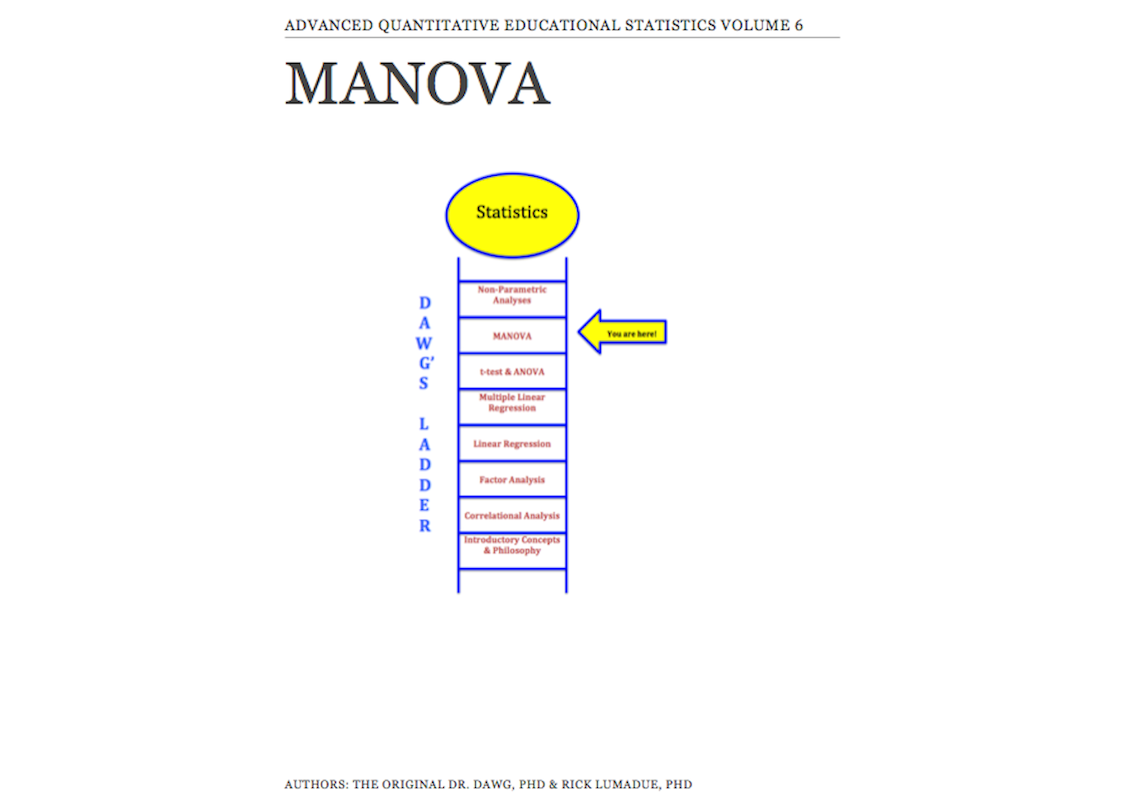
The SPSS readout for MANOVA contains a lot of information. It gives us everything that we told it to give us. Unfortunately, the readout also provides many things that for which we did not ask. Our task is to find those things we need and Have you noticed that this gets easier as you go along? You are, indeed, climbing a ladder. Each skill you master provides another rung upon which you can stand. Each rung allows you to reach higher. MANOVA is powerful. SPSS does all the work. You just have to tell SPSS what you want and know how to interpret the results. This is really easy. To help you better understand this, please view the video below.
Every quantitative process requires an ordered protocol. The stronger the protocol, the more defendable the analysis. The protocol should be designed to evaluate the assumptions of the analysis, conduct the analysis, and evaluate the quality of the analysis. This involves a great deal of knowledge concerning the quantitative methodology that is being utilized. The video discusses the methodology for conducting MANOVA.The protocol is where the rubber hits the road. To get where you are going, you need to follow the plan! This is a plan. “There are many like it, but this one is mine!” (Quote from Full Metal Jacket)