t-Test & ANOVA
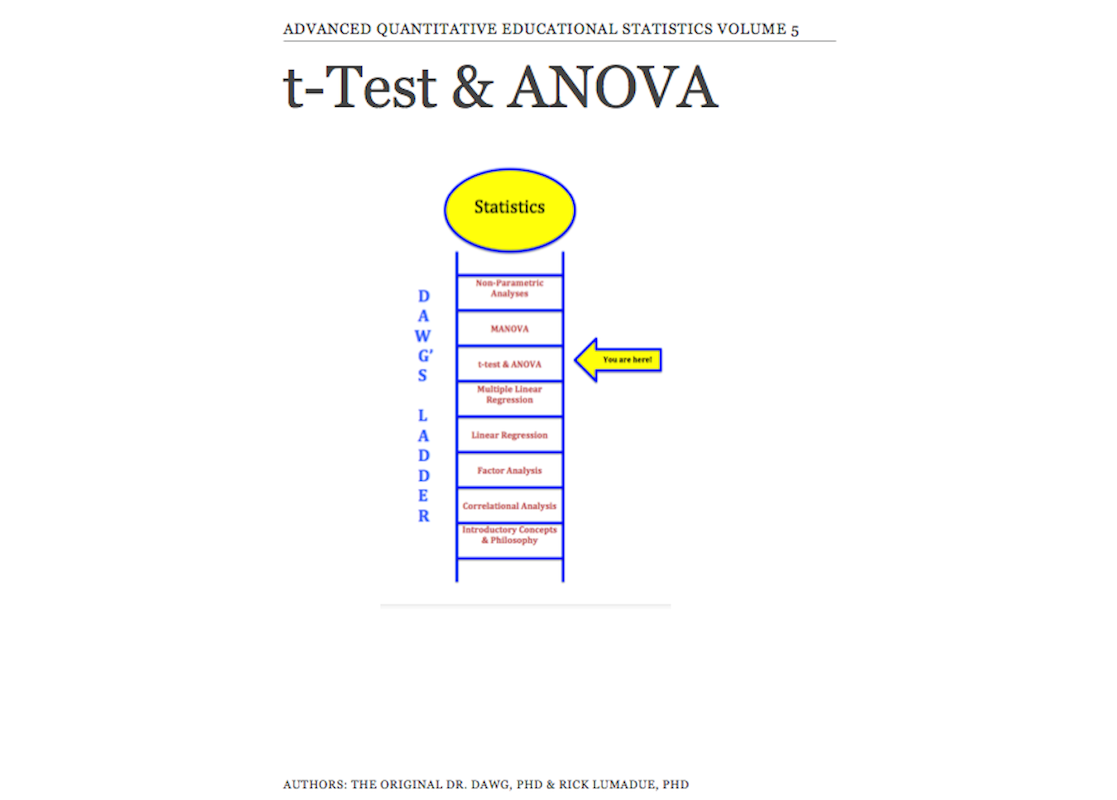
The fifth volume in a series of Advanced Educational Statistics, t-Test & ANOVA bulids on the innovative teaching methodology for learning educational statistics. A narrative, along with videos, output data sets and sample data sets are included. As with previous volumes in the series, the video presentations are the focal point and will be especially helpful for guiding the learner through the process of conducting statistical analyses using SPSS and interpreting SPSS output data.
Correlational research looks for relationships or associations. Comparative research looks for differences. Remember that words are very, very important in the business of statistical analysis. The word, difference, refers to a comparison of two or more groups. Simple comparative research compares one dependent variable across two groups where the grouping is considered the independent variable. Comparative analysis can be come quite complex. MANOVA allows us to compare several dependent variables across several groups. We will begin the study of comparative analysis by examining the most simple model then move to the more complex. The t-test is about comparing one dependent, normally distributed variable across two groups. The groupings are considered the independent variable. The variable being examined is the dependent variable. As previously mentioned, MANOVA, ANOVA, and t-test are closely related. An ANOVA is a MANOVA with only one variable under consideration. A t-test is an ANOVA with only two groups. The following video shares more insight into the t-test. The t-test is often called the difference of two means. As noted, the t-test has several important assumptions. These should be met before conducting a t-test. If the assumption of normality is not satisfied, the researcher would be wise to conduct a non-parametric test.
ANOVA stands for analysis of variance. Do you recall the statement that all advanced statistical inquiry is founded on mean and variance? I do not know that such is always the case; however, such is usually the case! The ANOVA is about analyzing the mean and variance for a dependent variable between 2 or more groups to determine if differences exist. ANOVA is a powerful process for comparing the values of one dependent variable across 2 or more groups. The video for introduces ANOVA and discusses the assumptions and methodologies for conducting ANOVA. Post hoc stands for "after the fact." Post hoc analysis is conducted after differences are identified in order to know where the differences exist. Generally significance is established at .05.
Normality is required in parametric design. ANOVA is certainly no exception. The process for examining a data set to determine if the data set is normally distributed follows. This process can be used to access any data set for normality regardless of the statistical analysis to be employed. Kurtosis is about testing to see if the data cluster around the mean as they would in a normal distribution. Skewness determines if a data set is centered like a normal distribution or if the data set is skewed to the left or the right.
Effect size is conducted to determine if the significance of a study is such that a randomly selected variable is likely to be identified as to the group from which it came based on its value. Power is about the probability of rejecting the null hypothesis when it is false. Effect size is the difference between the actual value and the anticipated value. The effect size coefficient, eta squared, gives us a measure by which we may determine if the effect size is strong, moderate, or weak. Power is just as important as significance. The video for discusses each of these coefficients and demonstrates the methodology for obtaining them using SPSS.
The protocols for conducting ANOVA are laid out in the video. In this video, the complete SPSS output is reviewed noting the items of importance to the analysis.