Factor Analysis
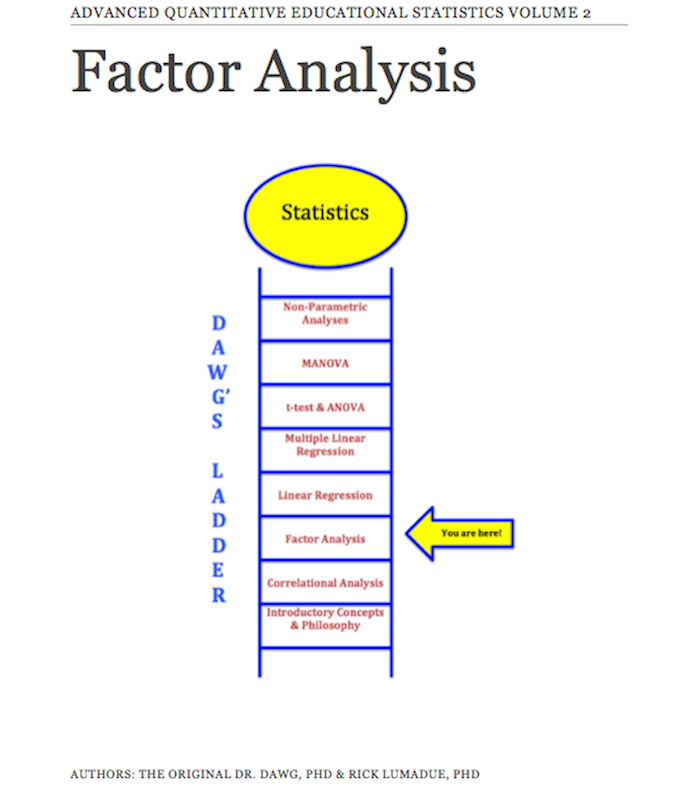
The second volume in a series of Advanced Educational Statistics, Factor Analysis continues a clear, demystified approach to learning educational statistics. A narrative, along with videos, output data sets and sample data sets are included. As with previous volumes in the series, the video presentations are the focal point and will be especially helpful for guiding the learner through the process of conducting statistical analyses using SPSS and interpreting SPSS output data.
Factor analysis is a correlational analysis that allows a researcher to reduce a large data set into the underlying factors that predict the variable data values. Sounds complicated doesn't it? My goal is to turn this process into something that you understand. Do not panic yet! Sit back and enjoy the videos. I will proceed to develop the concept of factor analysis in a local and concise fashion. The goal is for you to master and utilize the concept. An Introduction to Factor Analysis Factor analysis is a truly powerful process. Imagine reducing a large set of variables into only a set of underlying factors. This is why factor analysis is often referred to as data reduction. The videos move through the things that one must know in order to conduct and draw meaning from a factor analysis. Hope that you find them enjoyable.
As with everything statistical, every methodology is founded upon some sort of assumption or assumptions. Such is certainly the case for factor analysis. The video delineates and explains the underlying assumptions of factor analysis. Enjoy!
Factor Analysis research questions are about relationships and associations. They are about underlying factors. Well written research questions make the completion of a research project a joyous event. I thought I might take a moment in the video and help you write research questions for a factor analysis project. These questions will be very similar in construct to those written for simple correlational analysis. Remember that no ONE right way exists for writing research questions. However, many wrong ways exist
I hope that you are comfortable with conducting a factor analysis. Now you will need to understand and utilize the readout. This means that more videos are yet to come. Hang on!
Getting the SPSS readout and understanding it are different events altogether. Now that you know how to run the factor analysis, I want to help you understand the results. The readout displays many tables. Some of them will be used. Others will not. The following video is designed to assist you in getting the information that you need. From descriptives to correlation matrices to Bartlett's test of sphericity to total variance explained to scree plots to rotated component matrices, everything has a place. Their's is to give us information. Ours is to interpret and understand.
Our analysis would not be complete without examination of the rotated factor loadings. See the discussion in the video below.