Correlational Analysis
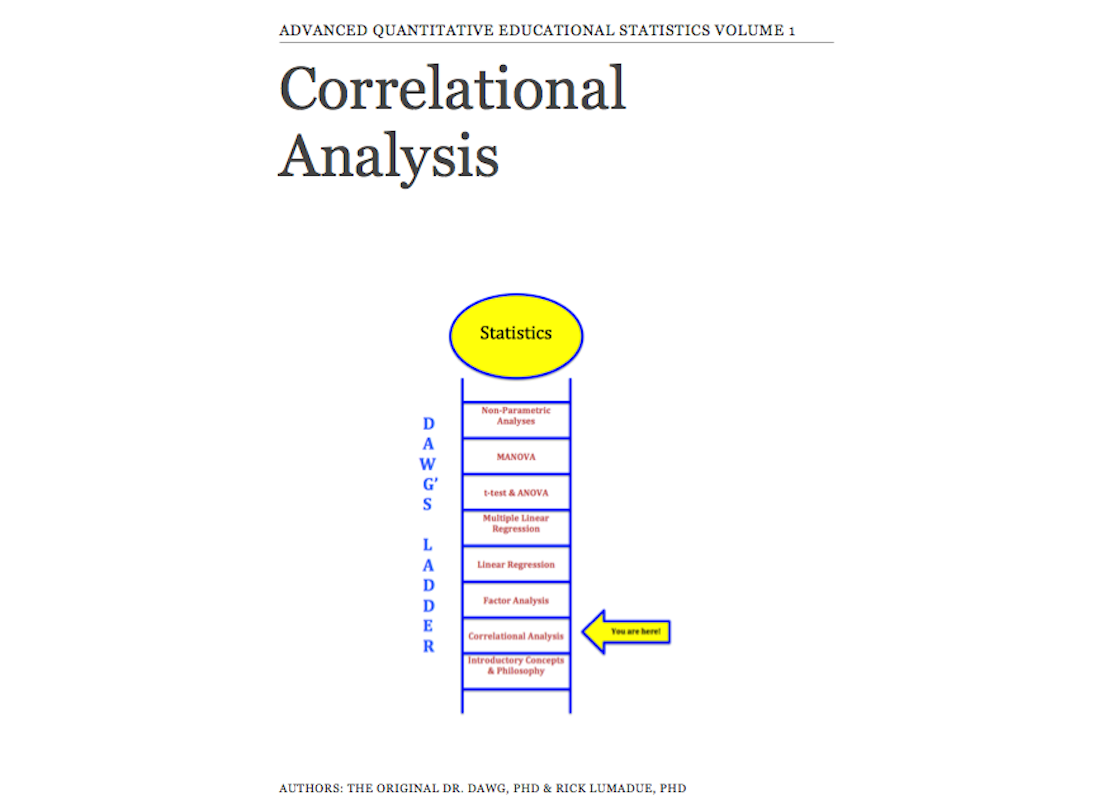
Finally, a clear, demystified approach to learning educational statistics. A narrative, along with videos, output data sets and sample data sets. The video presentations are the focus and will be especially helpful for guiding the learner through the process of conducting statistical analyses using SPSS and interpreting SPSS output data.
Correlational analysis is about examining relationships or associations. Generally, correlational analysis considers only two variables at a time. You did not know that you have been in the correlational analysis business all along, did you? My 3-year old granddaughter, Reagan, and I have a strong positive correlation. We are in absolute agreement about candy bars, watching television, playing on the iPad, and other things in life. My wife and I have a weak positive correlation. We generally move in the same direction; however, Sharon is a little more independent. My father and I had a strong negative correlation. Well, enough said! You get my drift. I hope you enjoy this video.
The Pearson Product Moment r Correlation Coefficient: Man, this sounds fearsome, doesn't it? Actually the Pearson r coefficient is one of the simpler statistical analytics. Guess who came up with the Pearson r. Do you think it could have been Pearson? If so, you are correct. This video develops the concept of the Pearson r. Enjoy!
When you begin your own research agenda (dissertation), you will need to know how to write research questions. Every methodology requires its own particular wording. Such is certainly the case for correlational analysis. The video (see below) shows you one method for writing correlational research questions. Always excel beyond what you are taught. When you develop a better approach, come back and share it with me so that I can rejoice with you. I hope that you understand the importance of relationships and associations. You might want to spend some time online in a thesaurus finding synonyms for these two words. They are certainly sign post warning the reader that they are about to enter into the realm of correlational research.
To perform our analyses, we need data sets upon which to operate. I could have been very nice and just given them to you. Instead, I had the bright idea that teaching you how to extract data from the IPEDS might provide a needed skill for your future success. After all, you have heard the old adage, "Give a man a fish and help him for a day. Teach a man how to fish and help him for a lifetime." My uncle Hopper taught me how to fish. He bought me my first Zebco rod and real. He also bought me my first H&H spinner bait. He ruined me for a lifetime. Perhaps I should teach him how to extract data from the IPEDS. What do you think? The video for will provide you the framework to begin data extraction.
As mentioned earlier, the Pearson r requires normality of the variables. In other words, the variables must be normally distributed. What do you do if they are not normally distributed? Non-parametric methodologies are designed to handle those variables that are not normally distributed. We will spend more time with this concept in the last module; however, I felt that you needed a brief exposure to two non-parametric correlational coefficients. They are included in this video.
In the old days, people did statistics by hand. Thank goodness that we have moved beyond those days. We are able to use powerful computer packages to do the calculations for us. Man, I enjoy the computer age. As I warned you in the beginning, you need access to SPSS. You can buy a student version of SPSS premium directly from IBM for around $95. This license is good for 1 year. Believe me that the purchase is a bargain. You will be asked to send proof of your status as a student. The software regularly runs about $5,000 otherwise. I intentionally saved you money by not adopting a textbook so that you could purchase this $95 software. Proficiency in SPSS will take you far in your quest for a doctorate.