
Introduction to Visual Arts HUM 120
Introduction to Visual Arts HUM 120
Purpose: to help other instructors teaching the same course
Common Course ID: Introduction to Visual Arts HUM-120
CSU Instructor Open Textbook Adoption Portrait
Abstract: This open textbook is being utilized in a visual arts course for undergraduate students by Lauren Hartman at CSU Maritime Academy. The open textbook provides demonstration, artwork by contemporary artists, and context to visual art movements. The main motivation to adopt an open textbook was to provide students with an accessible way to engage with contemporary art without purchasing an expensive textbook. Most students access the open textbook through PDFs or online links.
Introduction to Visual Arts HUM 120
Brief Description of course highlights: This course gives students the time and opportunity to explore ideas visually and polish their technical skills. Studying the foundations of visual art helps develop critical thinking and problem-solving skills. The class studies color theory, composition, drawing techniques, form, value, conceptual analysis, and figure-ground relationships. Students are encouraged to focus on self-expression and experiment with the materials to depart from what has been traditionally thought of as drawing and painting.
There are no prerequisites for this lower-level humanities course. This is a section C1 general education course.
Student Population: Students from all majors and years take this class. There is no prerequisite.
Learning or student outcomes: Student Learning Outcomes (SLO). Upon successful completion of this course, students will be able to:
- Discuss the dynamic nature of culture and processes of culture change
- Analyze the relation between a text and its socio-political, historical, and cultural contexts.
- Demonstrate ability to express ideas clearly and creatively, both in writing and speech.
- Analyze works of philosophical, literary, aesthetic, and cultural importance.
- Evaluate aesthetic and cultural experiences subjectively as well as objectively.
Key challenges faced and how resolved: How can you demonstrate and teach an art process to 25 students in a large classroom? Provide students with a range of resources from hands on live demonstrations, readings about the history of the art process, slideshows of example artwork, and live demonstrations.
Share any curricular or pedagogical changes that you made as part of the Textbook/OER/Low Cost Adoption I found that general visual art textbooks are centered around a European and American viewpoint. By expanding beyond a textbook and sourcing material online, I can expose students to artwork from many different voices and locations that are underrepresented in textbooks.
Textbook or OER/Low cost Title: I provide students with links to online articles and videos, and PDFs of articles they can access for free. All the material can be found on the course management system.
Brief Description: The texts and videos include the process of drawing, shading, watercolor painting, printmaking, and embossment. The readings focus on artists who work in these mediums and the evolution of the artform through history.
Student access: I post all the material and links on the course management system.
Supplemental resources: I create slideshows of example artwork and demonstration videos that students can access through the course management system.
Cost Savings: Visual Art textbooks and instruction manuals can cost up to $220 the material I provide for students is free.
License: Public domain, no copyright restrictions
OER/Low Cost Adoption Process
Provide an explanation or what motivated you to use this textbook or OER/Low Cost option. Save students money and improve the learning materials to be more inclusive.
How did you find and select the open textbook for this course? Evaluated resources.
Sharing Best Practices: Many art museums and cultural institutions have great education sites with project ideas and article links. Since the start of the pandemic many educators have made demonstration videos that are open sourced and a good resource if students want to review a demo you gave live in class.
Describe any challenges you experienced, and lessons learned. There are so many resources out there narrowing them down can be a challenge. Printing out instructions and reference images is very helpful to students.
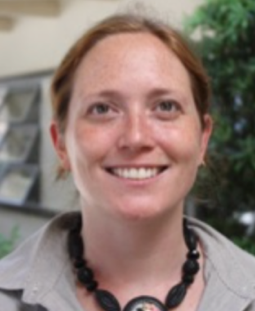
Lauren Hartman
Lecturer in the Dept. of Culture and Communication
California State University, Maritime Academy
https://www.csum.edu/culture-and-communication/faculty/lauren-hartman.html
Provide a statement of your teaching philosophy and courses you teach
My curriculum pairs hands-on projects with literature and lectures that help to reinforce critical thinking and expand classroom conversations. Making is not just about the physical object or artwork it is a way to develop a process that extends beyond the materials and speaks about concepts. Using hands-on project-based assignments, students are learning from their experiences and collaborations with other students.