
Faculty Showcase Adoption title
Faculty Showcase Adoption title
Purpose: to help other instructors teaching the same course
Common Course ID: Real Analysis Math 4300
CSU Instructor Open Textbook Adoption Portrait
Abstract: This open textbook is being utilized in a mathematics course for undergraduate or graduate students by Shawn McMurran at CSU San Bernardino. The open textbook provides an approach to the topic that structures the typical content according to its historical development. This allows students to see the questions mathematicians sought to answer and the struggles they encountered in their own learning while developing the theory. The main motivation to adopt an open textbook was two-fold: I felt students may choose not to purchase an expensive textbook and I hoped that the historical approach would supply motivation for the theory that is often absent in the traditional textbook, and hopefully inspire students to read more. Most students access the open textbook online; a few purchased a hard copy.
Real Analysis – Math 4300
Brief Description of course highlights: Properties of the set of real numbers and foundations of calculus: Equivalence relations, functions, cardinality, convergence of sequences and series of real numbers, topology of the real line, continuity, and differentiation. Emphasis on rigorous proof and mathematical communication. Professional mathematical typesetting and visualization technology.
Student population: The course is a required upper-division core course for all mathematics majors. Most students are junior or senior level math majors. A few math grad students may take the course to meet graduate course prerequisites.
Students have completed their core lower division work including single and multi-variable calculus and linear algebra. An intensive writing introduction to proof and communication in mathematics course is a required pre-requisite.
Learning or student outcomes: This course is designed to support the Mathematics Department undergraduate program learning goals, namely, that by completing the program you will build the following proficiencies: (1) Demonstrate a conceptual understanding of mathematics; (2) Attain procedural fluency in mathematics; (3) Demonstrate adaptive reasoning and problem-solving skills in mathematics; (4) Demonstrate mathematical communication skills; and (5) Understand and produce correct mathematical proofs. In particular, Math 4300 will emphasize and assess the following learning outcomes:
1.1 – Demonstrate an understanding of fundamental concepts, algorithms, operations, and relations
2.1 – Correctly apply mathematical theorems, properties, and definitions
3.3 – Critique mathematical reasoning, both correct and flawed
4.1 – Demonstrate mathematical communication skills using appropriate mathematical vocabulary and references
5.1 – Understand valid mathematical proofs
5.2 – Produce valid mathematical proofs
A complete list of SLOs and department student learning goals can be found on the Math Department webpage at Assessment | Department of Mathematics.
Key challenges faced and how resolved: The textbook’s approach was non-traditional. Most content in the course description was covered, but sequenced in a non-traditional way. Some topics were not covered by the text. I had to figure out how to include them in a way that made sense. I used supplemental materials and modified team worksheets from previous courses for the additional content.
It was frustrating that the bookstore charged so much for the optional hardcopy. To order the hardcopy online was $25, yet the bookstore charged $40.
Syllabus and/or Sample assignment from the course or the adoption:
Syllabus link: https://docs.google.com/document/d/1ZzY3UFoKnZZGYELKnWs7OyHUTbffiob07MBua3NPW60/edit?usp=sharing
Sample Assignment: https://drive.google.com/file/d/13TYjyg8Cddo3kbDH82YFs9y5eIgDwKXr/view?usp=sharing
Textbook or OER/Low cost Title: How We Got From There to Here: A Story of Real Analysis
http://personal.psu.edu/ecb5/ASORA/ASORA.html also https://open.umn.edu/opentextbooks/textbooks/200
Brief Description: The purpose is to help students make sense of the formal definitions, theorems, and proofs encountered in a typical real analysis course. The approach is different from most traditional texts; it’s structured around the story of how Calculus evolved into modern Real Analysis. The authors’ “… hope and intention is that this will help the student to appreciate why their intuitive understanding of topics encountered in calculus needs to be replaced by the formalism of Real Analysis.” The authors emphasize that it is not a history book, rather, “It is an introductory textbook on Real Analysis which uses the historical context of the subject to frame the concepts and to show why mathematicians felt the need to develop rigorous, non-intuitive definitions to replace their intuitive notions.”
Authors: Robert Rogers and Eugene Boman
Student access: Students access the text online. An inexpensive hard copy can be ordered from Amazon or Lulu.com. A copy could be purchased from the bookstore (more expensive).
Cost Savings: The current text book used by most other instructors costs $153.50 new, $115.25 used, and $55 to rent a digital copy.
The OER resource is free online, a pdf can be downloaded for free, and a new hardcopy is available from Amazon ($25) or the bookstore ($40).
License: The work is copyrighted and licensed under a Creative Commons Attribution-NonCommercial-ShareAlike 4.0 International License.
OER/Low Cost Adoption Process
Provide an explanation or what motivated you to use this textbook or OER/Low Cost option.
- Save students money
- I believe the approach provided more motivation for the abstract content by using a historical and humanistic approach.
- The approach had the added benefit of providing opportunities to fill in some of the gaps resulting from the stress of the pandemic and learning online.
How did you find and select the open textbook for this course? I heard of the textbook through an Mathematical Association of America special interest group.
Sharing Best Practices:
Be prepared to be a bit flexible.
Be sure information on the book, including relevant links, are provided in the syllabus and on the LMS.
Including links to the problems on the HW may have assisted students in navigating the text.
Shawn McMurran, Mathematics Professor
https://www.csusb.edu/mathematics/faculty-staff
California State University, San Bernardino 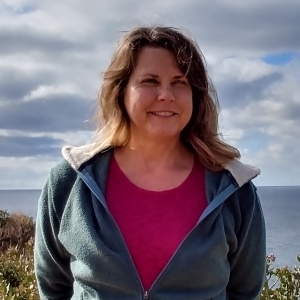 Describe your teaching philosophy and any research interests related to your discipline or teaching.I’ve taught nearly every course the department offers: GE courses; lower and upper division courses for math majors, primarily: calculus, differential equations, introduction to proof, analysis (real and complex), topology, and courses for pre-service teachers (both K-8 & secondary); graduate analysis; special topics courses in dynamical systems and mathematical biology.
I think my teaching philosophy is reflected in the syllabus linked to above.