GEOL 5000 Adv Topics Quaternary Geology
GEOL 5000 Adv Topics Quaternary Geology
Purpose: to save students the cost of a specialized graduate-level textbook
Common Course ID: GEOL 5000 Advanced Topics Quaternary Geology
CSU Instructor Open Textbook Adoption Portrait
Abstract: This open textbook is being utilized in a Geological Sciences course for undergraduate or graduate students by Dr. Claire Todd at CSUSB. The open textbook provides a series of scientific journal articles for students to explore questions, methods, and findings central to Quaternary Geology research. The main motivation to adopt an open textbook was to increase accessibility of course content by avoiding the expensive, hard to find, specialized textbooks offered in this subdiscipline. Most students access the open textbook in PDFs available on our course website.
GEOL 5000 Advanced Topics Quaternary Geology
Brief Description of course highlights: A course for majors or graduate students in Geology. Topics vary within this course number. The only prerequisite is instructor consent.
Student population: Geology graduate students, or undergraduate students who are in their final year of their undergraduate degree. Most students have taken multiple upper-division geology classes already, are familiar with fundamental geologic concepts, and have engaged in some form of geologic research.
Learning or student outcomes:
- Read and discuss scientific literature about the Quaternary Period
- Describe the biological, atmospheric, and geologic characteristics of the Quaternary Period
- Analyze a wide range of geochronological data about the Quaternary Period
- Critique a peer’s work effectively
- Respond thoroughly to peer review of their work
- Design a feasible research project, including assigning appropriate Quaternary research methods to a research question about the period
- Write a research proposal that makes a compelling case for funding
- Present and clearly explain technical information including Quaternary research questions, methodologies, datasets, and interpretations
Key challenges faced and how resolved: Students are not familiar with some of the vocabulary and techniques – but this challenge is a benefit, and resolved by class discussion and student writing about advanced terminology and concepts.
Syllabus and/or Sample assignment from the course or the adoption: Attached are example reading responses and the final research proposal assignment and rubric – which refers to the importance of incorporating scientific literature.
1 - 5 Proposal Review Scale.pdf
Quaternary Research Proposal - Google Docs.pdf
Todd_Quaternary_Geology_Milankovitch-scale climate in Australasia.pdf
Textbook or OER/Low cost Title: A reader of scientific journal articles accessed through our course website.
Brief Description: Students read a series of scientific journal articles that featured research sites around the world, state-of-the-art research methods, and complex datasets that yield clues about the Quaternary Period of Earth’s history, the last 2.58 million years. Authors:
Brad Pillans and Tim Naish, 2004
A.P.Kershaw, S.van der Kaars, P.T.Mossab, 2003
Daniel R.Muhs, Joaquín Meco, Kathleen R.Simmons, 2014
Alan Gillespie and Douglas Clark, 2011
Student access: Students accessed article PDFs on our course website.
Supplemental resources: Students completed “Reading Responses” in Google Forms, and the instructor created Google Slide presentations that structured in-class discussions of the research.
Cost Savings: $60-230
License: https://creativecommons.org/licenses/by-nc/4.0/
Describe any challenges you experienced, and lessons learned.
- Selecting journal articles for the course reader is time-consuming, but this challenge is easily resolved by advanced preparation.
- Choosing articles allowed for flexibility I would not have had with a textbook; toward the end of the course, I had students locate their own articles as part of their final research project. With a textbook, the temptation is to cover topics in order, and there is sometimes an obligation to cover all of the topics in the textbook you made students pay for. So while I may not have covered every single topic listed in the table of contents of most Quaternary textbooks, each article contained such a wide range of concepts and techniques that there was more than enough content to tackle with students.
- Students learned to use the scientific literature (both assigned and available through the library) as a resource – a way to answer questions, in the same way they might look up a question, definition, or topic in a textbook.
- My class was small – 6 students – typical of a graduate level class. It would be possible to scale up the journal article reading responses and class discussion to a larger class, but assessing student work such as research proposals would be more challenging with a larger class.
- I will definitely make a scientific-literature-based course reader again!
OER/Low Cost Adoption Process
Provide an explanation or what motivated you to use this textbook or OER/Low Cost option. Graduate-level, specialized textbooks are typically difficult to find and very expensive. I want students to have access to advanced, technical content without spending money. I also want students to navigate scientific literature with ease!
How did you find and select the open textbook for this course? I looked at the table of contents of Quaternary Geology textbooks and then identified scientific journal articles that would showcase those concepts in the context of recent research in the field.
Sharing Best Practices: It took me much longer than I expected to identify journal articles that would be manageable for students and featured the concepts central to Quaternary Geology. So make plenty of time to build a course reader!
- I avoided extremely long articles, even if the content aligned well with my goals for the course. Articles were 12 – 20 pages.
- Students read one scientific journal article most weeks of the semester.
- Skills for reading was a common discussion topic in the course. We discussed a range of approaches to reading scientific literature. We spoke freely about the challenges of different articles, and strategies for addressing these challenges.
- As a positive outcome, I received no pushback from students about the complexity of the readings; we relied solely on scientific research articles from the beginning, and I think that helped to establish student buy-in and engagement. I also repeatedly explained why it would help them professionally to be able to navigate complex, technical writing. I continued to explain the motivation for this approach throughout the semester.
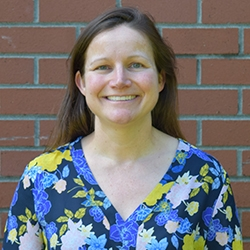
Claire Todd
Professor and Department Chair, Geological Sciences
https://www.csusb.edu/profile/claire.todd
 Provide a statement of your teaching philosophy and courses you teach (or taught) I’m new at CSUSB and part of my workload is taken up by being chair, so GEOL 5000 is the first class that I’ve taught here. At my former institution, I taught Global Climate Change, Meteorology, Glacial Geology, and courses in Environmental Studies.
Teaching Philosophy Community is central to my approach in the classroom. I believe firmly that students learn by doing; by practicing geologic skills with each other, they will be prepared to be geologists or to be more informed members of their community. Students in a recent Glacial Geology class engaged with each other in a variety of activities. They used “glacier goo” to model ice deformation, made educational videos that explained ice flow, and competed in a virtual “film festival” to select the best glacier movies. Students were each assigned a year of glacial hydrologic data and together with their peers built a 20-year history of meltwater discharge from a local glacier. Students began each class with a “roll call” question that asked them to make observations of satellite imagery, photos, or topographic maps of glaciated regions – by the end of roll call each student had contributed to a class-wide landscape analysis. Thoughtfully-designed, peer review exercises also build community in the classroom, and model a critical component of work in the scientific community.
In my classes, students model the community-based nature of the scientific research process. When possible, students work in teams to practice data collection and analysis techniques. They hypothesize about the geologic history of their immediate surroundings, use observations of rock samples and topographic features to support or refute their hypotheses, and place their findings in the context of published geologic maps or reports describing their location. Students share geologic interpretations in a class wide Google Slide presentation where they can review each other’s work. I encourage students to place their data in the context of published scientific research. All of my classes engage in scientific literature in some way – whether in closely guided reading assignments and in-class discussions in my lower-division classes, or in literature research or proposal development assignments in upper-division classes. I believe practicing and engaging with the scientific process prepares students to be well-rounded geoscientists and informed members of their community, and equips students to be lifelong learners whatever career path they choose.