
Affordable Learning Solutions to make zero-cost courses
Affordable Learning Solutions to make zero-cost courses
Purpose: to help other instructors teaching the same course
Common Course ID: MTH 250 – Introduction to Linear Algebra
CSU Instructor Open Textbook Adoption Portrait
Abstract: This open textbook is being utilized in a Mathematics course for undergraduate or graduate students by Frank Yip at CSU-Maritime Academy. The open textbook provides a comprehensive guide on the first course in linear algebra, a subject that has broad reaching applications and consequences for so many quantitative fields. The main motivation to adopt an open textbook was to ensure that the course was zero-cost to students. Most student access the open textbook in PDF form as posted on our course webpage and through direct url link from the author.
MATH 250 – Introduction to Linear Algebra
Brief Description of course highlights: Theory and applications of linearity, including vectors, matrices, systems of linear equations,dot and cross products, determinants, linear transformations in Euclidean space, linear independence, bases, eigenvalues, eigenvectors, and diagonalization. This is the beginning of learning a new language that mathematicians, physicists, engineers, economists, and many others speak. Linear algebra is most powerful in the abstract; it is through a theoretical foundation of the rules governing vector spaces that it is best applied to nearly any quantitative problem. The material we learn here finds applications and appears in a variety of contexts. In many ways, this class sets mathematicians upon the pathways to proofs (pure math) and more concrete applications (applied math). Physicists and engineers have made significant contributions and find infinite utility in the application of these ideas.
Student population: All of the students (14 in total) were mechanical engineering (ME) junior and senior students. Completion of this class, plus an additional special topics course that follows earns these students a Mathematics minor in the pathway along their ME degree. The class was nearly 50-50 male/female, which is distinct from the general population of our campus (17% female) and the Mechanical Engineering cohort (20% female), indicating that there is better parity for those who choose the optional Mathematics minor.
Learning or student outcomes: At the completion of this course, the successful student will be able to:
- Apply linear algebra to understand, model and solve practical problems in
- mathematics, science and engineering Recognize and understand the nature of vector spaces in a variety of contexts
- Be conversant in the language of linear algebra
- Approach a mathematical proof, with an understanding for its construction
Key challenges faced and how resolved: The instructor found that the best presentation of material was different than the order of chapters presented in the free textbook. In particular, abstract (and more general) ideas were included in later chapters that expounded further than more direct, numerical examples of ideas in early chapters. This required assigned reading and problems from different parts of the book. The students were amenable to this, but it did require some “jumping around” to tell a coherent story in the way that may be more traditionally presented.
Homework assigned from the textbook is pretty standard and so students were encouraged to discuss ideas with each other and not immediately search for the proofs of standard “Show that...” exercises on the internet.
Syllabus and/or Sample assignment from the course or the adoption [optional]: To illustrates how the open textbook is used in the course.
Textbook or OER/Low cost Title: A First Course in Linear Algebra.
https://lyryx.com/first-course-linear-algebra/
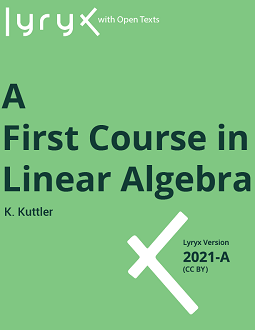 Authors: Ken Kuttler
Brief Description: A comprehensive free on-line textbook covering beyond a first course in linear algebra. Lots of sample problems and worked examples populate the text, as well as particular applications. Suggested exercises, many with solutions, are numerous and foundational and provide the instructor with plenty of material for assignments and discussion
Student access: How and where do students access materials? - Textbook was available on Course Management site (Brightspace) as well as viewable/downloadble PDF directly from the publisher (link above)
Cost Savings: Cost of a traditional Linear Algebra textbooks are $100-200 new, and less than that used
License: Material is Open Text with a Creative Commons License
Supplemental Resources: Many of the exercises have full or partial solutions in the back of the book. However, so many of the problems are standard and quintessential proofs in linear algebra that solutions to the problems can be widely found on-line. The instructor provided solutions after due dates and students were encouraged to work in small groups on problem sets.
OER/Low Cost Adoption Process
Provide an explanation or what motivated you to use this textbook or OER/Low Cost option. Save students money, have the course designated as a Zero-Cost course in the catalog
How did you find and select the open textbook for this course? I consulted with peers who teach Mathematics at my institution and who share a similar desire to use on-line and zero cost teaching materials. They provided a wide range of options that they liked and had used. I also searched on-line for open source texts, which is how I discovered the textbook selected. There were, however, many other options that would have been similar.
Sharing Best Practices: Please give suggestions for faculty who are just getting started with OER or Low Cost materials. List anything you wish that you had known earlier. Many options exist for courses that are rather standardized, but as subject matter gets more specialized, it becomes difficult. Traditional lower-division courses that have transferability between campuses are easy, but upper-division or interdisciplinary courses are much harder to transition, generally. I’d say don’t be afraid to pick and clip from a variety of open-access sources. As long as things are laid out in a rather direct fashion, students are willing to utilize many sources with good design to alert them of where to go.
Describe any challenges you experienced, and lessons learned. Most of the students would use the url link to view the textbook, or the course management software, when it was always available for download onto their local machines/devices. I recommended that they do the latter so that they’d have access to the material offline. It appears to be a generational thing to not download local copies (it’s less common), but the risk is that without internet, materials will not be available. This did happen at least once for an evening when WIFI on our campus went down before a deadline, but I extended it to be completable after the internet infrastructure was re-established. It did (and continues to) illustrate how students are less interested in having a local copy of digital materials and are very reliant on links being accessible and live.
Frank Yip, Assoc Professor.
Department of Sciences and Mathematics
California State University, Maritime Academy
https://www.csum.edu/sciences-and-mathematics/faculty/frank-yip.html
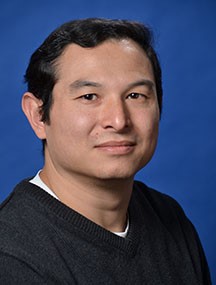
Please describe the courses you teach and your teaching philosophy The challenges associated with teaching mathematics or physical sciences are best met with making the particular concept or idea relevant and practical to the student throughout the instruction. Frequently students struggle to relate abstract theoretical ideas or conceptually challenging material because they initially find the principle or equations inapplicable to their daily lives. My philosophy of instruction dealing with mathematical concepts is to directly relate the ideas to something applied and practical. Often this can be accomplished by searching for a related application or parallel idea more frequently encountered of which the students might possess more understanding. In particular, this requires me as instructor to better know the student's background in order to relate the objective to something they might be more inclined to process and comprehend. My role as a teacher has commonly found me relying on the student's own experiences and I have benefited from getting to know the various backgrounds of my audience in order to best consider how to adapt concepts to something within their working knowledge.
Courses taught:
CHE105/CHE105L – Introductory Chemistry
CHE110/CHE110L – General Chemistry
CHE205 – Chemistry of Plant Processes
ENG210 – Engineering Computer Programming
MTH250 – Introduction to Linear Algebra
PHY120 – Physics for Future Leaders