
Using Free Online Materials in MGMT 3500: Applied Communication
Using Free Online Materials in MGMT 3500: Applied Communication
Purpose: to help other instructors teaching the same course
Common Course ID: MGMT 3500: Applied Communication
CSU Instructor Open Textbook Adoption Portrait
Abstract: This open textbook is being utilized in a Management course for undergraduate or graduate students by Dr. Bailey Benedict at California State University – San Bernardino. The open textbook provides an overview of both written and oral communication in business settings and is supplement with podcasts from various news media entities and other universities and videos from the professor. The main motivation to adopt an open textbook was to save students money, given the skyrocketing cost of rent in the Inland Empire. Most student access the open textbook in their web browser or through a downloadable PDF.
Applied Communication (MGMT 3500)
Brief Description of course highlights: Applied Communication (MGMT 3500) focuses on written and oral communication skills and theories most relevant to local and global organizations. It emphasizes effective and ethical interactions in an organizational context. Students will learn how to communicate to address specific audiences using appropriate mechanics and how to professionally and effectively present their ideas. MGMT 3500 is a Writing Intensive course and satisfies the General Education Writing Intensive designation.
Student population: Most students are Business Administration majors with concentrations in accounting and finance, information decision sciences, management, marketing, public administration, or entrepreneurship. There are no prerequisites for this course.
Learning or student outcomes: By the end of the semester, students will be able to:
- Apply foundational theories of communication to business issues
- Think critically about communication issues in various business contexts
- Gain a professional business communication mindset for a diverse global market
- Show an understanding of ethics in the business communication context
- Demonstrate movement toward mastering effective verbal communication skills in a business context
- Develop written communication skills to articulate content knowledge
- Make decisions about when to use informative or persuasive methods and how to match the appropriate communication channel to different business situations
- Practice techniques for communicating in small groups that will contribute to professional success
Key challenges faced and how resolved: Most of the challenges I experienced with MGMT 3500 were related to the sheer fact that I was teaching a new course at a new university to a new population of students in a new college (i.e., from Liberal Arts to Business). These challenges included being unfamiliar with the proficiencies of the students at the new university, gauging workload, and managing the workload of creating assignments, planning lessons, and grading.
To resolve these challenges, I surveyed students at three points in the semester as a way of checking in with them on how various topics related to class. In the Start-of-the-Semester Survey, I asked their about what their names and pronouns are, what their goals and concerns for the course are, what I could do to best support them, and if there was anything else I should know about their participation in this course. This helped me get to know them better, address their concerns, and tailor the course to their goals. Several students disclosed issues in their personal or professional life that may impact their performance. I also performed informal, anonymous mid-semester and end-of-semester course evaluations where students could provide feedback. Their responses were aggregated across the three sections. I inquired about the breakdown of the time we spent on Zoom and the usefulness, enjoyability, and easiness of each of the assignments. I also asked how many hours they spend on class work outside of class and what they like and do not like about MGMT 3500. Difficult quizzes and a very high workload were two primary concerns. As a result, I revised the schedule for the second half of the semester. One quiz and one presentation were dropped, and the points were reallocated toward an existing project. Consistent with a tenant of my teaching philosophy (i.e., valuing transparency), I shared all the results of the anonymous surveys with students during our in-class sessions.
Dr. Bailey C. Benedict
Assistant Professor of Management
Jack H. Brown College of Business and Public Admin
California State University, San Bernardino

I am passionate about teaching and believe my role as an educator is to promote students’ resilience. My teaching philosophy is rooted in fostering learning by creating spaces for growth, while recognizing the real threat of mental health crises on college campuses. Consequently, my pedagogy revolves around valuing transparency, cultivating comfort, and reducing uncertainty. I work to expose students to new ways of answering their questions about the world and to build practical skills with students that will benefit them in professional, academic, and personal situations, while protecting their well-being and appreciating their intersectional identities. I currently teach Applied Communication in Management but previously taught several courses in Communication at other universities: Foundations of Presentational Speaking, Business and Professional Communication, Organizational Communication, and Small Group Communication.
OER/Low Cost Adoption Process
Provide an explanation or what motivated you to use this textbook or OER/Low Cost option. FI used free materials in my course to save students money. Because I am a new Assistant Professor and was prepping a new course, the timing was perfect for me to choose Open Educational Resources.
How did you find and select the open textbook for this course? I browsed Open Educational Resources sites until I found a book that was easy to access and covered the material necessary for my course.
Sharing Best Practices: I highly suggest looking carefully for the date when an Open Educational Resource was initially published. This textbook had a publication date of 2015, but that year is when the textbook was adapted for OPEN publication… it was originally written in 2010, but I only found that out today when I was completing this reflection. Fortunately, I use the book to cover the fundamentals of management communication related to the content and presentation of written and oral communication which have not changed dramatically in the past decade… what has changed, I supplemented with podcasts!
Describe any challenges you experienced, and lessons learned: I experienced two key challenges related to this textbook. First, the content is a little bit disorganized. For example, media interviews are discussed in Chapter 17 and in Chapter 15.5, and visual aids are discussed in Chapter 2.5 and Chapter 11.4. I had to sift through the chapters very carefully to decide which individual sections of chapters I wanted students to read and when. For example, I tried to ensure I assigned redundancies at the same time or chose the better section for students to read. Second, our course site became a little bit overwhelming for students to navigate, because there was so much content. Since I chose several random chapter sections for students to read before class periods, I linked each chapter section in our course site to make the readings easy to find. However, the number of readings caused the other materials (e.g., assignment descriptions and submission folders) to become overshadowed.
Cost Savings: A textbook used by other MGMT 3500 instructors costs $30 to rent on Amazon and $139.50 from the University Bookstore. With 149 students taught in MGMT 3500 in Fall 2021 and Spring 2022, the cost savings range from $4,470 to $20,785.
Textbook or OER/Low cost Title: Textbook Citation. Please check out this brief video summarizing my experience with OER materials from MGMT 3500: https://www.youtube.com/watch?v=ohznJHIi-XY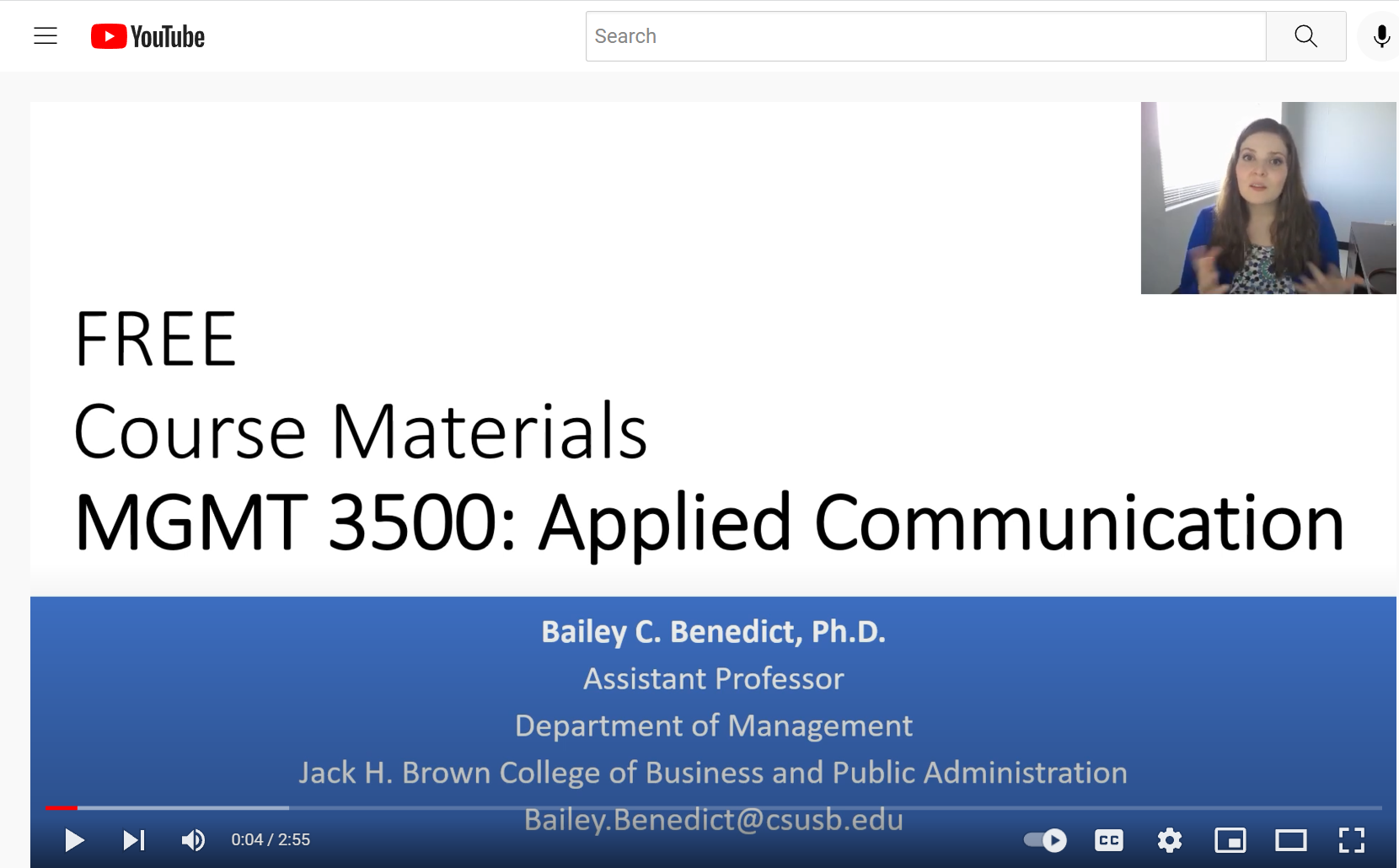 Brief Description: Business Communication for Success offers students an introduction to communicating in businesses and other professional settings. The general topics covered include organizing/outlining messages; writing, revising, and giving feedback on business document; and giving presentations to inform and persuade. Specific topics in individual chapters include audience analysis, nonverbal communication, interpersonal, crisis, intercultural, and group communication. This textbook emphasizes foundational information about communicating effectively, efficiently, and ethically.
Authors: The author’s name was removed by the original publisher.
Student access: Students access this textbook via a weblink that opens the textbook in their browser. In this version, students download the textbook in several file formats: EPUB3, EPUB, digital PDF, print PDF, MOBI, Pressbooks XML, and OpenDocument. Students also have access to the digital and print PDFs via the course site in the learning management system Canvas.
Supplemental resources: The textbook is mainly supplemented with videos created by their professor and podcasts. The videos instruct students on content that is not addressed in the textbook or content that could benefit from further elaboration. The videos are posted on the professors’ YouTube site: https://www.youtube.com/channel/UC0mj2dNZxca1S3-qBHGV1iw. Along with the 9 videos on the professors’ YouTube site, another video comes from her other YouTube account: https://www.youtube.com/watch?v=pLNiLlWY_q8&t=1s
Along with the videos created by their professor, students listen to podcasts and reflect on the podcasts’ topics, what they learned in the podcasts, and how they can apply what they learned in the podcasts to their business lives.
Required Podcasts
Podcast: How to Talk to Strangers. (2020, May). Slate. (32 minutes)
Links: Source & Transcript | Spotify | Apple
Podcast: High-Stakes Communication: How to Manage Anxiety Speaking in Front of Others. (2020, May 7). Think Fast, Talk Smart: Communication Strategies. (17 minutes) Links: Source & Transcript | Spotify | Apple
Podcast: Networking for People Who Hate Networking. (2019, March).
TED: Work Life with Adam Grant. (37 minutes)
Links: Source & Transcript | Spotify | Apple
Podcast: How to Get Anyone to Do Anything (Ep. 463). (2021, May 26). Freakonomics Radio. (59 minutes; 40 minutes if you skip the introduction)
Links: Source & Transcript | Spotify | Apple
Podcast: How to Ask for a Raise. (2021, February 16). NPR: Life Kit. (22 min)
Links: Source & Transcript | Spotify | Apple
Material: Why Meetings Go Wrong (And How to Fix Them). (2019, Nov. 05). HBR: IdeaCast. (29 minutes) Links: Source & Transcript | Spotify | Apple
Podcasts for Attendance “Make-Up” Assignments
Material: How to Come Out at Work, About Anything. (2021, Sept 6). TED Business. (13 min) Links: Spotify | Apple | Google
Material: How Can You Stop the Spread of Misinformation. (2020, Sept). Recode by Vox. (9 minutes) Links: Spotify | Apple
Podcast: *Starting Your Career After College. (2021, February 23). NPR: Life Kit. (27 min) *Note: This is good if you do not know you want to do after graduation.
Links: Source & Transcript | Spotify | Apple
Podcast: How to Rethink What you Spend Your Time – and Life – Doing. (2021, Oct 14). NPR: Life Kit. (20 min) Links: Source & Transcript | Spotify | Apple
Podcast: Tips for Making a Career Move. (2021, Feb. 25). NPR: Life Kit. (27 min) Links: Source & Transcript | Spotify | Apple
Podcast: What to Quit Your Job? Here’s How to Do It Well. (2020, January 9). NPR: Life Kit. (20 minutes) Links: Source & Transcript | Spotify | Apple
License: The textbook is adapted from another work distributed under a Creative Commons license (CC BY-NC-SA) in 2010.