
Principles of Environmental Health -HSCI 3052
Principles of Environmental Health -HSCI 3052
Purpose: to help other instructors teaching the same course
Common Course ID: Principles of Environmental Health (HSCI 3052)
CSU Instructor Open Textbook Adoption Portrait
Abstract: This open textbook is being utilized in the Principles of Environmental Health course for undergraduate students by Dr. Mahmood Nikbakhtzadeh at the California State University, San Bernardino. The open textbook provides materials to study in form of PDF, video clips and links to extra reading materials for further study.
Principles of Environmental Health (3 units), HSCI 3052
Brief Description of course highlights:
- Major course - Prerequisites: College-level biology
Principles of Environmental Health is in fact an introduction to the effects of the physical, chemical, and biological environments on human health and well-being. Assessment, evaluation and control of environmental risks related to public health will be discussed as well. Discussion topics include air, water and noise pollution, types of solid waste and their disposal plus food safety, radiation, pesticides, hazardous wastes and environmental impacts.
Topics discussed in this course include:
1. Environmental Health & Environmental Agencies
2. Principles of Ecology
3. Population Dynamics
4. Population and Food Predicament
5. Population Growth
6. Environmental Toxicology
7. Environmental Disease
8. Toxic Substances
9. Pests and Pesticides
10. Food Safety
11. Radiation
12. Air Pollution
13. Noise Pollution
14. Water Resources and Water Pollution
15. Safe Drinking Water
16. Solid and Hazardous Wastes
17. Occupational Health
18. Environmental Epidemiology
Student population: Most of my students are Health Science majors (Environmental Health, Public Health, Public Health Administration, Nutrition, etc.), however I have students of Environmental Science and Biology major as well. Graduate students of environmental science also sometimes take this course. Biology is a prerequisite for taking this course.
Since many of my students are in the last year of their undergraduate education, they have already passed a wide range of courses in Public Health Sciences. Except for students majoring in Environmental Health, this course offers a lot of new topics to other students. Because of no prior background, I had to first discuss terminology and tailor my course so that it covers some fundamental definitions. This way I could be ensured that all students can follow the discussions with no difficulty.
Learning or student outcomes:
* Understanding Population growth and dynamics
* Solve problems in Population growth and dynamics
* Understanding Environmental Toxicology
* Define toxicity and how it is measured
* Identify health conditions linked to selected toxic exposures from food, lifestyle, environment, workplace and home.
* Analyze dose and toxicity of various substances
* Calculate the LD50 and LC50 of pesticides
* Applying EHS knowledge in solving a scenario
Key challenges faced and how resolved: Overall, I could manage a smooth transition; however, it was very time consuming and very labor-intensive. Sometimes I had to search a long time to find a relevant, accurate and fit content. Then I had to stich many contents together in order to meet my expectations. It is not an easy job, but it worth it. It is an exciting work.
The new resources often did not have good relevant pictures and I had to look for pictures, graphics, tables and videos among lots of other resources to enrich my content of the day.|
Not all topics of syllabus could be fully covered by one open source. Therefore, I had to spend plenty of time to find suitable resources for each class topic I used multiple resources to eventually cover all topics of the syllabus.
Additionally, I needed some good video clips, not longer than 5-6 minutes, to be a complement to my teaching. Finding good and match videos was a time-consuming process. In several cases, I had to prepare the required videos myself. Another issue was the lack of a test bank or sample questions. Those could save my time.
Syllabus and/or Sample assignment from the course or the adoption [optional]: To illustrates how the open textbook is used in the course.
Textbook or OER/Low cost Title: I did not use a single resource. No single resource was so comprehensive to cover all desired topics. Therefore, I browsed OER resources until I found those which were fit to my HSCI 3052 class. Once I found an OER resource, I evaluated the content to see how this might contribute to my course. Another resource which considerably helped me for preparation of my course materials was websites of government agencies, such as EPA, Cal EPA, CDPH and Department of Pesticide Regulation which contain very detailed and precise information about the topics under discussion.
Brief Description: Even though I found good OER resources, not all topics of syllabus could be fully covered by one open source. Therefore, I had to spend plenty of time to find suitable resources for each class topic. I used multiple resources to eventually cover all topics of the syllabus. Additionally, I needed some good video clips, not longer than 5-6 minutes, to be a complement to my teaching. Finding good and match videos was a time-consuming process. In a few cases, I prepared the videos myself.
Another issue was the lack of a test bank or sample questions. Those could save my time, but I did not find any open one which fits to my needs. In their absence, I had to design sample questions for in-class exercises and problem solving myself. I did the same for in-class quizzes and exams too.
Authors: There is no single author. My course materials were prepared from around 60 different open resources, including extension flyers, government websites and publication and open university resources.
Student access: All students access the class content in form of PDF files on Canvas.
Supplemental resources: I designed sample questions for in-class exercise and also the quiz and exam questions myself. I provided video clips to my students on each single topic. Besides, I provided links to the websites of Federal agencies, such as EPA, FDA, USDA and CDC and California state, like CDPH to make my students more familiar with the updated info, in-depth knowledge and current status of every case in California, US and the world.
Cost Savings: If I had used the previous textbook (Our Global Environment: A Health Perspective), my students had to overall pay the following for either a hardcopy or E-book:
Hardcover copy saving: $ 3000.00
E-book copy saving: $ 1755.00
I replaced that textbook with OER resources, prepared all the required materials, including educational video clips, and therefore, made it zero cost to my students. New cost: $0.00
License: All materials I used were openly licensed.
OER/Low Cost Adoption Process
Provide an explanation or what motivated you to use this textbook or OER/Low Cost option. My main motivation to adopt an open textbook was first the cost of original textbook which was really considerable ($66.00 for paperback and $39.00 for the E-book individually). I knew most of my students were not in the position to spend money for a textbook. Most of my students work with the minimum wage at the same time as studying and paying this much is not easy for them. Right now, we are in the COVID pandemic time and I assumed some might have even lost their jobs. On the other hand, however the textbook was a good one, it was not compatible to the background knowledge of my students. On the other hand, some chapters of the textbook were not that much fit to my syllabus and also the needs of my students. I also wanted to emphasize on a couple of issues, like toxicity to metals, environmental toxicity and environmental epidemiology which were not covered in the original textbook.
By using OERs, I had the opportunity to gather whatever was exactly needed for teaching and place them in the right sequence to meet the course objectives. My students welcomed having no textbook as they could save. Many of them referred that they pay a lot for textbooks of other classes, but they do not study most chapters of the book. They found our class more appealing and straightforward than traditional classes with a textbook.
How did you find and select the open textbook for this course? I have prepared my whole course using open resources (OERs). All are easily available to students. I have prepared a learning pack which includes PP presentations, PDF files, video clips and a freely-accessible articles. Wherever possible, I brought tangible examples from our own county, state or country so students can easily connect with the subject. All those came after extensive searches and reading lots of materials freely available on the web. I put various pieces from many different sources together in a way that there is no gap or style difference in my content. After several revisions, my content is uniform throughout the course.
Sharing Best Practices: First refer to your own library collections. That includes the easiest and the most valuable resources. In my discipline, technical publications, including technical brochures, technical flyers and pamphlets are open to everyone and in fact have designed and produced to reach the maximum number of readers. Many of them have a knowledge level fit to an undergraduate class and are composed of first hand, updated materials, prepared by known experts.
There are even open-source books and booklets which are very valuable resources. These are free publications, prepared by professional organizations or state and federal agencies. In preparation of my teaching materials, I used the ones mostly prepared by EPA, FDA, CDC and California Department of Public health, California Department of Toxic Substances Control and California Environmental Protection Agency.
Share any curricular or pedagogical changes that you made: I changed the syllabus to achieve this adoption. As indicated above, I removed the need for a specific textbook and replaced that with materials gathered from many OERs. The sequence of course topics were rearranged. I also added some new topics to the class content to better match with the current needs.
Learning activities include class discussions, writing assignments, video analysis and integrating examples were incorporated into the course from my own research and prior experience. I lowered the weight of conventional exams (midterm and final) and increased the weight of other learning tools such as writing an analytical report, class discussion and class quizzes.
Mahmood Nikbakhtzadeh, Ph. D.
https://www.csusb.edu/profile/mahmood.nikbakhtzadeh
Assistant Professor of Environmental Healthy Science
Department of Health Science and Human Ecology
College of Natural Sciences, CSU, San Bernardino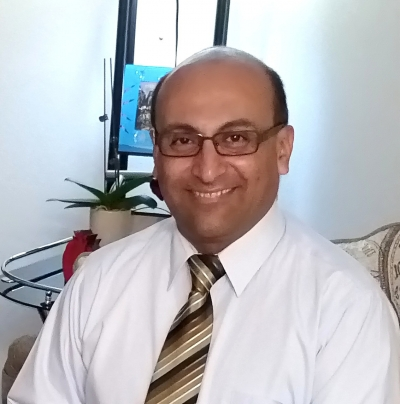
Courses I have taught, so far
- Epidemiology of vector-borne diseases (Graduate course, 2 credit hours)
- Insect Ecology (Graduate course, 3 credit hours)
- Insect Morphology & Physiology (Graduate course, 3 credit hours including lab)
- Introductory Entomology (Undergraduate course, 3 credit hours including lab)
- Medical Entomology (Graduate course, 4 credit hours including lab)
- Principles of Ecology (Undergraduate course, 3 credit hours)
- Principles of Environmental Health (Undergraduate, 3 credit hours)
- Principles of Toxicology (Undergraduate, 3 credit hours)
- Toxicology of Pesticides (Graduate course, 2 credit hours)
- Vector-borne Disease Control (Undergraduate course, 4 credit hours)
Describe your teaching philosophy and any research interests related to your discipline or teaching. My teaching philosophy is influenced by my experience as a student and later on as a researcher and instructor in various academic and government careers. In my opinion, great teachers are passionate about their subject and strive hard to transfer the same passion into their students. They have to establish a positive class environment and encourage an interactive class participation.
I believe an instructor is not only a source of information, but also a guide to his students. I like to provide my students with more than just lectures and books. For example, I believe my students should learn how and where in the real life they can apply the knowledge they have gained in the class. When they learn about the possible application of each episode, they will be more motivated to concentrate and so can grasp the details better. That is why I believe instructors with a career background in government, private, or industry sectors are more successful in transferring the concepts of the course to their students.
Good Practice in teaching stem from a philosophical understanding of how people learn and a practical understanding of how best to help people learn. Constructivism is a widely accepted educational philosophy and encourages teaching methods that support active learning aligning to the key components of problem-based learning. Problem-based learning is a rich approach to teaching that requires a lot of support and preparation to implement, and results in an exceptional learning environment for students.
As a faculty member, my ultimate goal is awakening students' curiosity by making them aware of the developments in the frontiers of that field. In this way, I aimed to provide my students with the analytical skills useful in the field, including the ability to think and express one’s self logically and the capability to learn outside the traditional classroom setting. I attempted to do so by modeling these behaviors in my own teaching and by providing appropriate opportunities for students to practice and develop those skills.
Students often have independent learning styles, which varied among all learners in the class; therefore, an instructor should consider those differences and try to diversify his teaching methods in order to share the lesson content with the maximum number of students and hence facilitate the learning process.