
Advanced Topics in Environmental Studies: National Parks and Public Lands
Advanced Topics in Environmental Studies: National Parks and Public Lands
Purpose: to help other instructors teaching the same course
Common Course ID: National Parks - GEOG 5301
CSU Instructor Open Textbook Adoption Portrait
Abstract: This textbook is being utilized in a Geography and Environmental Studies course for undergraduate students taught by Yolonda Youngs, Ph.D. at California State University San Bernardino. The textbook is predominantly written for an audience that is interested in national parks and public lands but has little knowledge of the policies, management approaches, and environmental issues related to this topic. The main motivation to adopt an open textbook was to save students money. Most students access the textbook directly online through our campus library’s website, which connects to an e-Text copy of the book with unlimited views and downloads for students.
GEOG 5301 - Advanced Topics in Environmental Studies: National Parks and Public Lands
Brief Description of course highlights: Advanced Topics in Environmental Studies: Provides an in-depth analysis of a current topic being examined by environmental studies. This course is intended to allow students to apply knowledge gained in other geography and environmental studies courses to explore a current topic in a critical manner. The course is open to both undergraduates and graduate students. Semester Prerequisite: Senior or Graduate standing or with instructor consent.
National Parks and Public Lands (this course): This class will provide a survey of the environmental, cultural, and political geography of national parks and public lands of the United States. We will explore how the U.S. national park model developed and how it informed and shaped public lands policy and management in the United States and, more broadly, the world. Class topics will include the history and organization of national and state public lands agencies, environmental policy & management, emerging topics in parks and public lands research, environmental and social justice, cultural heritage and historic preservation, economic impact of public lands on gateway communities, and tourism and outdoor recreation. Case studies and contemporary events will draw on examples from the United States as well as international locations (UNESCO World Heritage Sites).
This course is open to all students at CSUSB with a Senior standing. Students take it for their interest in national parks and public lands, environmental studies, and environmental management. Students also take it because it meets programmatic electives.
Student population: Senior standing
Learning or student outcomes: Each student who successfully passes the class is able to:
1. To critically analyze clashing ideas and values about the process of creating, experiencing, managing national parks and public lands in a variety of environmental, cultural, historical, and economic contexts.
2. Relate environmental issues in national parks and public lands to cultural, historical, social, and geopolitical forces that shape public lands policies, visitor use, land management, and land ownership.
3. Apply ecological principles/concepts to the conservation, preservation, and management of national parks and public lands.
4. Contrast environmental issues and policy choices associated with national parks and public lands management from local to global scales.
Key challenges faced and how resolved: There are no particular challenges for the textbook itself. The nature of the class requires constant updates of the material. Every semester, there are at least 3-5 journal articles or multimedia files that get added or deleted.
Syllabus: This is the Syllabus used for Spring 2022. Syllabus_GEOG 5301 National Parks Public Lands___.pdf
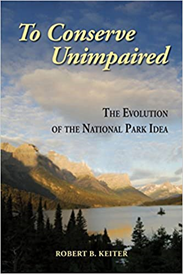 Textbook Title: To Conserve Unimpaired: The Evolution of the National Park Idea by (2013, Island Press) by Robert Keiter
Brief Description: When the national park system was first established in 1916, the goal "to conserve unimpaired" seemed straightforward. But Robert Keiter argues that parks have always served a variety of competing purposes, from wildlife protection and scientific discovery to tourism and commercial development. In this trenchant analysis, he explains how parks must be managed more effectively to meet increasing demands in the face of climate, environmental, and demographic changes. Taking a topical approach, Keiter traces the history of the national park idea from its inception to its uncertain future. Thematic chapters explore our changing conceptions of the parks as wilderness sanctua ries, playgrounds, educational facilities, and more. He also examines key controversies that have shaped the parks and our perception of them. Ultimately, Keiter demonstrates that parks cannot be treated as special islands, but must be managed as the critical cores of larger ecosystems. Today's mandate must remain to conserve unimpaired—but Keiter shows how the national park idea can and must go much farther.
Student access: The link is provided to students from the Canvas website. However, students download it (for free) or read it directly online through our campus Library’s website, which connects to the eText version of the book after students log onto MyCoyote, our campus’ official online entry/access point. I have requested that the CSUSB library also purchase a print copy of the book so that students who prefer this format may access it through the campus library and/or course reserves.
Cost Savings: I previously used the print version of this book which retails on Amazon for $74 hardback/$39paperback new. Since the class is offered to about 25 students annually, this is a potential saving for students of $1,850 ($74 hardback x 25 students) or $975 ($39 paperback x 25 students).
License: This book’s copyright is held by Island Press. Since students access the book through the CSUSB Library, they can read it for free.
OER/Low Cost Adoption Process
Provide an explanation or what motivated you to use this textbook or OER/Low Cost option. The main reason I am using this e-Textbook is to save students money. The textbook is relatively cheaper than comparable textbooks dealing with the same topic. It is very clearly written and is authored by one of the most respected authorities on this topic. Dr. Cary Barber contacted me and encouraged me to adopt it through the Affordable Learning Solution initiative.
How did you find and select the open textbook for this course?
I found the textbook for this course by evaluating other sources, in this case other books about national parks and protected areas in the United States. Once I selected the print copy of the book, I visited the publisher's website to explore eText options. At the publisher's website (Island Press), I found the ISBN# for the eBook Format as well as links to the Amazon Kindle, Apple Books, and other popular electronic book vendors. I shared the publisher's website and the eBook ISBN with the CSUSB Library contact for the ALS program. She assisted in ordering the book as an electronic copy for the students to access through the library.
Sharing Best Practices: My suggestion is to explore eText options for your textbooks early and often. In other words, when you select a textbook for your course, take a few moments to visit the publisher's website and see if there is an eText option available. Then search the CSU library system to see if we have a copy available. Keep in mind that publishers may release a book in hardback or paperback edition for the first year or two after publication, then release the eText later (so check their websites often or at least once an academic year for updates). I have also found that while many students appreciate and use the eText option and its easy access through the library, some students still prefer a paper book. If possible, it may be useful to offer both an eText and a paperback version of the book on course reserves at the library for students to check out.
Yolonda Youngs, Ph.D.
Geography and Environmental Studies Professor, California State University, San Bernardino. 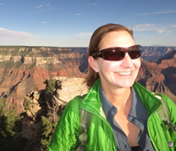
I am a Geography and Environmental Studies professor at the California State University San Bernardino. I teach multiple courses at the lower and upper division undergraduate level. The specific courses I teach include the following:
- GEOG 1070 Environmental Studies Orientation Seminar
- GEOG 3004 Field Methods in Geography
- GEOG 3500 Conservation and Natural Resources
- GEOG 3501 Environmental Sustainability
- GEOG 5351/5352 Professional Conferences
- GEOG 5301: Advanced Topics in Environmental Studies - National Parks & Public Lands
Teaching Statement: I am a broadly trained geographer with a passion for communicating geographic and environmental principles to students. I promote an active learning environment and community-based class projects for students through in-class discussions and out-of-class activities, individual and group projects, and field modules.
My courses integrate contemporary examples from local and national events, new and emerging technologies, and a variety of teaching strategies aimed at creating connections for students between their personal knowledge, their life experiences, and their intellectual curiosities.
My Research Interests:
- environmental studies
- national parks and protected areas
- public lands
- environmental justice
- cultural geography
- social science GIS
- conservation of natural resources
- environmental policy and land management
- regional expertise: western United States & Europe